


Classes Still Create Hoosier Hysteria
July 27, 2017
By Rob Kaminski
MHSAA benchmarks editor
This is the fourth part in a series on MHSAA tournament classification, past and present, that will be published over the next two weeks. This series originally ran in this spring's edition of MHSAA benchmarks.
Twenty years ago, Bloomington North High School won the Indiana High School Athletic Association boys basketball championship, defeating Delta 75-54 at the RCA Dome in Indianapolis.
The date, March 22, 1997, is at the same time revered and disdained by traditionalists in the state who saw it as the last schoolboy championship game the state would ever host.
That’s how devout the game of basketball, particularly interscholastic basketball, had become in the Hoosier state during the 87 years a state champion – one state champion, to be precise – was crowned.
Following that 1997 season, the IHSAA moved to a four-class system for its roundball tournaments, like so many of its state association counterparts had done years earlier.
It would be shocking to find more than a small percentage of current high school basketball players around the country unfamiliar with the iconic movie Hoosiers, even though the film is now more than 30 years old.
And, the storyline for that blockbuster unfolded more than 30 years prior to its release, when small-town, undermanned Milan High School defeated Muncie Central High School 32-30 in the 1954 IHSAA title game.
Perhaps it’s because of the David vs Goliath notion, or the fame of the movie that replaced Milan with the fictional Hickory and real-life star Bobby Plump with Hollywood hero Jimmy Chitwood, or the simple fact that Indiana had something other states didn’t.
Whatever the reason, plenty of opposition remains to this day to basketball classification in the state.
The fact is, the small rural schools were regularly being beaten handily by the much larger suburban and city schools as the tournament progressed each season.
Small schools also were closing at a rapid rate following the state’s School Reorganization Act in 1959, as students converged on larger, centralized county schools. From 1960 to 2000, the number of schools entering the tournament dropped from 694 to 381, and in 1997 a total of 382 schools and 4,584 athletes began competition at the Sectional level (the first level of the IHSAA Basketball Tournament).
It was at the entry level of the tournament where school administrators felt the pain of the new class system, but not necessarily for the same nostalgic reasons as the fans who either attended or boycotted the tournament.
At the Sectional round of the tournament, the IHSAA was culling just 2 percent of the revenue, with the participating schools splitting the balance. So, when Sectional attendance dropped by 14 percent in that first year of class basketball, many schools realized a financial loss. It was money they had grown to count on in prior years to help fund various aspects of the department.
Schools cumulatively received more than $900,000 from Sectional competition in 1998, but that total was down from more than $1 million in the last year of the single-class tournament.
Yet, the current format provides a great deal more opportunity and realistic chances at championship runs for schools of all enrollments.
To date, 60 additional teams have championship or runner-up trophies on display in school trophy cases around Indiana.
That was the mission in front of then-IHSAA commissioner Bob Gardner (now National Federation executive director) once the board made its decision: to give thousands more student-athletes the opportunity for once-in-a-lifetime experiences.
As any statistician knows, figures can be manipulated to tell any side of a story. Declining attendance in year one of class basketball is such a number.
The truth is tournament attendance had been on a steady downward spiral since its peak of just over 1.5 million in 1962. By the last single-class event in 1997, the total attendance was half that.
The challenge then and today, as it is for all state associations, is to find that delicate balance for those holding onto tradition, those holding onto trophies, and the number of trophies to hand out.
Editor’s Note: Stories from the Fort Wayne Journal Gazette in 1998 and from a 2007 issue of Indianapolis Monthly provided facts in this article.
St. Phil's Winning Ways Lead to Summer Celebration, Fall Anticipation
By
Pam Shebest
Special for MHSAA.com
August 24, 2021
BATTLE CREEK — Last season’s Division 4 championship gave Battle Creek St. Philip 11 over coach Vicky Groat’s 22 seasons leading the program.
 But those stats are a bit off. They do not include the three Class D titles she won as a player at St. Phil, giving her 14 overall.
“We won three state titles with Mom in ’83, ’84, ’85 and were in the final four in ’82,” Groat said.
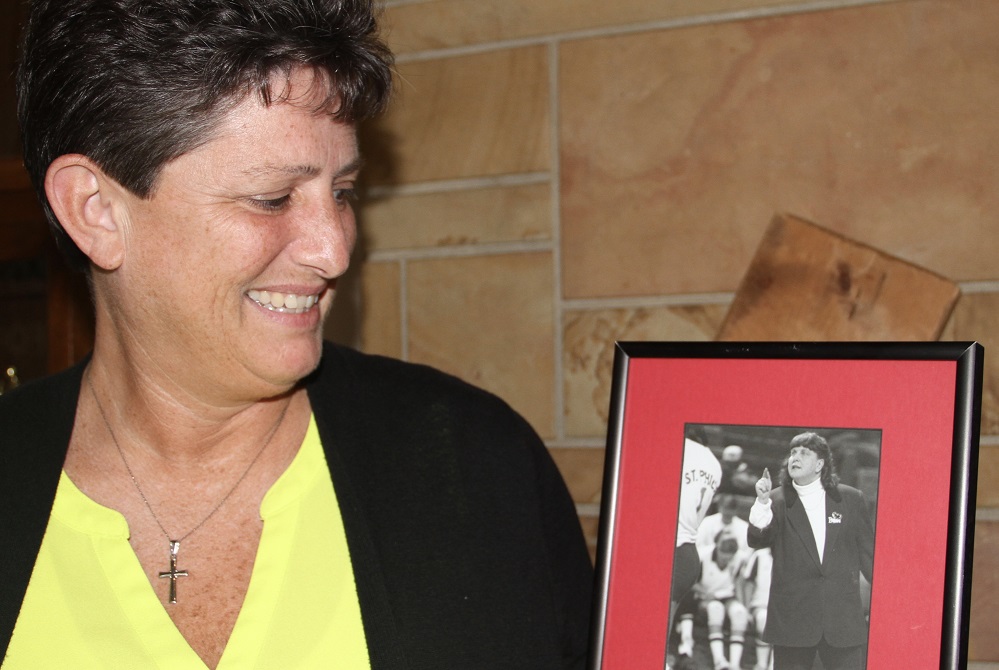
“Mom” is Sheila Guerra, who led the Tigers to nine Finals championships while guiding the program from 1982-1997. Together, the mother-daughter duo has accounted for 20 of the school’s MHSAA-record 21 state volleyball titles. (The first was under coach Becky Emrich in 1979.) Those 21 championships, in fact, are more than twice as many as any other volleyball program in the state, and the Tigers’ 30 MHSAA Finals appearances are 17 more than the next best achiever.
That incredible success was recognized in July when Groat was named the National High School Athletic Coaches Association’s Volleyball Coach of the Year.
Guerra died in May 2006. But Mom was very much on Groat’s mind as she received her award. While accolades, awards and championships continue to pile up, Groat said her mother is the foundation for it all.
“Mom always encouraged me, and there are still things I do today that she did,” Groat said. “It may be old school, but it still works.”
And the Tigers will have another strong chance this fall to show how.
Plenty to celebrate
Groat did not tell her players that she was a finalist for the award but they found out anyway, said senior standout Brooke Dzwik, an all-state first-team outside hitter last season.
“(The players) went on this camping trip up to Leland and stayed in Coach (Laurie) Glass’ backyard,” Dzwik said. “We were also with Notre Dame Prep and Bronson. Four winning coaches.”
 Dzwik said Bronson coach Jean LaClair spilled the beans, telling the players the news.
“(The other coaches) were teasing (Groat) about having a speech prepared and she was like ‘No way,’” Dzwik said.
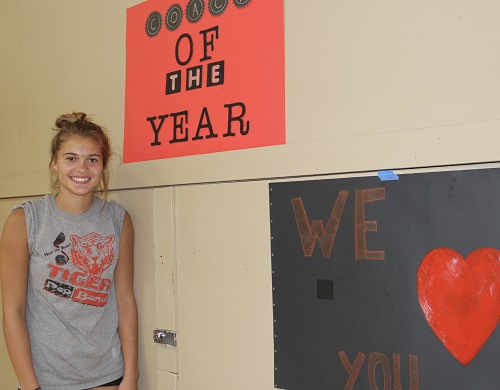
Groat texted her players a picture of herself with the trophy, and during the first day of tryouts in August, the girls welcomed the coach with a few signs, a balloon, a card and Mountain Dew, “her favorite,” Dzwik said.
“We were just overjoyed because no one deserves it more than her.
“She walked in (to the gym) and I think she was pretty happy, but she doesn’t like the attention on her so she will never admit it.”
After her mom retired after the 1996-97 season, Groat took over, stepped away for 1999-2000 but then returned to direct the Tigers again for the last two decades.
No one, including Groat, expected her team to win the Division 4 title after starting last season with a 23-13 record, just nine athletes on the team and no junior varsity to draw from in case of injury.
“I begged (current senior) Alex Kersten to come out — she’s a cross country runner — and she did,” Groat said.
After a two-month delay because of the pandemic a year ago, practice was held outside at Battle Creek’s Bailey Park.
“We started off in the sand, and we were grateful that we were even allowed to get together and see everyone’s faces for the first time,” Dzwik said.
“It was awful at first, but (playing in sand) definitely made our legs stronger by the end of the season, and we were thankful for it.”
This year, expectations are much higher.
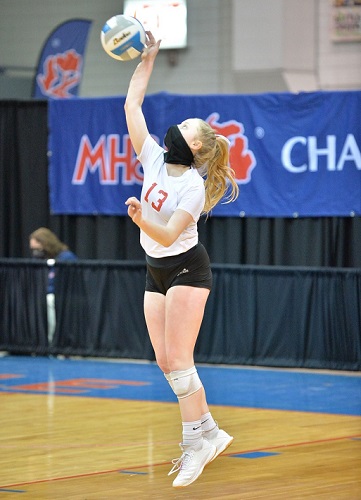
The Tigers lost just one player, Harleen Deol, to graduation and return five seniors also including Rachel Myers, Alexis Snyder and Bailey Fancher. Fancher made the all-state third team last season at libero.
“I feel more pressure now,” Dzwik said. “We didn’t have an amazing record last year and then pulled out a win.
“This year, we do have a (championship) win, so we placed a target on our backs.”
This season already includes a “first” for St. Phil.
“For the first time in St. Phil history, we have an eighth grader, Charli Greger (on varsity),” Groat said. “We were under 100 students last year, so we could have eighth graders play this year.
“Right now, we’re at 100 (students) so next year we won’t be able to have eighth graders.”
Other players are juniors Maddie Hoelscher and Kate Doyle and sophomores Rylee Altman and Makenzee Grimm.
Groat also has a junior varsity team for the first time in two years – a really good thing, she said.
“Take out the five seniors next year and I’m left with four players if I don’t have a JV team,” she said. “We brought eighth graders up to the JV team with four freshmen.
“Never thought we’d have to do that, but we want a program. I couldn’t imagine not having a St. Phil volleyball team. That would be a sad day.”
Family tradition
While a student at St. Phil, Groat was coached by her mother in volleyball and track. In addition, Groat’s father Lou coached basketball at the school.
Her parents as her coaches was not always an easy combination for a young teen.
“It’s always the coach’s kid who gets the brunt of it.” Groat said. “I still remember one of my friends and I were fighting during volleyball and my mom was blaming me. I was like, what about her?
“In track if she had no one to run something, ‘Vicky, you’re going to do it.’ But it was fun.”
 Groat, who is also principal and athletic director at the school, credits her parents for not only her coaching success, but her life skills.
“I learned from the best.” she said. “I try to carry both their philosophies in the way they treated people.
“My mom was tough on kids, but if anybody needed anything, she was the first one there. She pushed hard and had high expectations, but she really was a softie inside. People still don’t believe me on that.”
Groat relies on one other person who is like family: assistant coach Angela Williams Frost.
“We call her Willi,” Groat said. “She’s been a great assistant for 18 years. She was a head coach at Springport and could be a head coach anywhere in the state.
“She’s very talented and smart. It makes my job easier knowing that Willi is there. I’ll be in practice and someone will come to the door for me and Willi is there to take over.”
July’s recognition was a total surprise, Groat said, deflecting any accolades. But it also can be regarded as deserved praise for her work teaching an abundance of lessons she learned herself as part of the volleyball program and the Guerra coaching tree.
“It’s just so much about my kids, the kids who have been here and who have played in our system,” she said. “It’s not a big school; we have our traditions, and they buy into it. It’s been great.
“Hopefully over the years we, as coaches, have taught them the important things in life, the life lessons that they will carry on. Sports are an important part of it, but there are other things involved.”
 Pam Shebest served as a sportswriter at the Kalamazoo Gazette from 1985-2009 after 11 years part-time with the Gazette while teaching French and English at White Pigeon High School. She can be reached at [email protected] with story ideas for Calhoun, Kalamazoo and Van Buren counties.
PHOTOS: (Top) Battle Creek St. Philip coach Vicky Groat holds up a picture of her mother, Sheila Guerra, with whom she’s combined to lead the Tigers to 20 of their 21 MHSAA Finals volleyball championships. (Middle) Senior Brooke Dzwik shows some of the signs she and teammates made to celebrate Groat’s national Coach of the Year recognition. (Below) Then-junior Bailey Fancher serves during last season’s Division 4 title match. (Top and middle photos by Pam Shebest.)