


Classes Still Create Hoosier Hysteria
July 27, 2017
By Rob Kaminski
MHSAA benchmarks editor
This is the fourth part in a series on MHSAA tournament classification, past and present, that will be published over the next two weeks. This series originally ran in this spring's edition of MHSAA benchmarks.
Twenty years ago, Bloomington North High School won the Indiana High School Athletic Association boys basketball championship, defeating Delta 75-54 at the RCA Dome in Indianapolis.
The date, March 22, 1997, is at the same time revered and disdained by traditionalists in the state who saw it as the last schoolboy championship game the state would ever host.
That’s how devout the game of basketball, particularly interscholastic basketball, had become in the Hoosier state during the 87 years a state champion – one state champion, to be precise – was crowned.
Following that 1997 season, the IHSAA moved to a four-class system for its roundball tournaments, like so many of its state association counterparts had done years earlier.
It would be shocking to find more than a small percentage of current high school basketball players around the country unfamiliar with the iconic movie Hoosiers, even though the film is now more than 30 years old.
And, the storyline for that blockbuster unfolded more than 30 years prior to its release, when small-town, undermanned Milan High School defeated Muncie Central High School 32-30 in the 1954 IHSAA title game.
Perhaps it’s because of the David vs Goliath notion, or the fame of the movie that replaced Milan with the fictional Hickory and real-life star Bobby Plump with Hollywood hero Jimmy Chitwood, or the simple fact that Indiana had something other states didn’t.
Whatever the reason, plenty of opposition remains to this day to basketball classification in the state.
The fact is, the small rural schools were regularly being beaten handily by the much larger suburban and city schools as the tournament progressed each season.
Small schools also were closing at a rapid rate following the state’s School Reorganization Act in 1959, as students converged on larger, centralized county schools. From 1960 to 2000, the number of schools entering the tournament dropped from 694 to 381, and in 1997 a total of 382 schools and 4,584 athletes began competition at the Sectional level (the first level of the IHSAA Basketball Tournament).
It was at the entry level of the tournament where school administrators felt the pain of the new class system, but not necessarily for the same nostalgic reasons as the fans who either attended or boycotted the tournament.
At the Sectional round of the tournament, the IHSAA was culling just 2 percent of the revenue, with the participating schools splitting the balance. So, when Sectional attendance dropped by 14 percent in that first year of class basketball, many schools realized a financial loss. It was money they had grown to count on in prior years to help fund various aspects of the department.
Schools cumulatively received more than $900,000 from Sectional competition in 1998, but that total was down from more than $1 million in the last year of the single-class tournament.
Yet, the current format provides a great deal more opportunity and realistic chances at championship runs for schools of all enrollments.
To date, 60 additional teams have championship or runner-up trophies on display in school trophy cases around Indiana.
That was the mission in front of then-IHSAA commissioner Bob Gardner (now National Federation executive director) once the board made its decision: to give thousands more student-athletes the opportunity for once-in-a-lifetime experiences.
As any statistician knows, figures can be manipulated to tell any side of a story. Declining attendance in year one of class basketball is such a number.
The truth is tournament attendance had been on a steady downward spiral since its peak of just over 1.5 million in 1962. By the last single-class event in 1997, the total attendance was half that.
The challenge then and today, as it is for all state associations, is to find that delicate balance for those holding onto tradition, those holding onto trophies, and the number of trophies to hand out.
Editor’s Note: Stories from the Fort Wayne Journal Gazette in 1998 and from a 2007 issue of Indianapolis Monthly provided facts in this article.
Unexpected Becomes Elite As Hartland Makes History
By
Tom Kendra
Special for MHSAA.com
June 19, 2021
EAST LANSING – Hartland wasn’t supposed to be in the Division 1 championship game.
And Julia Pietila wasn’t supposed to play.
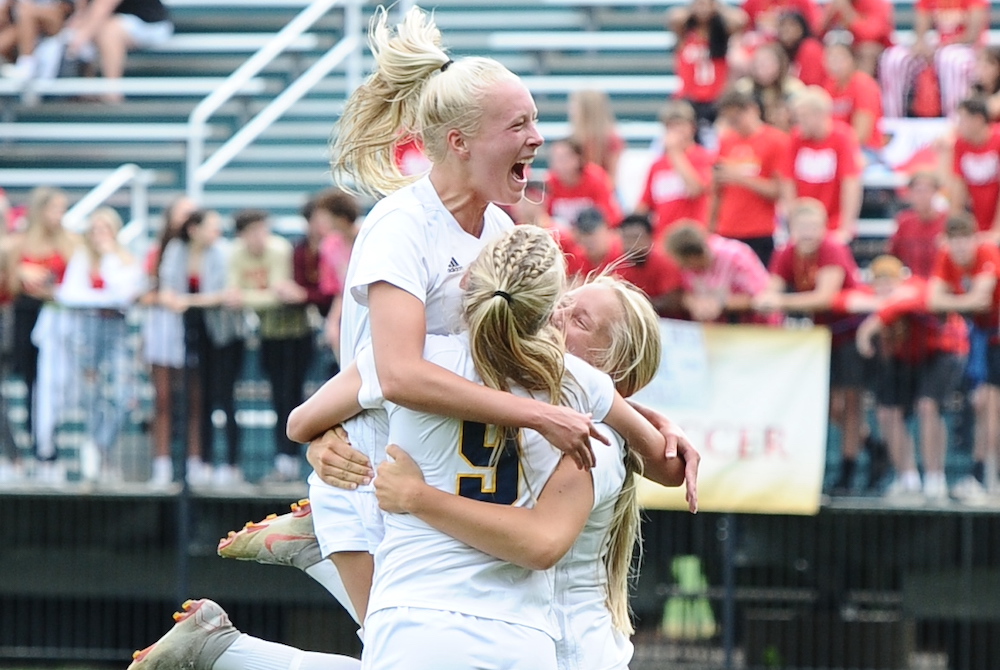
So, naturally, it was Pietila – hobbling on a severely sprained left ankle which almost kept her out of the game altogether – who scored two goals as Hartland blanked Troy Athens, 4-0, in Saturday’s MHSAA Division 1 Girls Soccer Final.
“It was hurting, but it’s the state championship game,” explained Pietila, who scored the Eagles’ first and last goals in the weekend’s final game in calm, dry conditions at Michigan State University’s DeMartin Soccer Complex.
“It was now or never, so I just went with it. Once I got into the swing of things, I forgot about it.”
Hartland (20-4-1) had entered the postseason off a third-place league finish and ranked 23rd in Division 1 based on the Michigan Power Rating used to seed the top two teams at the District level.
But the Eagles seemingly forgot about all of that and the fact that it had never played in a girls soccer Finals game before, shutting out six of its seven postseason opponents.
The Eagles capped it Saturday by making Athens – No. 2 in final regular-season MPR – pay for its aggressiveness with an impressive counterattack, then cashing in on their opportunities.
It was an emotional win for veteran Hartland coach Andrew Kartsounes – who has been teaching at Hartland for 30 years and coaching soccer for 27, including the past 16 as the girls head coach – in his first appearance in a championship game.
“I was wondering if I was ever going to get here, and then to play the kind of game we did today was just amazing,” said Kartsounes, who is assisted by Wade Foster and Eric Anderson. “We just kept plugging away and created chances and, today, we finished a lot of our chances.”
Hartland grabbed a 1-0 halftime lead after junior Hannah Kastamo broke through the Athens defense and put a shot on goal, which Pietila booted in off the rebound at the 16:56 mark.
The key portion of the game was the first 10 minutes of the second half. During that period, the Red Hawks controlled play and had two excellent scoring chances – a header off a free kick that missed wide right and a nifty boot by junior Abby Mayne which just missed wide left.
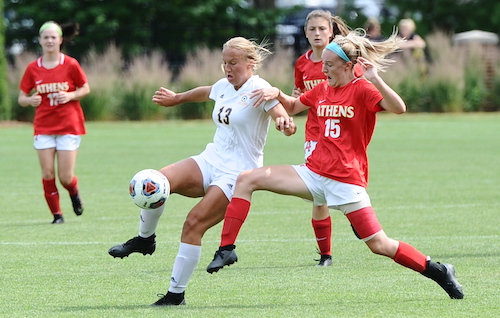 But just as Athens was feeling good about things and the crowd of red was coming alive in the stands, Hartland responded with its aforementioned counterattack.
Senior Maria Storm was able to break away and send a perfectly angled kick into the top-right corner of the net with 31:32 remaining to make it 2-0 – a goal which seemed to demoralize Athens. Just two minutes later, Hartland made it 3-0 on another goal by Kastamo.
“We haven’t seen that kind of counterattack in a while,” said 10th-year Athens coach Todd Heugh. “We generated corner kicks, and they generated goals. Soccer is a game of chances. They made good on theirs, and we did not on ours.”
Athens (17-2-4) has won four girls soccer championships, but its last title came 21 years ago in 2000. The Red Hawks, who had posted eight consecutive shutouts coming into Saturday’s Final, now have three runner-up finishes.
Kartsounes agreed the key to the victory was weathering the storm early in the second half.
“They started the second half and were really taking it to us,” said Kartsounes, who received tremendous on-field leadership from captains Kamryn Gereck, Justina L’Esperance and Storm. “I told my assistants that we can’t survive like this for 40 minutes, then we finally started possessing the ball.”
Pietila completed the scoring with her second goal of the day at the 18:21 mark. Alyse Daavettila and L’Esperance added assists for the Eagles.
Athens actually held the edge in total shots (16-14) and corner kicks (6-3), but Hartland held a 9-7 advantage in shots on goal. Athens senior keeper Nitya Balusu made five saves.
Hartland junior keeper Morgan Seog was outstanding in goal, finishing with six saves. The Eagles produced shutouts in the first five playoff games and final game.
The only postseason game in which Hartland allowed a goal was Wednesday’s Semifinal, a narrow 3-2 win over Grand Rapids Forest Hills Central. It was also seven minutes into that game when Pietila sprained her ankle on a sprinkler.
“On Wednesday night, there was no way she was going to play, Thursday was a little better and it wasn’t until after warmups today that we knew she was going to play for sure,” said Kartsounes. “Then she goes out there and scores the game-winning goal of the state finals on one leg.”
PHOTOS: (Top) Hartland players celebrate during their Division 1 Final win Saturday. (Middle) The Eagles’ Maria Storm (13) and Athens’ Meagan Lindgren (15) battle for possession.