


Classes Still Create Hoosier Hysteria
July 27, 2017
By Rob Kaminski
MHSAA benchmarks editor
This is the fourth part in a series on MHSAA tournament classification, past and present, that will be published over the next two weeks. This series originally ran in this spring's edition of MHSAA benchmarks.
Twenty years ago, Bloomington North High School won the Indiana High School Athletic Association boys basketball championship, defeating Delta 75-54 at the RCA Dome in Indianapolis.
The date, March 22, 1997, is at the same time revered and disdained by traditionalists in the state who saw it as the last schoolboy championship game the state would ever host.
That’s how devout the game of basketball, particularly interscholastic basketball, had become in the Hoosier state during the 87 years a state champion – one state champion, to be precise – was crowned.
Following that 1997 season, the IHSAA moved to a four-class system for its roundball tournaments, like so many of its state association counterparts had done years earlier.
It would be shocking to find more than a small percentage of current high school basketball players around the country unfamiliar with the iconic movie Hoosiers, even though the film is now more than 30 years old.
And, the storyline for that blockbuster unfolded more than 30 years prior to its release, when small-town, undermanned Milan High School defeated Muncie Central High School 32-30 in the 1954 IHSAA title game.
Perhaps it’s because of the David vs Goliath notion, or the fame of the movie that replaced Milan with the fictional Hickory and real-life star Bobby Plump with Hollywood hero Jimmy Chitwood, or the simple fact that Indiana had something other states didn’t.
Whatever the reason, plenty of opposition remains to this day to basketball classification in the state.
The fact is, the small rural schools were regularly being beaten handily by the much larger suburban and city schools as the tournament progressed each season.
Small schools also were closing at a rapid rate following the state’s School Reorganization Act in 1959, as students converged on larger, centralized county schools. From 1960 to 2000, the number of schools entering the tournament dropped from 694 to 381, and in 1997 a total of 382 schools and 4,584 athletes began competition at the Sectional level (the first level of the IHSAA Basketball Tournament).
It was at the entry level of the tournament where school administrators felt the pain of the new class system, but not necessarily for the same nostalgic reasons as the fans who either attended or boycotted the tournament.
At the Sectional round of the tournament, the IHSAA was culling just 2 percent of the revenue, with the participating schools splitting the balance. So, when Sectional attendance dropped by 14 percent in that first year of class basketball, many schools realized a financial loss. It was money they had grown to count on in prior years to help fund various aspects of the department.
Schools cumulatively received more than $900,000 from Sectional competition in 1998, but that total was down from more than $1 million in the last year of the single-class tournament.
Yet, the current format provides a great deal more opportunity and realistic chances at championship runs for schools of all enrollments.
To date, 60 additional teams have championship or runner-up trophies on display in school trophy cases around Indiana.
That was the mission in front of then-IHSAA commissioner Bob Gardner (now National Federation executive director) once the board made its decision: to give thousands more student-athletes the opportunity for once-in-a-lifetime experiences.
As any statistician knows, figures can be manipulated to tell any side of a story. Declining attendance in year one of class basketball is such a number.
The truth is tournament attendance had been on a steady downward spiral since its peak of just over 1.5 million in 1962. By the last single-class event in 1997, the total attendance was half that.
The challenge then and today, as it is for all state associations, is to find that delicate balance for those holding onto tradition, those holding onto trophies, and the number of trophies to hand out.
Editor’s Note: Stories from the Fort Wayne Journal Gazette in 1998 and from a 2007 issue of Indianapolis Monthly provided facts in this article.
St. Mary's Tops Off Tourney Run with Title, Record-Tying Win
By
Dean Holzwarth
Special for MHSAA.com
June 19, 2021
EAST LANSING – Orchard Lake St. Mary’s senior Tommy Allman stole the show on the mound in Saturday’s Division 2 Final.
His talented teammates did the same on the base paths.
Allman pitched six solid innings, and the Eaglets set a new Finals record for stolen bases in a decisive 9-0 win over Stevensville Lakeshore at Michigan State’s McLane Stadium.
Top-ranked St. Mary’s (43-1) won its second Division 2 championship in a row and the program’s fifth Finals title overall. The 43 wins tied for the MHSAA record with four other teams: 2010 Ann Arbor Father Gabriel Richard, 1997 Midland Dow, 1995 Stevensville Lakeshore and 1985 Harper Woods Bishop Gallagher.
“It was a good outing, and I was dialed in,” said Allman, who’s headed next to Jacksonville University. “I trusted my team behind me, and everything was working; the off-speed, curveball and slider.
“This is the best way to end it, with a state championship. The whole year we battled, and we pulled it off. I’m proud of my team.”
Allman surrendered only two hits in 6 1/3 innings of work. He struck out seven and didn’t allow a walk.
Relief pitcher Jake Keaser recorded the final two outs.
 “It was a heck of a performance from Tommy; that was awesome,” St. Mary’s coach Matt Petry said. “The plan was to split the game among three guys, but Tommy was throwing so well that we didn’t do that. I made the decision to take him out (in the seventh), and he got a great ovation.”
The Eaglets finished with 12 stolen bases. The total eclipsed the previous Finals record of nine, set by Colon in the 1989 Class D Final against Gaylord St. Mary’s.
Alex Mooney and Ryan Mooney both tied the Finals individual record with three steals each.
“We work out all year trying to stay athletic, and I feel like it really helps,” said Alex Mooney, who scored twice and had two RBI.
“From the first inning we knew we were getting good jumps and their pitchers were not doing the best job of keeping us on. We got our timing down, and we knew we could swipe bags and we did.”
Nolan Schubart broke a scoreless tie in the fourth inning with a two-RBI double.
“Nolan is a stud, and I had all the confidence in the world that he was going to get a hit there,” Alex Mooney said. “It was a huge hit for us, and it really got us going and started that big inning for us.”
Ryan McKay followed with another double to drive in a pair and make it 4-0.
The Eaglets finished with six runs in the inning, then added another three in the sixth.
“This was the ultimate goal,” said Petry, whose starting lineup was loaded with Division I college talent.
“We have three goals each season: Win the Catholic League regular season, the Catholic League tournament championship and the state championship. We always had this day in the back of our mind, and we were able to close it out.”
Freshman Noah Chase started on the mound and went 3 ⅔ innings for the Lancers.
Lakeshore, which committed three errors and had only two hits, finished the season at 28-12 overall. The loss was its first in a Final after winning back-to-back Division 2 titles in 2017 and 2018 and a Class B crown in 1990.
“Going into the fourth, we felt really good about ourselves and the game plan was working,” Lancers coach Mark Nate said. “I’m proud of our kids for the way they fought early, and then their true talent came out and that's the bottom line.
“That team is a very, very good baseball team, and they’re deserving of winning it all.”
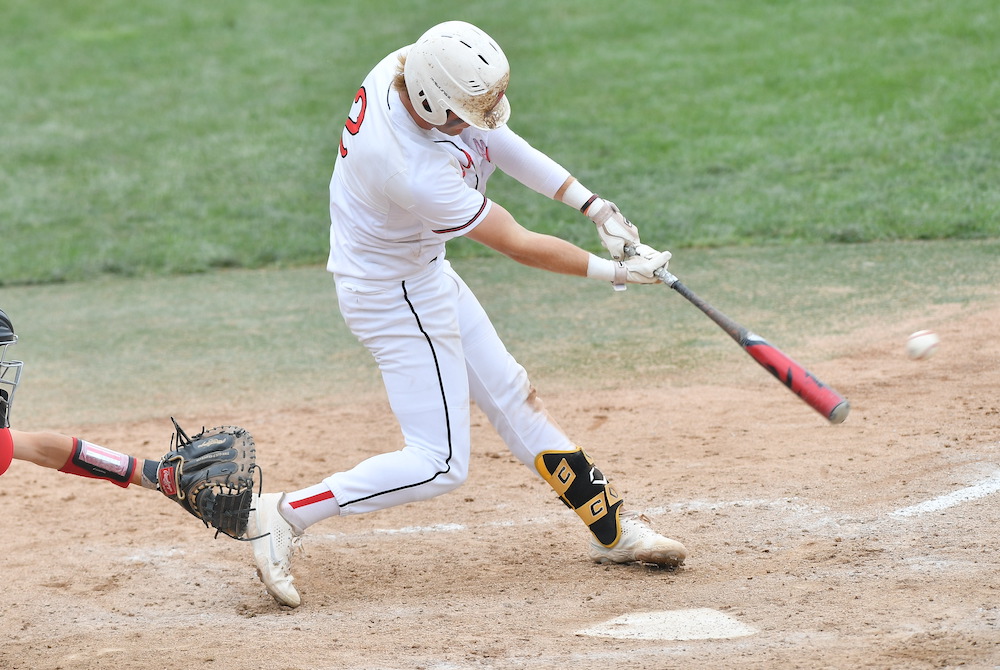
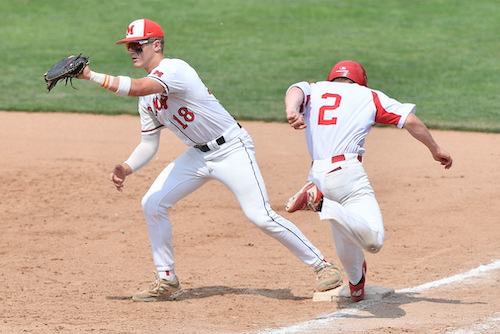
PHOTOS: (Top) Orchard Lake St. Mary's Alex Mooney (2) hones in on a pitch during Saturday's Division 2 Final. (Middle) Lakeshore's Andrew Lies (2) stretches for first base as St. Mary's Ike Irish takes a throw.