


Classes Still Create Hoosier Hysteria
July 27, 2017
By Rob Kaminski
MHSAA benchmarks editor
This is the fourth part in a series on MHSAA tournament classification, past and present, that will be published over the next two weeks. This series originally ran in this spring's edition of MHSAA benchmarks.
Twenty years ago, Bloomington North High School won the Indiana High School Athletic Association boys basketball championship, defeating Delta 75-54 at the RCA Dome in Indianapolis.
The date, March 22, 1997, is at the same time revered and disdained by traditionalists in the state who saw it as the last schoolboy championship game the state would ever host.
That’s how devout the game of basketball, particularly interscholastic basketball, had become in the Hoosier state during the 87 years a state champion – one state champion, to be precise – was crowned.
Following that 1997 season, the IHSAA moved to a four-class system for its roundball tournaments, like so many of its state association counterparts had done years earlier.
It would be shocking to find more than a small percentage of current high school basketball players around the country unfamiliar with the iconic movie Hoosiers, even though the film is now more than 30 years old.
And, the storyline for that blockbuster unfolded more than 30 years prior to its release, when small-town, undermanned Milan High School defeated Muncie Central High School 32-30 in the 1954 IHSAA title game.
Perhaps it’s because of the David vs Goliath notion, or the fame of the movie that replaced Milan with the fictional Hickory and real-life star Bobby Plump with Hollywood hero Jimmy Chitwood, or the simple fact that Indiana had something other states didn’t.
Whatever the reason, plenty of opposition remains to this day to basketball classification in the state.
The fact is, the small rural schools were regularly being beaten handily by the much larger suburban and city schools as the tournament progressed each season.
Small schools also were closing at a rapid rate following the state’s School Reorganization Act in 1959, as students converged on larger, centralized county schools. From 1960 to 2000, the number of schools entering the tournament dropped from 694 to 381, and in 1997 a total of 382 schools and 4,584 athletes began competition at the Sectional level (the first level of the IHSAA Basketball Tournament).
It was at the entry level of the tournament where school administrators felt the pain of the new class system, but not necessarily for the same nostalgic reasons as the fans who either attended or boycotted the tournament.
At the Sectional round of the tournament, the IHSAA was culling just 2 percent of the revenue, with the participating schools splitting the balance. So, when Sectional attendance dropped by 14 percent in that first year of class basketball, many schools realized a financial loss. It was money they had grown to count on in prior years to help fund various aspects of the department.
Schools cumulatively received more than $900,000 from Sectional competition in 1998, but that total was down from more than $1 million in the last year of the single-class tournament.
Yet, the current format provides a great deal more opportunity and realistic chances at championship runs for schools of all enrollments.
To date, 60 additional teams have championship or runner-up trophies on display in school trophy cases around Indiana.
That was the mission in front of then-IHSAA commissioner Bob Gardner (now National Federation executive director) once the board made its decision: to give thousands more student-athletes the opportunity for once-in-a-lifetime experiences.
As any statistician knows, figures can be manipulated to tell any side of a story. Declining attendance in year one of class basketball is such a number.
The truth is tournament attendance had been on a steady downward spiral since its peak of just over 1.5 million in 1962. By the last single-class event in 1997, the total attendance was half that.
The challenge then and today, as it is for all state associations, is to find that delicate balance for those holding onto tradition, those holding onto trophies, and the number of trophies to hand out.
Editor’s Note: Stories from the Fort Wayne Journal Gazette in 1998 and from a 2007 issue of Indianapolis Monthly provided facts in this article.
Memorable Wins and Multi-Champs Highlight LPD1 Track's Return
By
Steve Vedder
Special for MHSAA.com
June 5, 2021
KENTWOOD – The particulars didn't necessarily matter to Rockford coach Andrew Martin. The only thing which truly mattered was the stunning finish to Saturday's Lower Peninsula Division 1 boys track & field championships at East Kentwood.
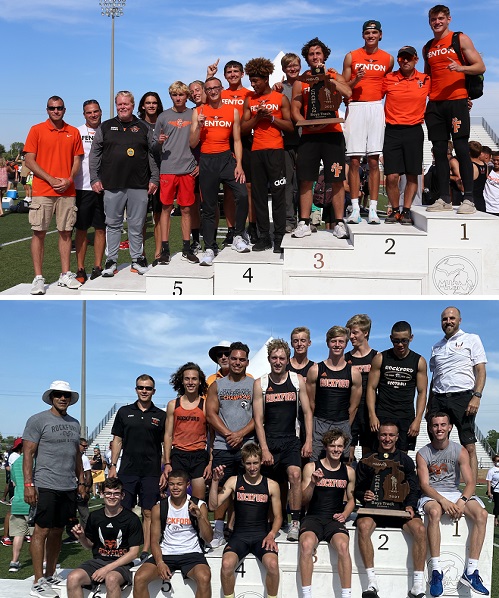
Seemingly out of the running for the team title, the Rams' 1,600 relay – a foursome not even running in the event's fast heat – managed a third place in the final event to earn Rockford a tie with Fenton for first place in a wild meet.
Both teams finished with 34 points. Instead of finishing as low as third place in a meet where the top eight were separated by just 12 points, Rockford earned its first Finals crown in 12 years under Martin.
"It doesn't matter how we got there," Martin said of tying for the title. "We were seeded 10th, but these kids are all about doing your own thing."
The Rams relay was comprised of three seniors in Daniel Leja, Gage Martin and Jacob Peck and junior Jacob Bissell. While they finished with a time of 3:23.84, Fenton was slowed by not having a team qualify for the final relay. It was a turn of events which left Fenton coach Anthony McMillan pacing nervously as the final race played out.
"To still do what we did was great," he said. "These kids left a legacy, a path. To bring a state title home is a very special moment. To be one of the (two) teams means a lot to us."
 Rockford and Fenton were far from the only teams with a breath of life until the final event. Zeeland West finished third with 30 points, Ann Arbor Skyline had 28, Pinckney and Novi 25 and Dexter and Macomb Dakota 24.
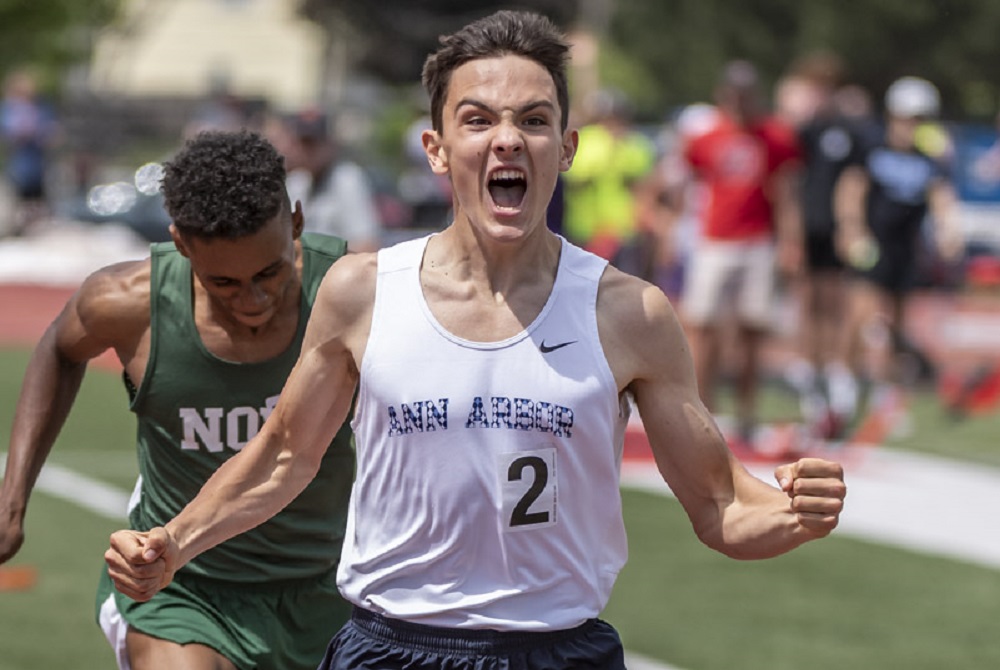
While the team title was captivating to the very end, Skyline's Hobbs Kessler virtually stole the individual part of the Finals. Kessler, who became the first Michigan high schooler to qualify for the Olympic trials in 80 years, won the 1,600 (4:16.68) and the 800 (1:54.13). While those finishes weren't necessarily surprises, Kessler's ability to live up to high expectations – including amazing kicks in both events – was even more impressive.
"It's the way I like to win," he said of running his last lap of the 1,600 in 55.1 seconds while also coming from behind to win the 800. "I want to give myself the best shot to win. The wind hit, and I snuck in.
"I know if I work out well and run my best, good things will happen. I know who I have to listen to, and the others aren't as important. I have a good support system, so I can just go out and win."
Kessler qualified for the Olympic trials last Saturday. He said he'll think more about the future now that the high school season is completed. But he wouldn't rule out competing in this summer's Japan Olympics.
"There's no reason to think I can't," he said.
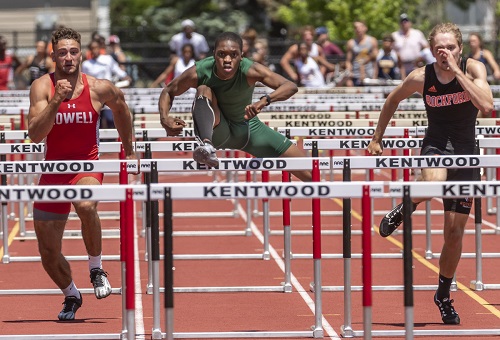
Among the other double winners at East Kentwood were Tamaal Myers II of Detroit Cass Tech, who claimed the 110 hurdles (14.26) and 300 hurdles (37.87), and Udodi Onwuzurike of Bloomfield Hills Brother Rice, who won the 100 (10.55) and 200 (21.23).
Myers said an extremely strong headwind didn't do runners any favors. But he was able to overcome the obstacle because of physical toughness, he said.
"It was a strong wind, but I just pushed through it to finish where I did," he said. "Mentally, you just keep going forward. It's all about technique; it's the arms, legs, everything."
Among other runners winning events were Terrence Muex of Flint Carman-Ainsworth in the 400 (46.52) and Hartland's Riley Hough, who won the 3,200 (9:07.91).
Zeeland West won the 800 (1:28.12) and the 1,600 (3:21.82) relays. St. Joseph won the 400 (42.65) and Novi the 3,200 (7:48.53).
 Dexter's Cole Sheldon won the pole vault (15-3) to complete an inspiring climb that included failing to qualify as a freshmen, to finishing 26th in 2019 to winning Saturday.
"It was just hard work," said Sheldon, who was seeded fourth. "It's nice being the underdog. I didn't have that great of a Regional, and I told my coach I was saving it for the Finals."
Sheldon also credited teammate Noah Schultz, who finished second with a vault of 14-9.
"That was probably the best thing that could have happened to me," Sheldon said. "He's the reason I did so well. If he goes high, I want to go higher."
Among other field event winners was Zachary Webb of Macomb Dakota, who won the high jump in 6-6. While some competitors are actually surprised by winning a state title, Webb doesn't count himself among them.
"I knew when I came in here I couldn't miss," he said. "I wanted to put the pressure on others, and I think I did that. I practice so much, I knew I could do this. I break down a lot of video. If I'm going bad, I look at the video and fix what I need to fix."
The other field event winners were Drake Willenborg of South Lyon in the discus (183-3), Levi Honderd of Holland in the long jump (22-6) and Ben Haas of Clarkston in the shot put (57-8).
PHOTOS: (Top) Ann Arbor Skyline’s Hobbs Kessler celebrates his victory in the 800 on Saturday. (Middle) Detroit Cass Tech’s Tamaal Myers II sets the pace during his hurdles sweep. (Below) Fenton, top, and Rockford celebrate their team championships.(Action photos by Ike Lea; team photos by John Brabbs/RunMichigan.com.)