


Classes Still Create Hoosier Hysteria
July 27, 2017
By Rob Kaminski
MHSAA benchmarks editor
This is the fourth part in a series on MHSAA tournament classification, past and present, that will be published over the next two weeks. This series originally ran in this spring's edition of MHSAA benchmarks.
Twenty years ago, Bloomington North High School won the Indiana High School Athletic Association boys basketball championship, defeating Delta 75-54 at the RCA Dome in Indianapolis.
The date, March 22, 1997, is at the same time revered and disdained by traditionalists in the state who saw it as the last schoolboy championship game the state would ever host.
That’s how devout the game of basketball, particularly interscholastic basketball, had become in the Hoosier state during the 87 years a state champion – one state champion, to be precise – was crowned.
Following that 1997 season, the IHSAA moved to a four-class system for its roundball tournaments, like so many of its state association counterparts had done years earlier.
It would be shocking to find more than a small percentage of current high school basketball players around the country unfamiliar with the iconic movie Hoosiers, even though the film is now more than 30 years old.
And, the storyline for that blockbuster unfolded more than 30 years prior to its release, when small-town, undermanned Milan High School defeated Muncie Central High School 32-30 in the 1954 IHSAA title game.
Perhaps it’s because of the David vs Goliath notion, or the fame of the movie that replaced Milan with the fictional Hickory and real-life star Bobby Plump with Hollywood hero Jimmy Chitwood, or the simple fact that Indiana had something other states didn’t.
Whatever the reason, plenty of opposition remains to this day to basketball classification in the state.
The fact is, the small rural schools were regularly being beaten handily by the much larger suburban and city schools as the tournament progressed each season.
Small schools also were closing at a rapid rate following the state’s School Reorganization Act in 1959, as students converged on larger, centralized county schools. From 1960 to 2000, the number of schools entering the tournament dropped from 694 to 381, and in 1997 a total of 382 schools and 4,584 athletes began competition at the Sectional level (the first level of the IHSAA Basketball Tournament).
It was at the entry level of the tournament where school administrators felt the pain of the new class system, but not necessarily for the same nostalgic reasons as the fans who either attended or boycotted the tournament.
At the Sectional round of the tournament, the IHSAA was culling just 2 percent of the revenue, with the participating schools splitting the balance. So, when Sectional attendance dropped by 14 percent in that first year of class basketball, many schools realized a financial loss. It was money they had grown to count on in prior years to help fund various aspects of the department.
Schools cumulatively received more than $900,000 from Sectional competition in 1998, but that total was down from more than $1 million in the last year of the single-class tournament.
Yet, the current format provides a great deal more opportunity and realistic chances at championship runs for schools of all enrollments.
To date, 60 additional teams have championship or runner-up trophies on display in school trophy cases around Indiana.
That was the mission in front of then-IHSAA commissioner Bob Gardner (now National Federation executive director) once the board made its decision: to give thousands more student-athletes the opportunity for once-in-a-lifetime experiences.
As any statistician knows, figures can be manipulated to tell any side of a story. Declining attendance in year one of class basketball is such a number.
The truth is tournament attendance had been on a steady downward spiral since its peak of just over 1.5 million in 1962. By the last single-class event in 1997, the total attendance was half that.
The challenge then and today, as it is for all state associations, is to find that delicate balance for those holding onto tradition, those holding onto trophies, and the number of trophies to hand out.
Editor’s Note: Stories from the Fort Wayne Journal Gazette in 1998 and from a 2007 issue of Indianapolis Monthly provided facts in this article.
Gazelles Cap Return Season with Familiar Celebration
By
Pam Shebest
Special for MHSAA.com
June 4, 2021
PORTAGE — Sisters Marisa and Kayla Nafso were ecstatic after pulling out a tough three-setter for the No. 4 doubles title Friday at Portage Central High School.
The last match off the courts, they had no clue that their team, Bloomfield Hills Academy of the Sacred Heart, won the team title at the MHSAA Lower Peninsula Division 4 tennis championship.
They were stunned to learn that their semifinal win actually had been team title clincher.
“Oh, we won?” Marisa, a junior, said, grabbing her sister in a big hug.
“Wait, wait, wait. Our semifinal win? Oh my gosh, we won. That’s great!
“Wow. I really wanted to win individually, but the team makes it 20 times better,” Kayla, a freshman, exclaimed with a huge grin.
Sacred Heart finished with 29 points, six ahead of Traverse City St. Francis.
Just two points separated the next four teams.
North Muskegon and Portland tied for third with 18 points each, Grand Rapids West Catholic was fifth with 17 and Jackson Lumen Christi sixth with 16.
Marisa Nafso won a state title at No. 2 doubles in 2019, and her sister was thrilled to be her partner this year.
“I was really lucky because she won states when she was a freshman,” Kayla Nafso said.
“Because of her experience, I was more comfortable. It was great that I got to win as a freshman.”
The sisters said the final was the match that scared them the most.
The top seeds at their flight, they defeated Grand Rapids NorthPointe Christian’s Delanie Minnema and Caroline Rudolph, the third seeds, 7-6(3), 2-6, 6-1.
“We were watching them play at the other site,” Nafso said. “Creds to the team we played for playing two three-set matches back to back.”
The team win was the Gazelles’ third Finals title in a row, but the first under coach Chris Shaya.
 Neither the coach nor the players knew for sure they clinched the title until all matches were finished.
“I figured we won but I was going to wait for the team so we all could find out together,” Shaya said.
“None of us looked. I knew Traverse City was very strong in singles, and I knew we were strong in doubles. In singles, they competed extremely well. It was tough for us to overcome, and they deserve those wins.”
As a coach, Shaya said, “First of all, you want their experience to be fun. You want to teach them some life lessons about hard work and how that pays off, and sometimes it doesn’t pay off.”
At No. 1 singles, top-seeded Moorea McNalley finished the season undefeated after entering the tournament with a 28-0 record.
She lost just seven games over her four tournament matches.
The Clarkston Everest Collegiate junior defeated the second seed, Lilly Bobrowski of St. Francis, 6-0, 6-0.
McNalley also won the No. 1 singles title two years ago. (The 2020 season was canceled due to COVID-19).
As the top seed, she said she felt a bit of pressure coming into the tournament, “especially the further matches. They are all very good players.”
Bobrowski, a senior who plans to play tennis at Ave Maria University in Florida, said the two played earlier in the regular season.
“We went into a third set tiebreak then,” she said. “(Friday, McNalley) was definitely on her game and I made a few unforced errors, but it was a lot of fun.”
Senior Alexi Lewis, one of two St. Francis singles winners, defeated Sacred Heart’s Isabelle Burg, the second seed, 6-2, 6-3, for the No. 2 flight championship.
“My goal was to win but I got kind of nervous looking at the draw because I had never played the No. 2 seed,” the top seed said.
“All the other seeds I had played and had good scores against them, so I was really confident going in. I was preparing myself for playing the No. 2 seed — a lot.”
Lewis, who plans to play tennis at Hope College, said the afternoon wind was a factor in the match.
“That threw me off a little bit,” she said. “So much of it was just mental toughness. (Burg) was a really, really good player and could get the ball back with a lot of pace.
“It was just working against that and trying to find that little spot where I could move her around. The wind complicated all that.”
Lewis was also undefeated entering the tournament.
The other St. Francis singles champ was Jillian Sodini, the top seed at No. 3, who defeated Portland’s Adriana Krieger, 6-2, 6-1.
“I knew I had to keep my eye on the prize and stay calm with it and play my game,” said Sodini, who ended her senior season undefeated.
 “(Second place as a team) is awesome. We have six underclassmen this year and six seniors. You’ve just got to bring it at states. We’ve been pretty rowdy all day.”
“Rowdy” is the perfect word for one of the loudest and most supportive teams at the tournament.
First-year coach Dane Fosgard thought for sure this would be the year St. Francis won the team title after finishing runner-up three of the last five seasons.
“Just when you have a team you think is good enough to win States, it’s not good enough,” he said.
“We have good players coming up. This year’s going to be tough to beat.”
He gave a nod to his three senior singles players, all co-captains, for being leaders on the team.
“Six seniors and three of them went out as finalists and two state champs,” he said. “Those three seniors, Lilly, Alexi and Jillian, have worked so hard all four years of their high school careers, both on the court and off the court.
“Having those three on the same team is something special. They’re all No. 1 singles-caliber players.”
Seeded third at No. 4 singles, Olivia Eaker of Jackson Lumen Christi was the lowest seed to win a title.
She upset top-seeded Erika Graham, of Ann Arbor Father Gabriel Richard, 6-0, 6-4, in the final after defeating St. Francis’ No. 2 seed, Mary Chittle, 5-6, 7-6(3), 6-4 in the semifinal.
Graham also won her semi in three sets, 6-7(2), 6-3, 6-4, over fourth seed Eve Jackson of Sacred Heart.
Both Eaker and Graham were exhausted after their match, the next to last off the courts.
Just a freshman, “I don’t even know,” Eaker said, catching her breath, about winning the final. “I’m honored and very grateful for this.
“I feel amazing, excited. It was definitely tough. We both worked really hard for it. We gave it all we had.”
Other doubles winners included second seeds Reagan Nauta and Shannon Russell, from Grand Rapids West Catholic, 7-5, 6-2, over top seeds Lulu George and Maggie Pulte of Sacred Heart.
Top seeds Noor Simon and Angelina Kakos, also of Sacred Heart, defeated third seeds Hannah Nelson and Brooke Tietz from West Catholic, 7-6(5), 6-4, at No. 3 doubles.
At No. 4, second seeds Marilyn Gaston and Greta Goszkowicz, from North Muskegon, defeated West Catholic top seeds Olivia Vallone and Karlie Kurlenda, 6-3, 6-5.
Goszkowicz, a senior, was one of the most exuberant winners, commenting, “My goal was to make it to the second day.”
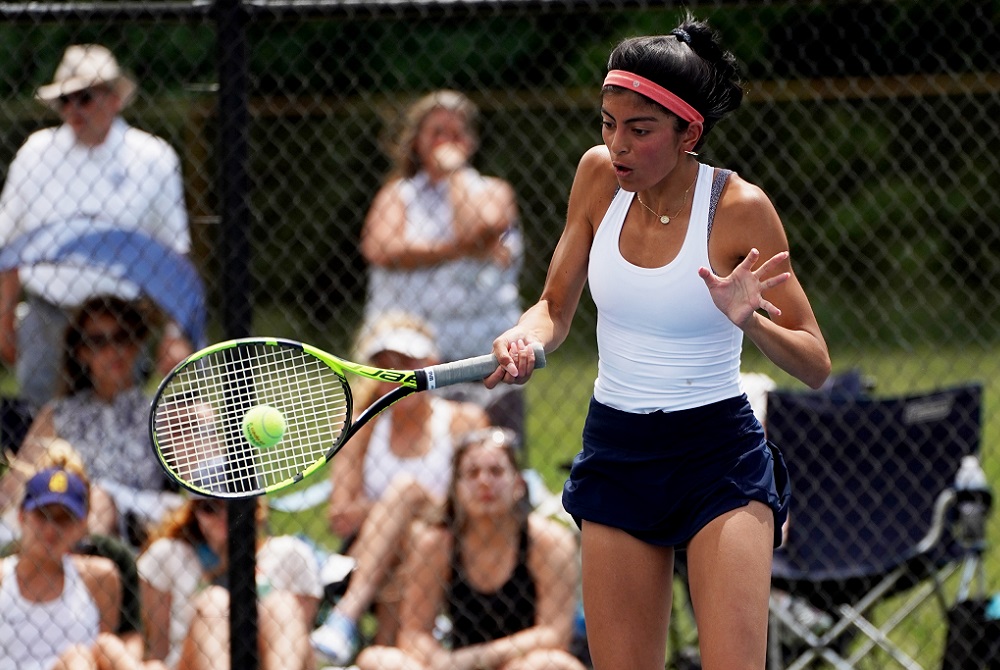
PHOTOS: (Top) Sacred Heart’s Marisa Nafso returns a volley during her and sister Kayla’s championship match win at No. 1 doubles Friday. (Middle) Clarkston Everest Collegiate's Moorea McNalley follows through on a return during her No. 1 singles championship match. (Below) Lilly Bobrowski scored big for Traverse City St. Francis also advancing to the No. 1 singles final. (Click for more from High School Sports Scene.)