


Classes Still Create Hoosier Hysteria
July 27, 2017
By Rob Kaminski
MHSAA benchmarks editor
This is the fourth part in a series on MHSAA tournament classification, past and present, that will be published over the next two weeks. This series originally ran in this spring's edition of MHSAA benchmarks.
Twenty years ago, Bloomington North High School won the Indiana High School Athletic Association boys basketball championship, defeating Delta 75-54 at the RCA Dome in Indianapolis.
The date, March 22, 1997, is at the same time revered and disdained by traditionalists in the state who saw it as the last schoolboy championship game the state would ever host.
That’s how devout the game of basketball, particularly interscholastic basketball, had become in the Hoosier state during the 87 years a state champion – one state champion, to be precise – was crowned.
Following that 1997 season, the IHSAA moved to a four-class system for its roundball tournaments, like so many of its state association counterparts had done years earlier.
It would be shocking to find more than a small percentage of current high school basketball players around the country unfamiliar with the iconic movie Hoosiers, even though the film is now more than 30 years old.
And, the storyline for that blockbuster unfolded more than 30 years prior to its release, when small-town, undermanned Milan High School defeated Muncie Central High School 32-30 in the 1954 IHSAA title game.
Perhaps it’s because of the David vs Goliath notion, or the fame of the movie that replaced Milan with the fictional Hickory and real-life star Bobby Plump with Hollywood hero Jimmy Chitwood, or the simple fact that Indiana had something other states didn’t.
Whatever the reason, plenty of opposition remains to this day to basketball classification in the state.
The fact is, the small rural schools were regularly being beaten handily by the much larger suburban and city schools as the tournament progressed each season.
Small schools also were closing at a rapid rate following the state’s School Reorganization Act in 1959, as students converged on larger, centralized county schools. From 1960 to 2000, the number of schools entering the tournament dropped from 694 to 381, and in 1997 a total of 382 schools and 4,584 athletes began competition at the Sectional level (the first level of the IHSAA Basketball Tournament).
It was at the entry level of the tournament where school administrators felt the pain of the new class system, but not necessarily for the same nostalgic reasons as the fans who either attended or boycotted the tournament.
At the Sectional round of the tournament, the IHSAA was culling just 2 percent of the revenue, with the participating schools splitting the balance. So, when Sectional attendance dropped by 14 percent in that first year of class basketball, many schools realized a financial loss. It was money they had grown to count on in prior years to help fund various aspects of the department.
Schools cumulatively received more than $900,000 from Sectional competition in 1998, but that total was down from more than $1 million in the last year of the single-class tournament.
Yet, the current format provides a great deal more opportunity and realistic chances at championship runs for schools of all enrollments.
To date, 60 additional teams have championship or runner-up trophies on display in school trophy cases around Indiana.
That was the mission in front of then-IHSAA commissioner Bob Gardner (now National Federation executive director) once the board made its decision: to give thousands more student-athletes the opportunity for once-in-a-lifetime experiences.
As any statistician knows, figures can be manipulated to tell any side of a story. Declining attendance in year one of class basketball is such a number.
The truth is tournament attendance had been on a steady downward spiral since its peak of just over 1.5 million in 1962. By the last single-class event in 1997, the total attendance was half that.
The challenge then and today, as it is for all state associations, is to find that delicate balance for those holding onto tradition, those holding onto trophies, and the number of trophies to hand out.
Editor’s Note: Stories from the Fort Wayne Journal Gazette in 1998 and from a 2007 issue of Indianapolis Monthly provided facts in this article.
Preview: Fast Finals in Weekend Forecast
By
Geoff Kimmerly
MHSAA.com senior editor
March 25, 2021
Lower Peninsula boys swimming & diving has come back in a big, or rather really fast, way this winter.
The sport was halted days before last season’s MHSAA Finals. But contenders have sped through this season at an impressive pace – and have loaded this weekend’s championship meets with plenty of storylines.
Diving is Friday and all swimming Saturday – click for more meet details (and note that in Division 3 all diving is at Hamilton High School and all swimming at the Holland Aquatic Center). Because of the large numbers of participants, spectators are not allowed this weekend – but both days of all three meets will be streamed live and viewable with subscription on MHSAA.tv.
Here’s a glance at team and individual favorites:
Lower Peninsula Division 1 at Hudsonville
Top-ranked teams: 1. Ann Arbor Pioneer, 2. Holland West Ottawa, 3. Detroit Catholic Central.
With no Finals competed in 2020, Holland West Ottawa remains the reigning champion – and is expected to give a mighty Pioneer team its strongest competition. Pioneer is seeking its first championship since 2009 and first top-two Finals finish since 2011, and enters with all three relays and 25 individual entries seeded to score plus three divers competing. West Ottawa will have all three relays competing with 11 individual entries seeded to score. DCC was the runner-up to West Ottawa at that most recent Finals two seasons ago, and the Shamrocks will attempt to earn their first championship with all three relays and 12 entries seeded to score and one diver competing.
Matt Adanin, Saline junior – He’s the favorite in the backstroke at his first Finals with a seed time of 49.94, and he’s also seeded third in the 200-yard freestyle (1:42.76).
Conner Halberg, Northville senior – After also qualifying as a top contender in the 500 and 200 freestyles last season, Halberg enters this weekend top-seeded in the 500 (4:36.8) and second-seeded in the 200 (1:40.94).
Dane Herrick, Lake Orion senior – The top seed in the 50 (21.01) and fourth seed in the 100 freestyle (46.82) also was slated to contend in both in 2020.
Ryan Hume, Ann Arbor Pioneer junior – Slated to swim other races last season, Hume is a favorite in his pair of individual events this weekend with the top seed in the individual medley (1:52.58) and second seed in the 500 (4:37.74).
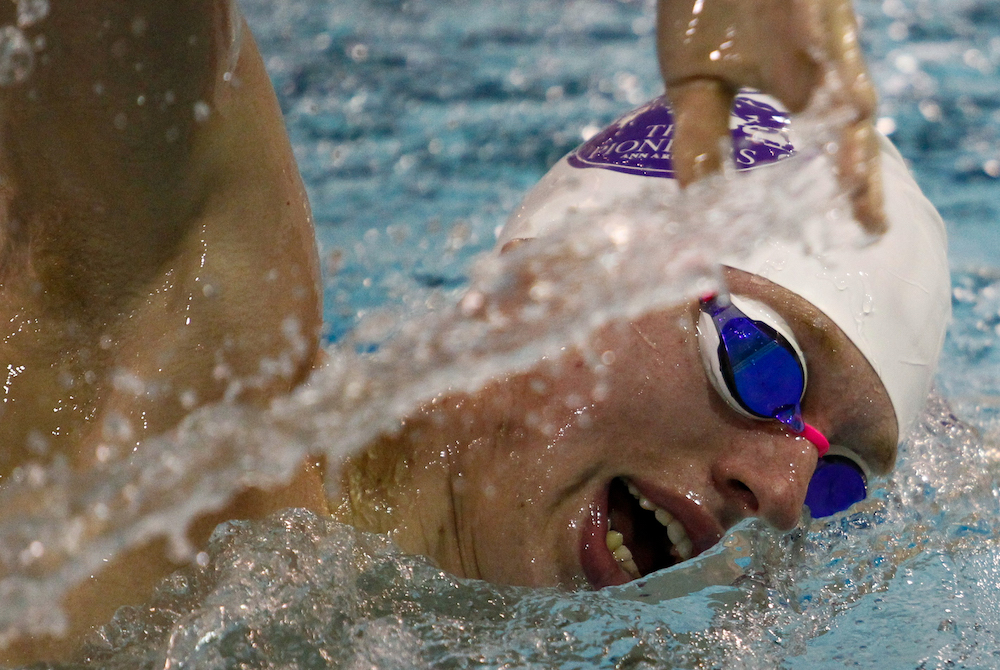
Matthew Segal, Ann Arbor Pioneer senior – He earned a third in the 200 freestyle and fourth in the breaststroke as a sophomore and was the favorite in the breaststroke and second-seeded in the IM last season. He comes into this weekend seeded first in both the 200 free (1:39.62) and breaststroke (53.99), the latter with a time only four tenths of a second off the all-division/class Finals record.
Fletcher Smith, Huron Valley United junior – He qualified in the backstroke and butterfly last year and this weekend should contend in both with the top seed in the butterfly (50.58) and seventh in the 200 free.
Jack VanHowe, Rochester junior – A backstroke contender and 100 free qualifier a year ago, he is the top seed in the 100 (46.35) and second seed in the backstroke (50.02) this time.
Ann Arbor Pioneer’s 400 freestyle relay – The Pioneers’ top seed time of 3:04.99 is 2.9 seconds faster than the field and 2.93 seconds off the all-division/class Finals record.
Cole Tremewan, Ann Arbor Pioneer senior – He finished fifth at the Finals as a freshman and second as a sophomore, and his 507.55 Regional score last week was nearly 27 points higher than the next contender’s total and one of only five scores across the three Regionals above 400.
Lower Peninsula Division 2 at Jenison
Top-ranked teams: 1. Birmingham Seaholm, 2. Grosse Pointe South, 3. Ann Arbor Skyline.
The Maples will be competing for a first team championship since winning back-to-back in 2014 and 2015 and enter the weekend with all three relays and 13 entries seeded to score plus three divers competing. Grosse Pointe South will make a run at its first team title since 1968, boasting all three relays and nine entries seeded to score and a diver competing. Skyline chased Pioneer during the regular season and could join its neighbor as a champion with all three relays and 10 entries seeded to score, plus a diver. Skyline won the Division 1 championship in 2018.
Aidan Boldt, St. Clair Shores Lakeview senior – He finished fourth in the 200 and 500 freestyles as a sophomore and had top-three seeds in both heading into last year’s Finals. This weekend he has the top seed in the 200 (1:42.16) and second seed in the 500 (4:39.05).
Gianni Carlino, Grosse Pointe North junior – He and Boldt will be chasing each other; Carlino also was expected to contend in the 200 and 500 freestyles last season and has the second seed in the 200 (1:42.90) and top seed in the 500 (4:38.84) this weekend.
Michael Grover, Byron Center junior – He made a jump to the fifth seed in the breaststroke in 2020 and this time is the top seed in that race (56.73) and eighth seed in the IM.
Jack Hamilton, Berkley senior – Hamilton has another chance to build on his backstroke championship and third place in the IM as a sophomore. He’s the top seed in the backstroke (49.30) for the third season in a row and this time by nearly two seconds, and he’s also the second seed in the IM (1:51.94).
Trevor Jones, Farmington senior – The top-seeded contender in both the IM (1:51.79) and 100 free (45.55) was ninth in the butterfly in Division 1 as a sophomore and expected to contend in the butterfly and 200 free in Division 2 last season.
Avery LeTourneau, Grand Rapids Forest Hills Central senior – He was seeded to score in both the 200 free and butterfly last season and is again, this time sixth in the 200 and the favorite in the butterfly (49.69).
Micah Scheffer, Temperance Bedford junior – After taking fifth in the 50 and 11th in the 100 freestyle as a freshman, Scheffer was seeded eighth in both the 50 and butterfly last season. But this weekend he’s moved up to the top seed in the 50 (21.07) and third in the butterfly (50.72).
Kameron Liberman, Birmingham Seaholm senior – His 525.45 was the highest in all of Division 3’s Regionals last week. He improved from 12th at the Finals as a freshman to fifth as a sophomore.
Lower Peninsula Division 3 at Holland Aquatic Center/Hamilton
Top-ranked teams: 1. East Grand Rapids, 2. Bloomfield Hills Cranbrook Kingswood, 3. Holland Christian.
Even after the year off, there are some interesting streaks worth noting in this division. The 2018 and 2019 Division 3 Finals ended with Holland Christian as champion and East Grand Rapids as runner-up, and the Pioneers have actually finished second four straight seasons and last won the team title in 2013. Cranbrook was the champion four straight seasons from 2014-17. The Pioneers will bring potentially the two strongest divers plus all three relays and 13 entries seeded to score, while Cranbrook will lean on three relays and nine entries seeded among the top 16 in their events. Holland Christian’s three-peat could rely on three relays and 10 top-16 individual entries, plus a diver.
Charles Brown, Spring Lake junior – Brown has jumped from an expected middle-placing sprinter in 2020 to a major contender with the second-fastest 50 seed time (21.14) and best in the butterfly (51.08).
Jonas Cantrell, Mason senior – Cantrell is another of a handful of past champions getting another shot as he’s seeded first in both the 200 (1:40.01) and 500 (4:34.97) freestyles after winning the 500 and finishing third in the 200 as a sophomore.
Andrew Dobrzanski, Milan junior – Dobrzanski also is a past champion, having won the breaststroke and taken second in the IM in 2019. He’s seeded first in both this weekend with seed times of 54.79 and 1:50.87, respectively.
Colin Kalkman, Holland Christian senior – Kalkman was third in the IM and fifth in the backstroke and part of a championship relay two seasons ago, and he returns as the top seed in the 100 free (47.04) and second in the backstroke (53.04).
Tyler Ray, Pinckney junior – He was off to a great start with an eighth in the butterfly and 12th in the backstroke as a freshman and qualified for both in Division 2 a year ago. Back in Division 3 this weekend, he’s seeded first in the backstroke (52.95) and second in the butterfly (51.44).
Jacob Ryan, Detroit Country Day senior – He has posted a combined three top-eight Finals finishes in the 50 or 100 freestyles and was expected to pick up two more last season. He could be in for a big high school finale seeded first in the 50 (21.01) and second in the 100 (48.02) this weekend.
Charley Bayer, East Grand Rapids junior – Pioneers divers posted the two highest total scores at Regionals, with Bayer edging senior teammate Billy Kirchgessner. Bayer was eighth as a freshman in 2019, when then-sophomore Kirchgessner finished third, and both were slated to dive last season as well.
PHOTO: Matthew Segal, here against Ann Arbor Huron on Feb. 25, brings a pair of individual top seeds into the Division 1 Finals as he attempts to help top-ranked Pioneer secure its first team title since 2009. (Photo courtesy of We Love Ann Arbor.)