


Classes Still Create Hoosier Hysteria
July 27, 2017
By Rob Kaminski
MHSAA benchmarks editor
This is the fourth part in a series on MHSAA tournament classification, past and present, that will be published over the next two weeks. This series originally ran in this spring's edition of MHSAA benchmarks.
Twenty years ago, Bloomington North High School won the Indiana High School Athletic Association boys basketball championship, defeating Delta 75-54 at the RCA Dome in Indianapolis.
The date, March 22, 1997, is at the same time revered and disdained by traditionalists in the state who saw it as the last schoolboy championship game the state would ever host.
That’s how devout the game of basketball, particularly interscholastic basketball, had become in the Hoosier state during the 87 years a state champion – one state champion, to be precise – was crowned.
Following that 1997 season, the IHSAA moved to a four-class system for its roundball tournaments, like so many of its state association counterparts had done years earlier.
It would be shocking to find more than a small percentage of current high school basketball players around the country unfamiliar with the iconic movie Hoosiers, even though the film is now more than 30 years old.
And, the storyline for that blockbuster unfolded more than 30 years prior to its release, when small-town, undermanned Milan High School defeated Muncie Central High School 32-30 in the 1954 IHSAA title game.
Perhaps it’s because of the David vs Goliath notion, or the fame of the movie that replaced Milan with the fictional Hickory and real-life star Bobby Plump with Hollywood hero Jimmy Chitwood, or the simple fact that Indiana had something other states didn’t.
Whatever the reason, plenty of opposition remains to this day to basketball classification in the state.
The fact is, the small rural schools were regularly being beaten handily by the much larger suburban and city schools as the tournament progressed each season.
Small schools also were closing at a rapid rate following the state’s School Reorganization Act in 1959, as students converged on larger, centralized county schools. From 1960 to 2000, the number of schools entering the tournament dropped from 694 to 381, and in 1997 a total of 382 schools and 4,584 athletes began competition at the Sectional level (the first level of the IHSAA Basketball Tournament).
It was at the entry level of the tournament where school administrators felt the pain of the new class system, but not necessarily for the same nostalgic reasons as the fans who either attended or boycotted the tournament.
At the Sectional round of the tournament, the IHSAA was culling just 2 percent of the revenue, with the participating schools splitting the balance. So, when Sectional attendance dropped by 14 percent in that first year of class basketball, many schools realized a financial loss. It was money they had grown to count on in prior years to help fund various aspects of the department.
Schools cumulatively received more than $900,000 from Sectional competition in 1998, but that total was down from more than $1 million in the last year of the single-class tournament.
Yet, the current format provides a great deal more opportunity and realistic chances at championship runs for schools of all enrollments.
To date, 60 additional teams have championship or runner-up trophies on display in school trophy cases around Indiana.
That was the mission in front of then-IHSAA commissioner Bob Gardner (now National Federation executive director) once the board made its decision: to give thousands more student-athletes the opportunity for once-in-a-lifetime experiences.
As any statistician knows, figures can be manipulated to tell any side of a story. Declining attendance in year one of class basketball is such a number.
The truth is tournament attendance had been on a steady downward spiral since its peak of just over 1.5 million in 1962. By the last single-class event in 1997, the total attendance was half that.
The challenge then and today, as it is for all state associations, is to find that delicate balance for those holding onto tradition, those holding onto trophies, and the number of trophies to hand out.
Editor’s Note: Stories from the Fort Wayne Journal Gazette in 1998 and from a 2007 issue of Indianapolis Monthly provided facts in this article.
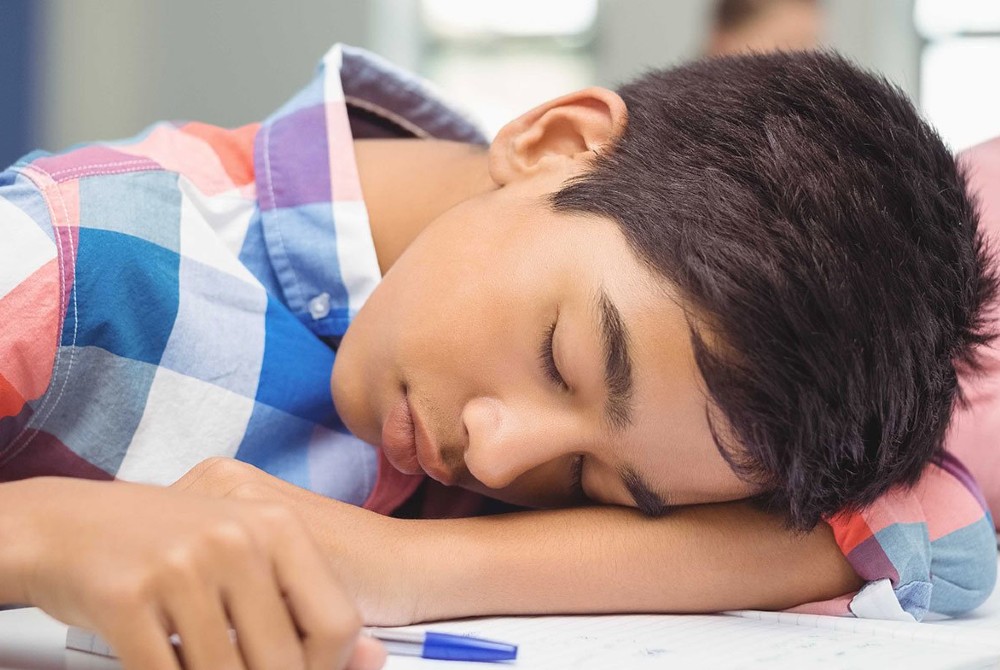
Is Your Teen Sleep-Deprived?
March 2, 2021

Many teens tend to stay up late. They’re on social media, watching television or YouTube, studying, or just tossing and turning for hours unable to fall asleep. Sleep can also be disrupted during stressful times during adolescence like exams or relationship problems.
More than two-thirds of high school students in the U.S. are failing to get sufficient sleep on school nights, according to a recent study from the Centers for Disease Control and Prevention (CDC).
“The American Academy of Sleep Medicine (AASM) recommends that teens should sleep eight to 10 hours per night on a regular basis to promote optimal health,” explains Virginia Skiba, M.D., a sleep specialist with the Henry Ford Health System. Insufficient sleep can have a negative impact on their grades, athletic performance and mental and physical well-being, including depression and anxiety issues and drug and alcohol use.
It’s a safety issue, as well. Motor vehicle crashes are a leading cause of teen deaths in the U.S. In a recent survey, more than half of teens admitted to having driven when feeling too tired and nearly one in 10 teens reported having fallen asleep at the wheel.
A typical high school student is biologically wired to fall asleep around 11 p.m. Many high schools in Michigan start school as early as 7 a.m. – long before a teen’s natural wake time. The AASM advocates a later middle school and high school start time of 8:30 a.m. or later.
Tips for a Good Night’s Sleep
Teenagers’ sleep-wake cycles are biologically determined – they are programmed to stay up late at night and sleep later in the morning. Most teens are instinctively night owls. Falling asleep is often a challenge, but there are things teens can do that may help them get a good night’s sleep.
Here are some tips from Dr. Skiba, which apply not only to teens but are great advice for anyone who is struggling with feeling sleep deprived:
► First and foremost, make sleep a priority. In our busy society, too often making time for sleep is last on the list.
► Maintain a consistent bedtime and wake time that allows at least eight hours of nightly sleep, including on weekends and vacation.
► Keep the bedroom quiet and dark. Keep the TV, computer, phone and video game system out of the bedroom.
► Set a technology curfew; turn off all devices one hour before bedtime.
► Engage in quiet activities before bed, like reading, journaling or yoga, and establish a relaxing bedtime ritual.
Dr. Virginia Skiba is a sleep medicine expert who sees patients at Henry Ford Medical Centers in Grosse Pointe and Sterling Heights.
If your teen is struggling with sleep issues, talk to your pediatrician or family doctor to find out if he or she could benefit from a sleep evaluation. Call 1-800-HENRYFORD (436-7936) or visit henryford.com to learn more.
Visit henryford.com/sports or call (313) 972-4216.