


Classes Still Create Hoosier Hysteria
July 27, 2017
By Rob Kaminski
MHSAA benchmarks editor
This is the fourth part in a series on MHSAA tournament classification, past and present, that will be published over the next two weeks. This series originally ran in this spring's edition of MHSAA benchmarks.
Twenty years ago, Bloomington North High School won the Indiana High School Athletic Association boys basketball championship, defeating Delta 75-54 at the RCA Dome in Indianapolis.
The date, March 22, 1997, is at the same time revered and disdained by traditionalists in the state who saw it as the last schoolboy championship game the state would ever host.
That’s how devout the game of basketball, particularly interscholastic basketball, had become in the Hoosier state during the 87 years a state champion – one state champion, to be precise – was crowned.
Following that 1997 season, the IHSAA moved to a four-class system for its roundball tournaments, like so many of its state association counterparts had done years earlier.
It would be shocking to find more than a small percentage of current high school basketball players around the country unfamiliar with the iconic movie Hoosiers, even though the film is now more than 30 years old.
And, the storyline for that blockbuster unfolded more than 30 years prior to its release, when small-town, undermanned Milan High School defeated Muncie Central High School 32-30 in the 1954 IHSAA title game.
Perhaps it’s because of the David vs Goliath notion, or the fame of the movie that replaced Milan with the fictional Hickory and real-life star Bobby Plump with Hollywood hero Jimmy Chitwood, or the simple fact that Indiana had something other states didn’t.
Whatever the reason, plenty of opposition remains to this day to basketball classification in the state.
The fact is, the small rural schools were regularly being beaten handily by the much larger suburban and city schools as the tournament progressed each season.
Small schools also were closing at a rapid rate following the state’s School Reorganization Act in 1959, as students converged on larger, centralized county schools. From 1960 to 2000, the number of schools entering the tournament dropped from 694 to 381, and in 1997 a total of 382 schools and 4,584 athletes began competition at the Sectional level (the first level of the IHSAA Basketball Tournament).
It was at the entry level of the tournament where school administrators felt the pain of the new class system, but not necessarily for the same nostalgic reasons as the fans who either attended or boycotted the tournament.
At the Sectional round of the tournament, the IHSAA was culling just 2 percent of the revenue, with the participating schools splitting the balance. So, when Sectional attendance dropped by 14 percent in that first year of class basketball, many schools realized a financial loss. It was money they had grown to count on in prior years to help fund various aspects of the department.
Schools cumulatively received more than $900,000 from Sectional competition in 1998, but that total was down from more than $1 million in the last year of the single-class tournament.
Yet, the current format provides a great deal more opportunity and realistic chances at championship runs for schools of all enrollments.
To date, 60 additional teams have championship or runner-up trophies on display in school trophy cases around Indiana.
That was the mission in front of then-IHSAA commissioner Bob Gardner (now National Federation executive director) once the board made its decision: to give thousands more student-athletes the opportunity for once-in-a-lifetime experiences.
As any statistician knows, figures can be manipulated to tell any side of a story. Declining attendance in year one of class basketball is such a number.
The truth is tournament attendance had been on a steady downward spiral since its peak of just over 1.5 million in 1962. By the last single-class event in 1997, the total attendance was half that.
The challenge then and today, as it is for all state associations, is to find that delicate balance for those holding onto tradition, those holding onto trophies, and the number of trophies to hand out.
Editor’s Note: Stories from the Fort Wayne Journal Gazette in 1998 and from a 2007 issue of Indianapolis Monthly provided facts in this article.
1st Finals Win Might Only be Start for Traverse City West
By
James Cook
Special for MHSAA.com
February 22, 2021
HARBOR SPRINGS — Recent history in Michigan high school skiing is dotted with dynasties.
Maybe it's time to welcome the newest one.
Traverse City West's boys ski team made history Monday, winning the program's first MHSAA Finals championship at Nub's Nob in Harbor Springs. The Titans can return the same lineup next season for a title defense.
"We had the talent," Titans sophomore Luke Wiersema said. "We just had to put it all together, and then we could be a state champions. It's really exciting. I feel like we could do this for the next two, three years."
West won with 63.5 points, surviving a Rochester Adams comeback attempt in the afternoon to win by 5.5. Bloomfield Hills placed third at 85.5 and Traverse City Central fourth with 140.
Wiersema placed eighth in slalom and seventh in giant slalom to earn first-team all-state in both disciplines. Junior Andy Hill did the same all-state double dip, placing eighth in GS and taking runner-up honors in the afternoon's slalom.
"I think everyone thought at the beginning of the season that we could," Wiersema said. "We could destroy this season. We could win it all."
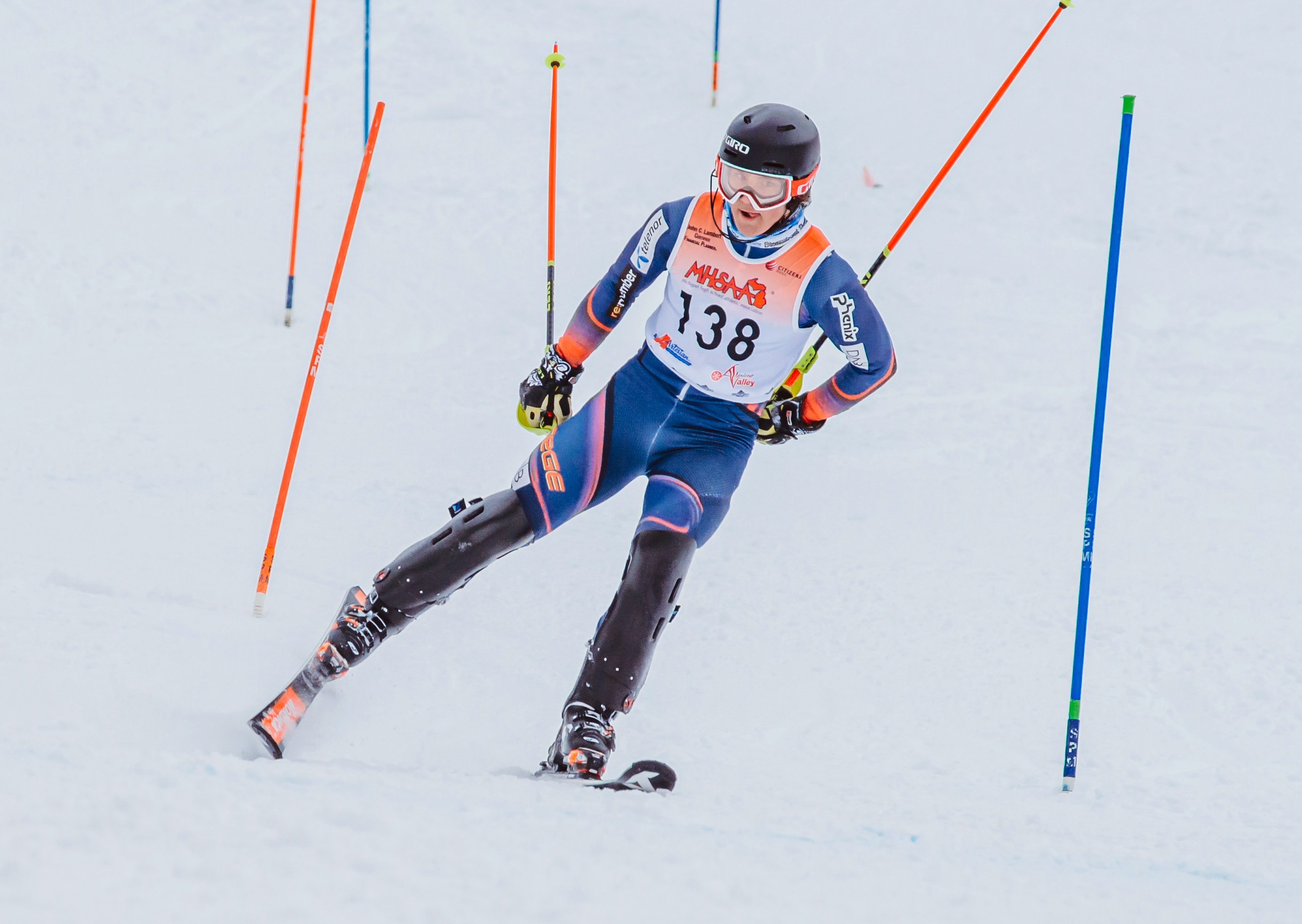
West junior Aiden Lewandowski won the giant slalom by one tenth of a second over Nathan Dehart of Rochester Adams, posting the only sub-24-second GS time of the day in his second run. He trailed Dehart by 0.03 after the first.
The Titans' history-making championship is the first since the school split off from Traverse City Central in 1997. Ed Johnson, who coached West its first season in 1997, said finally getting that championship trophy was a huge relief, especially after three runner-up finishes, the most recent in 2019 behind Marquette.
"It means a lot. It means a lot for me," Johnson said. "I've been coaching at that school since the school was opened. So it's incredible just to see it finally happen. We've had a number of runner-ups over the years, so we were close, and we had other teams that could have done it as well but just didn't quite pull it together on that day. So it's just so nice to see it happen finally."
Marquette's run of eight straight Division 1 championships ended at Regionals, when the Redmen didn't qualify among the top three to move on to Monday's Finals. Since 1997 when TC West opened, the only schools that had won a D1 Finals title were Marquette (15 times), TC Central (four), Clarkston (one), Petoskey (two) and Bloomfield Hills Brother Rice (one).
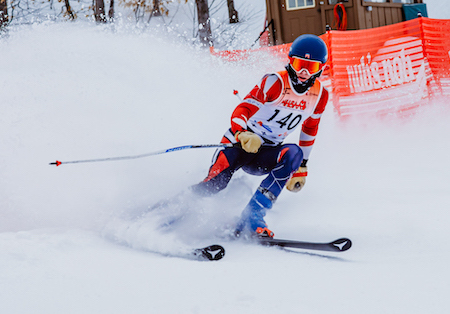 Hill was eighth after the first slalom run, then made up for that with the best time of all second runs at 34.53 seconds, 0.99 seconds better than eventual champ Hunter Halstead of Bloomfield Hills.
"The first one I felt really iffy," Hill said. "I just wasn't really mentally prepared. We were waiting at the top for a long time, so I kind of lost my focus. But the second run, I knew that I had to make up some time. So I just got in the zone and gave it all I had."
After Halstead and Hill in slalom were Adams' Zeke King in third, followed by Bloomfield Hills' Matthew Coates, Adams' Jacob Corsi, Traverse City Central’s Max Werner, West's Caleb Lewandowski, Wiersema, Adams' Charlie Buckmaster and Brighton's Andrew Myers.
Halstead placed third in GS, behind Aiden Lewandowski and Dehart. The rest of the top 10 was comprised of Clarkston's Andrew Roeser, Marquette's Logan Audette, Brighton's Luke Vaden, Wiersema, Bloomfield Hills' Bode Iuppenlatz, Hill and West’s Ben Lober.
Aiden Lewandowski finished 45th in slalom after hiking on both runs, but his GS championship helped give the Titans a nice cushion over Rochester Adams going into slalom.
"We were definitely concerned to have that happen on that first run of the afternoon, so that put the rest of our guys into a tough spot," Johnson said. "But they all work together and without Aidan's win in the morning, it wouldn't have happened either. So everybody did their thing today, did what they had to do so."
While Lewandowski didn't place in slalom, the family still did. His younger brother Caleb took seventh as a freshman.
"It's just amazing how much we can do when we put everything together," Hill said. "We're all super strong individuals, but when we put ourselves together we make something that's like unbreakable. We will be back in full force next year."
West was the only team with more than two competitors in the GS top 10, boasting four.
"First run of GS, we all score within the top 10," Hill said. "And we're like, 'If we do this, we can really do it,' and then GS ends and we had four in the top 10. We knew from there that as long as we make it down with relatively good times, we will win.
“But then slalom was a bit of a scare; some of our top athletes fell. So then we all had to ski a little bit more conservatively and just make sure not to fall."
Maybe Nub's Nob itself served as a lift for the Titans, who had been strong all season. The green and gold lifts match the Titans’ colors and suited them well as a youthful West team reached new heights.
"It's so much fun to see these guys do this," Johnson said. "We knew we could do it at the beginning of the year. We just had to pull them together as a team and not just a bunch of individuals that were really good. That was our main focus all season was to ski as a team, perform as a team, and they stepped up to it. They stepped up in the middle of the season, and just kept carrying it all the way through."
PHOTOS: (Top) Traverse City West's Aiden Lewandowski navigates the course during Monday's Division 1 Finals at Nub's Nob. (Middle) Bloomfield Hills' Hunter Halstead claimed the slalom championship. (Click for more photos from Sports in Motion.)