


Classes Still Create Hoosier Hysteria
July 27, 2017
By Rob Kaminski
MHSAA benchmarks editor
This is the fourth part in a series on MHSAA tournament classification, past and present, that will be published over the next two weeks. This series originally ran in this spring's edition of MHSAA benchmarks.
Twenty years ago, Bloomington North High School won the Indiana High School Athletic Association boys basketball championship, defeating Delta 75-54 at the RCA Dome in Indianapolis.
The date, March 22, 1997, is at the same time revered and disdained by traditionalists in the state who saw it as the last schoolboy championship game the state would ever host.
That’s how devout the game of basketball, particularly interscholastic basketball, had become in the Hoosier state during the 87 years a state champion – one state champion, to be precise – was crowned.
Following that 1997 season, the IHSAA moved to a four-class system for its roundball tournaments, like so many of its state association counterparts had done years earlier.
It would be shocking to find more than a small percentage of current high school basketball players around the country unfamiliar with the iconic movie Hoosiers, even though the film is now more than 30 years old.
And, the storyline for that blockbuster unfolded more than 30 years prior to its release, when small-town, undermanned Milan High School defeated Muncie Central High School 32-30 in the 1954 IHSAA title game.
Perhaps it’s because of the David vs Goliath notion, or the fame of the movie that replaced Milan with the fictional Hickory and real-life star Bobby Plump with Hollywood hero Jimmy Chitwood, or the simple fact that Indiana had something other states didn’t.
Whatever the reason, plenty of opposition remains to this day to basketball classification in the state.
The fact is, the small rural schools were regularly being beaten handily by the much larger suburban and city schools as the tournament progressed each season.
Small schools also were closing at a rapid rate following the state’s School Reorganization Act in 1959, as students converged on larger, centralized county schools. From 1960 to 2000, the number of schools entering the tournament dropped from 694 to 381, and in 1997 a total of 382 schools and 4,584 athletes began competition at the Sectional level (the first level of the IHSAA Basketball Tournament).
It was at the entry level of the tournament where school administrators felt the pain of the new class system, but not necessarily for the same nostalgic reasons as the fans who either attended or boycotted the tournament.
At the Sectional round of the tournament, the IHSAA was culling just 2 percent of the revenue, with the participating schools splitting the balance. So, when Sectional attendance dropped by 14 percent in that first year of class basketball, many schools realized a financial loss. It was money they had grown to count on in prior years to help fund various aspects of the department.
Schools cumulatively received more than $900,000 from Sectional competition in 1998, but that total was down from more than $1 million in the last year of the single-class tournament.
Yet, the current format provides a great deal more opportunity and realistic chances at championship runs for schools of all enrollments.
To date, 60 additional teams have championship or runner-up trophies on display in school trophy cases around Indiana.
That was the mission in front of then-IHSAA commissioner Bob Gardner (now National Federation executive director) once the board made its decision: to give thousands more student-athletes the opportunity for once-in-a-lifetime experiences.
As any statistician knows, figures can be manipulated to tell any side of a story. Declining attendance in year one of class basketball is such a number.
The truth is tournament attendance had been on a steady downward spiral since its peak of just over 1.5 million in 1962. By the last single-class event in 1997, the total attendance was half that.
The challenge then and today, as it is for all state associations, is to find that delicate balance for those holding onto tradition, those holding onto trophies, and the number of trophies to hand out.
Editor’s Note: Stories from the Fort Wayne Journal Gazette in 1998 and from a 2007 issue of Indianapolis Monthly provided facts in this article.

After Regional Run, Paw Paw Rolling Again
By
Pam Shebest
Special for MHSAA.com
February 17, 2021
PAW PAW — Ethan Van Der Slik has some definite goals in mind when it comes to bowling.
 The Paw Paw junior is aiming to break personal records set by his mentor and grandfather, Rich Van Der Slik.
“When I heard that I said, ‘Good for you. Beat this old man,” his grandpa said.
The younger bowler has plenty of time to catch up.
His grandfather started bowling at age 20, had his first of two 300s at age 51 and threw an 810 series at age 59.
So far, Ethan has one 700 series. But there are plenty of opportunities ahead – both for individual achievements and as part of a Paw Paw varsity with experience from last season and aspirations to finish this one even better.
Van Der Slik is the youngest on a senior-laden Paw Paw team that won its Regional last year and is 2-0 this young Southwest Michigan High School Bowling Conference season.
However, after dominating performances at the local level last year, the boys underwent an eye-opening experience at state competition.
Bowling was one of the few winter sports that actually competed through the Finals during the 2019-20 winter season, and the Red Wolves hope to build on that experience if they return to the MHSAA Division 3 Finals this March 26-27. At last year’s Finals, Paw Paw missed the team match play by 148 pins during qualifying despite showing potential with an 852 regular game and high Baker of 187.
“Competition is a lot harder outside our little town,” said Derek Ballard, one of five seniors on the team. “You can’t get nervous; you have to keep striking. You can’t get away from what you do just because you’re in a bigger town.
“The important thing is, if you’re nervous, you’re going to miss your mark. You’ve got to keep steady and if you keep steady, your shots are going to look good.”
Lifetime Sport
“I bowled for 44 years and quit when my shoulder said it didn’t want to do it anymore,” Rich Van Der Slik said. Now he spends his time at bowling centers working with his grandson.
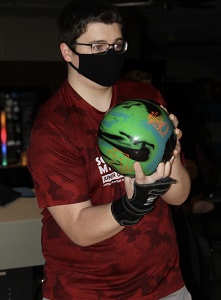 “He’s a good kid and very coachable,” Rich Van Der Slik said. “He listens and he tries.
“He’s thinking ahead. He knows when it’s time to make his ball changes.”
Trying to best his grandfather “pushes me to be better,” said Van Der Slik, who has a few warmup routines before his Saturday high school matches.
He and his grandfather go to breakfast, then he shoots splits and strikes at Continental Lanes when the high school match is not there.
Although baseball is his other sport, Van Der Slik also throws a football before matches, an exercise he learned from Scott Brunner, who has the pro shop at Continental.
“It helps me get my hand through the (bowling) ball better; shows me the spin,” Van Der Slik said.
Paw Paw bowling brings together the Zolp family as well.
Boys coach Chuck Zolp is in his 22nd season. His daughter, Jessica, coaches the girls and “I’ve been working (at Rainbow Lanes) since 1972 and bought the place in 1979,” Zolp said.
That is a big advantage for both teams since they do not have to worry about scheduling practice time. While the Red Wolves boys are an experienced contender, they are relying on a new anchor, Ballard, after the team graduated Michael Hiestand last spring.
Hiestand was the team’s top singles roller at last year’s Regional, just missing the Finals with a 13th place. Van Der Slik was 24th and Ballard 25th.
“(Derek) helps with the rest of the team, coaches them in-between matches and in practice,” said Chuck Zolp, in his 22nd year coaching the team. “He’s very consistent. He brings a lot to the team.”
The other seniors on the team are Peyton Long, Zach Dooley, Christian Johnson and Vaughn Stiglich. Long, Dooley and Stiglich all bowled during last season’s Singles Regional as well.
 Although he has not thrown a 700 series yet, Ballard’s top score is 277.
He started bowling at a young age.
“There was a youth sign up out here (at Rainbow) and I asked my dad (Doug) if I could join and I never stopped,” he said.
Making Adjustments
The biggest differences for bowlers this year are wearing masks and having no spectators. However, MHSAA guidelines allow them to drop the masks at the approach.
“It’s kind of hot after a few games, but it’s not bad,” Ballard said. “We can take it down on the approach, but I usually don’t because it’s annoying to pull it down. I have no problem with it.”
Van Der Slik, who also has no problem with the mask, is aware of his role on the team.
“Being the young guy, I’m going to be the only one here next year so I’ve got to do what I can to make the team better,” he said.
“I see myself as almost the middle man, trying to keep everyone happy and doing the best I can.”
The lack of spectators also does not bother Van Der Slik at all.
“It’s actually not as bad as you would think because I’m a very loud person,” he said. “Everyone hearing me, it’s definitely a scary thing for them but fun for us.”
 Pam Shebest served as a sportswriter at the Kalamazoo Gazette from 1985-2009 after 11 years part-time with the Gazette while teaching French and English at White Pigeon High School. She can be reached at [email protected] with story ideas for Calhoun, Kalamazoo and Van Buren counties.
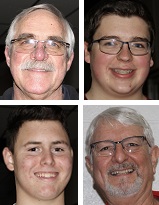
PHOTOS: (Top) Paw Paw’s Ethan Van Der Slik begins his approach during a recent practice. (Middle) Senior Derek Ballard lines up his next shot. (Below) Clockwise from top left: Red Wolves boys bowling coach Chuck Zolp, Ballard, Rich Van Der Slik and Ethan Van Der Slik. (Photos by Pam Shebest.)