


Classes Still Create Hoosier Hysteria
July 27, 2017
By Rob Kaminski
MHSAA benchmarks editor
This is the fourth part in a series on MHSAA tournament classification, past and present, that will be published over the next two weeks. This series originally ran in this spring's edition of MHSAA benchmarks.
Twenty years ago, Bloomington North High School won the Indiana High School Athletic Association boys basketball championship, defeating Delta 75-54 at the RCA Dome in Indianapolis.
The date, March 22, 1997, is at the same time revered and disdained by traditionalists in the state who saw it as the last schoolboy championship game the state would ever host.
That’s how devout the game of basketball, particularly interscholastic basketball, had become in the Hoosier state during the 87 years a state champion – one state champion, to be precise – was crowned.
Following that 1997 season, the IHSAA moved to a four-class system for its roundball tournaments, like so many of its state association counterparts had done years earlier.
It would be shocking to find more than a small percentage of current high school basketball players around the country unfamiliar with the iconic movie Hoosiers, even though the film is now more than 30 years old.
And, the storyline for that blockbuster unfolded more than 30 years prior to its release, when small-town, undermanned Milan High School defeated Muncie Central High School 32-30 in the 1954 IHSAA title game.
Perhaps it’s because of the David vs Goliath notion, or the fame of the movie that replaced Milan with the fictional Hickory and real-life star Bobby Plump with Hollywood hero Jimmy Chitwood, or the simple fact that Indiana had something other states didn’t.
Whatever the reason, plenty of opposition remains to this day to basketball classification in the state.
The fact is, the small rural schools were regularly being beaten handily by the much larger suburban and city schools as the tournament progressed each season.
Small schools also were closing at a rapid rate following the state’s School Reorganization Act in 1959, as students converged on larger, centralized county schools. From 1960 to 2000, the number of schools entering the tournament dropped from 694 to 381, and in 1997 a total of 382 schools and 4,584 athletes began competition at the Sectional level (the first level of the IHSAA Basketball Tournament).
It was at the entry level of the tournament where school administrators felt the pain of the new class system, but not necessarily for the same nostalgic reasons as the fans who either attended or boycotted the tournament.
At the Sectional round of the tournament, the IHSAA was culling just 2 percent of the revenue, with the participating schools splitting the balance. So, when Sectional attendance dropped by 14 percent in that first year of class basketball, many schools realized a financial loss. It was money they had grown to count on in prior years to help fund various aspects of the department.
Schools cumulatively received more than $900,000 from Sectional competition in 1998, but that total was down from more than $1 million in the last year of the single-class tournament.
Yet, the current format provides a great deal more opportunity and realistic chances at championship runs for schools of all enrollments.
To date, 60 additional teams have championship or runner-up trophies on display in school trophy cases around Indiana.
That was the mission in front of then-IHSAA commissioner Bob Gardner (now National Federation executive director) once the board made its decision: to give thousands more student-athletes the opportunity for once-in-a-lifetime experiences.
As any statistician knows, figures can be manipulated to tell any side of a story. Declining attendance in year one of class basketball is such a number.
The truth is tournament attendance had been on a steady downward spiral since its peak of just over 1.5 million in 1962. By the last single-class event in 1997, the total attendance was half that.
The challenge then and today, as it is for all state associations, is to find that delicate balance for those holding onto tradition, those holding onto trophies, and the number of trophies to hand out.
Editor’s Note: Stories from the Fort Wayne Journal Gazette in 1998 and from a 2007 issue of Indianapolis Monthly provided facts in this article.
Macomb Bowling Over with Champions
By
Tom Markowski
Special for Second Half
February 11, 2021
Bowling coaches in Macomb County point to a number of factors to explain why high school programs in their county have been and remain so highly competitive.
 One is tradition – and another is the automotive industry.
Greg Villasurda is in his sixth season coaching the girls program at St. Clair Shores Lake Shore, and he’s worked for Chrysler Corporation for the past 25 years. A graduate of Clinton Township Clintondale, Villasurda has been a bowler since his youth – and he said where he grew up, there were bowling establishments seemingly on every corner.
“I could walk to my bowling alley,” he said. “There were so many good bowlers back then. When I grew up, we didn’t have competitive bowling. We bowled for recreation. Back then all the dads worked for the Big 3, and they all bowled. That’s what you did.”
The numbers tell the tale of how that bowling way of life has cultivated success at the local high school level.
It should be noted that teams in other areas, like Genesee, Oakland and Wayne counties, also have excelled in high school bowling over the last 15 seasons. But since 2005, teams from Macomb County have won nine MHSAA Division 1 Finals titles (five boys, four girls) and finished second seven times (four for the boys, three for the girls).
Bowling is a sport the entire family can enjoy together and, in an odd way, this is how Villasurda became involved with coaching. His daughter Taylor was a freshman at Lake Shore in 2013 when she tried out for volleyball but was cut.
“She was really upset she didn’t make (the volleyball team),” Villasurda said. “She came home and said one of her friends was on the bowling team and (that) she wanted to bowl. I said, ‘What?’ She said yes and I said, well, let’s go. I bought her a ball, but it was just two weeks before tryouts. So we bowled every day to get her ready. She goes to try out and bowls a 216 and beat everybody. That opened up the floodgates.”
Taylor graduated from Lake Shore in 2017 and attends Siena Heights, where she competes on the bowling team.
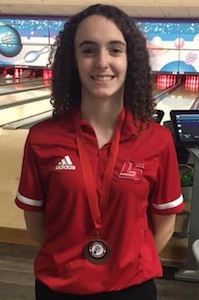
Last season, Villasurda had one of the state’s top bowlers and a title-contending team. Led by then-junior Dani Decruydt – the 2019 Division 1 singles runner-up – Lake Shore qualified for the Division 1 Team Final by placing third at its Regional, and the Shorians finished a respectable eighth at the championship tournament. Lake Shore was also co-champ (with Macomb Dakota) in the Macomb Area Conference Red. Lake Shore, the smallest school by enrollment in the Red, had won the division title outright in 2019 and was second in 2018, Decruydt’s freshman year.
Lake Shore is a good example of the overall strength of the programs Macomb County. A member of the MAC Gold in 2016, Lake Shore moved to the Red where perennially strong programs like Dakota and L’Anse Creuse North compete. The Shorians took their lumps that first season within the division, but has competed well since. With all but one starter returning this season, Lake Shore is expected to be in the mix again.
 Utica Eisenhower’s boys won their program’s first MHSAA Finals championship last season, as the Eagles came from behind in the final few frames to defeat Salem by five pins in the Division 1 championship match.
Eisenhower was a member of the MAC White last season and entered the MHSAA tournament ranked No. 1. Coach John Snider is in his seventh season this winter, and his experienced team is competing now in the MAC Red.
“The competition is extremely strong in the county,” Snider said. “The people I worked with in the MAC, the guys are so dedicated, so knowledgeable about the sport. They are good, solid, caring people. There are a lot of people committed to making this sport a success.”
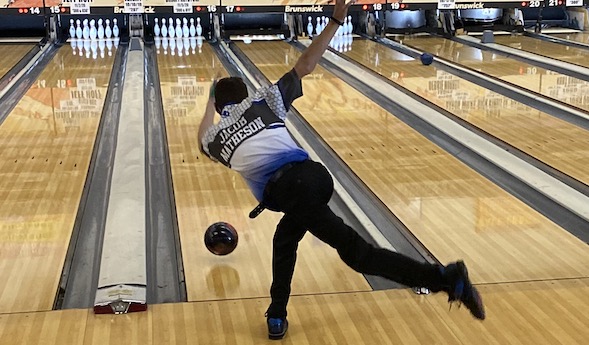
Eisenhower’s top bowler is Carter Milasinovich, one of five juniors returning. Milasinovich averaged in the mid-220s the past two seasons and is backed by fellow juniors Nolan Horne and Jacob Matheson, whose mother Lisa Matheson coaches the girls varsity team.
The bowling community is a tightly-knit group. Proprietors, according to Snider, have bent over backward in their attempts to serve the public at large and the students competing in the sport. Snider said practices have been all but eliminated because of COVID-19 restrictions on the hours bowling centers can be open and how many people proprietors can accommodate.
“I’m real proud of the organization and the people behind us,” Snider said. “It’s a labor of love for all of us.”
Snider has bowled nearly his entire life and, like many, got his start through his parents who also bowled. One reason he got into coaching was the opportunity he had to coach his son during his senior year.
Eisenhower had its share of success before last season, as the Eagles had won the MAC White three of the last four seasons. But 2020 was magical. Eisenhower won six tournaments before going to the Finals. The Eagles trailed Salem until the final frame before pulling out the title-clinching victory.
“We were down like 70 to 80 pins in the seventh,” Snider said. “We talked all year about being gentlemen and not giving up, and I was thinking about the speech I was going to give them after we lost. I’m glad I didn’t have to give it.”
Eisenhower opened this season Jan. 30 with a strong victory (18-12) over Sterling Heights Stevenson. Those two teams plus Dakota are expected to challenge for the division title.
Last season Dakota, the MHSAA Division 1 champion in 2011 and ’12, and L’Anse Creuse North – the Division 1 runner-up in 2016 – tied for the Red title just as they did in 2018. Dakota captured the division title outright in 2019.
Dakota was a Regional champion last season and the top seed going into the Finals Round of 16, but was defeated by Davison in the first match.
“It happens,” Dakota coach Jason Kavanagh said of the loss to Davison. “We had a great year. Heck, we had a Baker game of 300, and I’ve only seen that one other time in my five years of coaching.”
Dakota always seems to be in the mix when it comes to deciding the Division 1 champion, and with five seniors returning, including Gregory Guzik, this season should be no different. The school will sponsor three junior varsity teams, one more than last year.
“There’s a level we try to keep (at Dakota),” Kavanagh said. “We don’t want to be arrogant. We don’t need that. We want to be confident. We want to be the best team out on those lanes.”
Kavanagh points to the tradition at the school and in the community, as well as the sport being passed on from generation to generation as keys to bowling being so popular and thus, competitive, in the county.
“A lot of it has to do with their parents who are good bowlers,” he said. “And they’re having the kids come here and compete carrying on what they’ve done.
“Plus being in the MAC Red, the competition is so tough. The better the competition, the better you bowl.”
This bowling fever is not limited to the Red or the White divisions, nor is it just in the northern part of the county. Craig Geml is in his eighth season at Warren Woods Tower, a member of the MAC Gold. The last seven he’s coached both the boys and girls programs. Noah Tafanelli, a senior this season, won the MHSAA Division 2 individual title last season. Tafanelli’s sister, Kayla, was a freshman last season and advanced to the Division 2 singles semifinals.
Geml contends that much of the success programs like his and many in the county have achieved got its start on Detroit’s eastside. Geml grew up in the 7 Mile Road and Kelly Road area in Detroit, and attended Harper Woods Notre Dame, a school that bordered Detroit’s city limits. Geml won a number of amateur bowling tournaments before competing in the sport while attending Wayne State University.
“Bowling was a working-man’s game, a middle class sport, back then,” Geml said. “It’s what you did. I bowled at two different lanes back then in Detroit, and that’s what your friends did. It’s a family-oriented sport. It’s almost hereditary. It’s grown into your physique.”
As time progressed and families moved further north into Macomb County, they took the sport with them and introduced it to their children.
Geml’s teams have won eight MAC Gold titles (boys and girls combined) and he’s proud of the success they’ve earned. Both squads have four starters returning this winter. And although neither team reached the MHSAA Finals a year ago, Geml did have six of his bowlers (out of 10) qualify as individuals.
 Tom Markowski is a correspondent for the State Champs! Sports Network and previously directed its web coverage. He also covered primarily high school sports for the The Detroit News from 1984-2014, focusing on the Detroit area and contributing to statewide coverage of football and basketball. Contact him at [email protected] with story ideas for Oakland, Macomb and Wayne counties.
PHOTOS: (Top) Utica Eisenhower's Jacob Matheson follows through on a roll for the reigning Division 1 champion. (Middle) St. Clair Shores Lake Shore's Dani Decruydt was the Division 1 singles runner-up in 2019. (Photos courtesy of the Eisenhower and Lake Shore bowling programs, respectively.)