


Classes Still Create Hoosier Hysteria
July 27, 2017
By Rob Kaminski
MHSAA benchmarks editor
This is the fourth part in a series on MHSAA tournament classification, past and present, that will be published over the next two weeks. This series originally ran in this spring's edition of MHSAA benchmarks.
Twenty years ago, Bloomington North High School won the Indiana High School Athletic Association boys basketball championship, defeating Delta 75-54 at the RCA Dome in Indianapolis.
The date, March 22, 1997, is at the same time revered and disdained by traditionalists in the state who saw it as the last schoolboy championship game the state would ever host.
That’s how devout the game of basketball, particularly interscholastic basketball, had become in the Hoosier state during the 87 years a state champion – one state champion, to be precise – was crowned.
Following that 1997 season, the IHSAA moved to a four-class system for its roundball tournaments, like so many of its state association counterparts had done years earlier.
It would be shocking to find more than a small percentage of current high school basketball players around the country unfamiliar with the iconic movie Hoosiers, even though the film is now more than 30 years old.
And, the storyline for that blockbuster unfolded more than 30 years prior to its release, when small-town, undermanned Milan High School defeated Muncie Central High School 32-30 in the 1954 IHSAA title game.
Perhaps it’s because of the David vs Goliath notion, or the fame of the movie that replaced Milan with the fictional Hickory and real-life star Bobby Plump with Hollywood hero Jimmy Chitwood, or the simple fact that Indiana had something other states didn’t.
Whatever the reason, plenty of opposition remains to this day to basketball classification in the state.
The fact is, the small rural schools were regularly being beaten handily by the much larger suburban and city schools as the tournament progressed each season.
Small schools also were closing at a rapid rate following the state’s School Reorganization Act in 1959, as students converged on larger, centralized county schools. From 1960 to 2000, the number of schools entering the tournament dropped from 694 to 381, and in 1997 a total of 382 schools and 4,584 athletes began competition at the Sectional level (the first level of the IHSAA Basketball Tournament).
It was at the entry level of the tournament where school administrators felt the pain of the new class system, but not necessarily for the same nostalgic reasons as the fans who either attended or boycotted the tournament.
At the Sectional round of the tournament, the IHSAA was culling just 2 percent of the revenue, with the participating schools splitting the balance. So, when Sectional attendance dropped by 14 percent in that first year of class basketball, many schools realized a financial loss. It was money they had grown to count on in prior years to help fund various aspects of the department.
Schools cumulatively received more than $900,000 from Sectional competition in 1998, but that total was down from more than $1 million in the last year of the single-class tournament.
Yet, the current format provides a great deal more opportunity and realistic chances at championship runs for schools of all enrollments.
To date, 60 additional teams have championship or runner-up trophies on display in school trophy cases around Indiana.
That was the mission in front of then-IHSAA commissioner Bob Gardner (now National Federation executive director) once the board made its decision: to give thousands more student-athletes the opportunity for once-in-a-lifetime experiences.
As any statistician knows, figures can be manipulated to tell any side of a story. Declining attendance in year one of class basketball is such a number.
The truth is tournament attendance had been on a steady downward spiral since its peak of just over 1.5 million in 1962. By the last single-class event in 1997, the total attendance was half that.
The challenge then and today, as it is for all state associations, is to find that delicate balance for those holding onto tradition, those holding onto trophies, and the number of trophies to hand out.
Editor’s Note: Stories from the Fort Wayne Journal Gazette in 1998 and from a 2007 issue of Indianapolis Monthly provided facts in this article.
Amid Loss, Marian Closes Out Inspired Win
By
Paul Costanzo
Special for MHSAA.com
January 16, 2021
BATTLE CREEK – One of the great moments at the end of any MHSAA Final is the winning coach hoisting the trophy aloft and joining their players in celebration.
On Saturday, Bloomfield Hills Marian volleyball coach Mayssa Cook passed on that moment, and in the process made it even more special for all involved.
Cook handed the honor off to Jacqui Feldman, the daughter of Dave Feldman, the Marian athletic director who died Thursday after a long battle with COVID-19.
“It was so special,” Marian junior outside hitter Ava Brizard said. “Me, Sara Sylvester and Sophie Treder played with her our freshman year, so we know the Feldman family really well. It was so devastating to hear that he passed away the night before we were supposed to go to Battle Creek, because he was just as competitive as we were the whole season. He loved volleyball so much, and we know that. It was just kind of more fuel to our fire to win a state championship, as if we didn’t have enough already, to win it for him and win it for her. It was just so special for her to give us that trophy, because we were like, ‘We did it for your dad.’”
The players had Feldman in their hearts as they defeated Lowell 25-17, 25-20, 25-19 in the Division 1 Final at Kellogg Arena. It’s the Mustangs’ third title, and first since 2010.
“I think this whole season, it was just about resilience,” Brizard said. “Starting off in August, we didn’t get to start right away and we had to practice in the muddy water on the beach and the grass. We just dealt with all the punches that came our way this season, so to finally get here to Battle Creek and win the whole thing and play the way we did out there and play so amazing, it feels like all of our hard work paid off. Especially with Mr. Feldman passing, we feel so grateful that we can win it for him, and we know he’s definitely smiling and jumping around up in heaven, cheering us on.”
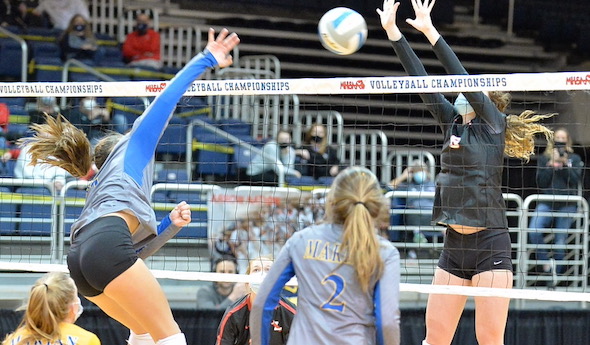
Marian (35-5) was solid in all phases, but Brizard’s dominance at the net was too much for Lowell to contain. She finished with 29 kills compared to just four errors on 52 attacks. Her last three kills provided the final three points of the match.
 “We do call her our finisher, our closer,” Cook said. “It’s one of those things they know that if she’s in the front row, we’re going to fight to keep her in the front row. Obviously, we have capable hitters all around. It’s nice, because she’s probably hitting close to .500 on the season, so at the end of the day, the odds are that one out of two balls is likely to be a kill. Let’s just play those odds.”
Brizard was fed by Ava Sarafa, who finished the match with 39 assists. Ella Schomer added eight kills and 11 digs for the Mustangs, while Lauren Heming had 15 digs.
Marian’s entire roster is eligible to come back next season, and while that’s nice to think about now, it was something that drove Cook and her team all season.
“A reporter was already talking about next year, and I said, ‘I don’t know why you’re talking about next year. This year’s not over, and we have a mission, we have a goal,’” Cook said. “I went back to the team and said, ‘This is what this reporter said, can you believe it?’ We grab little things as coaches, and we use it as fuel to push them to go beyond their comfort zone.”
Lowell (35-5) was led by Jenna Reitsma, who had 22 kills, while Emily Struckmeyer had 10. Sophie Powell finished with 32 assists, and Emma Hall had 17 digs.
“(Reitsma) is phenomenal; she’s special,” Lowell coach Jordan Drake said. “I don’t know if I’ll ever coach a hitter like her again. She’s the best of the best. At the same time, she doesn’t get the kills she does without a good pass. She doesn’t get the kills she does without a good set. These three (seniors Reitsma, Powell and Hall) are like sisters, and it’s not just Jenna, it’s the whole team.”
It was the second straight Finals appearance for Lowell, and while neither ended with a title, that success has elevated the program to a new level.
“It’s just really cool to see the support from our community,” Reitsma said. “And all of the younger girls that we can have an impression on, and see how they grow up to be, and just how they watch us. It’s going to be amazing to come back and watch the program over the years to see what an impact we had, because all the little girls out there that watch us play have big dreams to do what we do, too. It’s really cool, and I’m hoping they can keep that legacy going.”
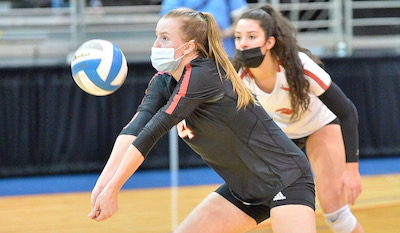
PHOTOS: (Top) Bloomfield Hills Marian’s Ava Brizard sends a kill attempt during Saturday’s Division 1 Final. (Middle) Lowell’s Jenna Reitsma controls possession. (Click for more from Hockey Weekly Action Photos.)