


Classes Still Create Hoosier Hysteria
July 27, 2017
By Rob Kaminski
MHSAA benchmarks editor
This is the fourth part in a series on MHSAA tournament classification, past and present, that will be published over the next two weeks. This series originally ran in this spring's edition of MHSAA benchmarks.
Twenty years ago, Bloomington North High School won the Indiana High School Athletic Association boys basketball championship, defeating Delta 75-54 at the RCA Dome in Indianapolis.
The date, March 22, 1997, is at the same time revered and disdained by traditionalists in the state who saw it as the last schoolboy championship game the state would ever host.
That’s how devout the game of basketball, particularly interscholastic basketball, had become in the Hoosier state during the 87 years a state champion – one state champion, to be precise – was crowned.
Following that 1997 season, the IHSAA moved to a four-class system for its roundball tournaments, like so many of its state association counterparts had done years earlier.
It would be shocking to find more than a small percentage of current high school basketball players around the country unfamiliar with the iconic movie Hoosiers, even though the film is now more than 30 years old.
And, the storyline for that blockbuster unfolded more than 30 years prior to its release, when small-town, undermanned Milan High School defeated Muncie Central High School 32-30 in the 1954 IHSAA title game.
Perhaps it’s because of the David vs Goliath notion, or the fame of the movie that replaced Milan with the fictional Hickory and real-life star Bobby Plump with Hollywood hero Jimmy Chitwood, or the simple fact that Indiana had something other states didn’t.
Whatever the reason, plenty of opposition remains to this day to basketball classification in the state.
The fact is, the small rural schools were regularly being beaten handily by the much larger suburban and city schools as the tournament progressed each season.
Small schools also were closing at a rapid rate following the state’s School Reorganization Act in 1959, as students converged on larger, centralized county schools. From 1960 to 2000, the number of schools entering the tournament dropped from 694 to 381, and in 1997 a total of 382 schools and 4,584 athletes began competition at the Sectional level (the first level of the IHSAA Basketball Tournament).
It was at the entry level of the tournament where school administrators felt the pain of the new class system, but not necessarily for the same nostalgic reasons as the fans who either attended or boycotted the tournament.
At the Sectional round of the tournament, the IHSAA was culling just 2 percent of the revenue, with the participating schools splitting the balance. So, when Sectional attendance dropped by 14 percent in that first year of class basketball, many schools realized a financial loss. It was money they had grown to count on in prior years to help fund various aspects of the department.
Schools cumulatively received more than $900,000 from Sectional competition in 1998, but that total was down from more than $1 million in the last year of the single-class tournament.
Yet, the current format provides a great deal more opportunity and realistic chances at championship runs for schools of all enrollments.
To date, 60 additional teams have championship or runner-up trophies on display in school trophy cases around Indiana.
That was the mission in front of then-IHSAA commissioner Bob Gardner (now National Federation executive director) once the board made its decision: to give thousands more student-athletes the opportunity for once-in-a-lifetime experiences.
As any statistician knows, figures can be manipulated to tell any side of a story. Declining attendance in year one of class basketball is such a number.
The truth is tournament attendance had been on a steady downward spiral since its peak of just over 1.5 million in 1962. By the last single-class event in 1997, the total attendance was half that.
The challenge then and today, as it is for all state associations, is to find that delicate balance for those holding onto tradition, those holding onto trophies, and the number of trophies to hand out.
Editor’s Note: Stories from the Fort Wayne Journal Gazette in 1998 and from a 2007 issue of Indianapolis Monthly provided facts in this article.
Moment: Streak-Ender Highlights 1st Finals
December 11, 2020
By John Johnson
MHSAA Director of Broadcast Properties
It’s been 45 years since the first MHSAA Football Playoffs took place, a two-week, 16-team tournament with the top teams of each of four regions in all four classes finally settling gridiron championships on the playing field.
In that first year, cries of “U.P. Power” thundered through the stands at Waldo Stadium in Kalamazoo and the new Perry Shorts Stadium in Mt. Pleasant as Crystal Falls Forest Park and Ishpeming claimed the 1975 titles in Classes D and C respectively. Bill Santilli ran wild for 179 yards on 37 carries and three touchdowns as the Trojans manhandled Flint Holy Rosary, 50-0, in the Class D game. But the Class C affair was one for the ages - perhaps the biggest upset in the history of the finals.
It was billed as David and Goliath. The mighty Hudson Tigers roared north to Mt. Pleasant riding a 72-game winning streak, which would stand as a national record until 1992; and is still a state record, only threatened once by a 69-game skein by Ithaca which ended in the 2014 Finals. Hudson had also laid claim to mythical state titles in Class C the three previous seasons. Ishpeming’s pedigree dated back to 1900, when it won the first of three straight - and of four in a five-year period - state titles in a championship conducted at and by the University of Michigan, primarily for the purpose of recruiting for Fritz Crisler’s Wolverines football program. The Hematites, having their best season in 15 years, had even lost a regular-season game along the way to a 9-0 Marquette squad that didn’t qualify for the playoffs.
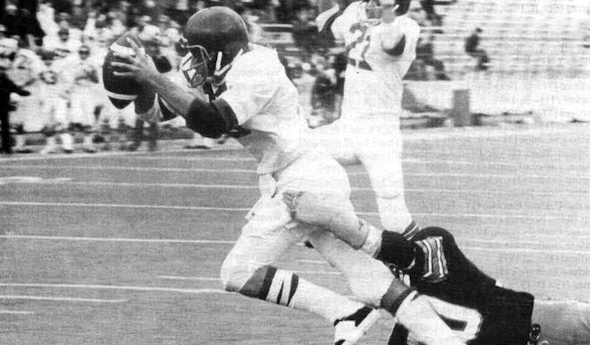
On a cold, windy day at Central Michigan University, Ishpeming struck first and struck hard. Four minutes into the game, Tom Andriacchi blocked a Hudson punt and returned it to the Tigers' 10-yard line. Four plays later, quarterback Mark Marana kept the ball on the option and scored from two yards out. On its next possession just midway through the first period, the Hematites ripped off a 61-yard drive capped by a three-yard scoring run by Dave Farragh, and Ishpeming was up 16-0.
Hudson rallied following the ensuing kickoff with its first score, a 28-yard pass from Chris Luma to Dan Salamin, but the Hematites came right back with their third score of the opening frame, a 60-yard run by Mike Dellangelo to give Ishpeming all the points it would need.
The two teams traded scores in the second period, when Hudson then missed a golden opportunity to tighten things up just before halftime, fumbling at the Hematites' 2-yard line and with Ishpeming recovering for a touchback.
Dellangelo picked up a second TD in the third quarter, and finished the game with 156 of Ishpeming’s 336 rushing yards in the 38-22 victory.
“It wasn’t hard getting our guys up for the game,” Hematites coach Mike Mileski told Central Michigan Life after the game. “The emotion factor was a ready-made thing considering Hudson’s streak …”
Our action footage this week comes courtesy of Brian Sarvello, a member of that 1975 Ishpeming team. About 17 minutes film from that game was assembled with some of the local radio station call into a DVD that was shared with the team several years ago. We found it in a random internet search for this most recent series of MHSAA Moments, and appreciate Mr. Sarvello’s help in bringing it to you.
If you know of championship game footage from those pre-television years (1975-88) of the MHSAA Football Finals, we’d love to hear about it. Drop us a line at [email protected].
PHOTO: Ishpeming's Mark Marana works to break away from a tackler during the 1975 Class C Final. (MHSAA file photo).