


Classes Still Create Hoosier Hysteria
July 27, 2017
By Rob Kaminski
MHSAA benchmarks editor
This is the fourth part in a series on MHSAA tournament classification, past and present, that will be published over the next two weeks. This series originally ran in this spring's edition of MHSAA benchmarks.
Twenty years ago, Bloomington North High School won the Indiana High School Athletic Association boys basketball championship, defeating Delta 75-54 at the RCA Dome in Indianapolis.
The date, March 22, 1997, is at the same time revered and disdained by traditionalists in the state who saw it as the last schoolboy championship game the state would ever host.
That’s how devout the game of basketball, particularly interscholastic basketball, had become in the Hoosier state during the 87 years a state champion – one state champion, to be precise – was crowned.
Following that 1997 season, the IHSAA moved to a four-class system for its roundball tournaments, like so many of its state association counterparts had done years earlier.
It would be shocking to find more than a small percentage of current high school basketball players around the country unfamiliar with the iconic movie Hoosiers, even though the film is now more than 30 years old.
And, the storyline for that blockbuster unfolded more than 30 years prior to its release, when small-town, undermanned Milan High School defeated Muncie Central High School 32-30 in the 1954 IHSAA title game.
Perhaps it’s because of the David vs Goliath notion, or the fame of the movie that replaced Milan with the fictional Hickory and real-life star Bobby Plump with Hollywood hero Jimmy Chitwood, or the simple fact that Indiana had something other states didn’t.
Whatever the reason, plenty of opposition remains to this day to basketball classification in the state.
The fact is, the small rural schools were regularly being beaten handily by the much larger suburban and city schools as the tournament progressed each season.
Small schools also were closing at a rapid rate following the state’s School Reorganization Act in 1959, as students converged on larger, centralized county schools. From 1960 to 2000, the number of schools entering the tournament dropped from 694 to 381, and in 1997 a total of 382 schools and 4,584 athletes began competition at the Sectional level (the first level of the IHSAA Basketball Tournament).
It was at the entry level of the tournament where school administrators felt the pain of the new class system, but not necessarily for the same nostalgic reasons as the fans who either attended or boycotted the tournament.
At the Sectional round of the tournament, the IHSAA was culling just 2 percent of the revenue, with the participating schools splitting the balance. So, when Sectional attendance dropped by 14 percent in that first year of class basketball, many schools realized a financial loss. It was money they had grown to count on in prior years to help fund various aspects of the department.
Schools cumulatively received more than $900,000 from Sectional competition in 1998, but that total was down from more than $1 million in the last year of the single-class tournament.
Yet, the current format provides a great deal more opportunity and realistic chances at championship runs for schools of all enrollments.
To date, 60 additional teams have championship or runner-up trophies on display in school trophy cases around Indiana.
That was the mission in front of then-IHSAA commissioner Bob Gardner (now National Federation executive director) once the board made its decision: to give thousands more student-athletes the opportunity for once-in-a-lifetime experiences.
As any statistician knows, figures can be manipulated to tell any side of a story. Declining attendance in year one of class basketball is such a number.
The truth is tournament attendance had been on a steady downward spiral since its peak of just over 1.5 million in 1962. By the last single-class event in 1997, the total attendance was half that.
The challenge then and today, as it is for all state associations, is to find that delicate balance for those holding onto tradition, those holding onto trophies, and the number of trophies to hand out.
Editor’s Note: Stories from the Fort Wayne Journal Gazette in 1998 and from a 2007 issue of Indianapolis Monthly provided facts in this article.
Whymer Made Blue Water Moments into Memories
By
Paul Costanzo
Special for MHSAA.com
September 29, 2020
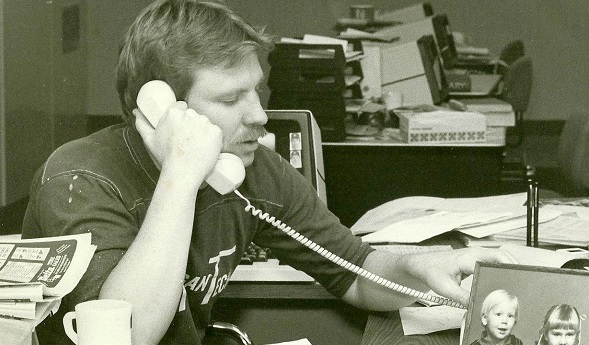
 When considering all the reasons Jim Whymer was a beloved and Hall of Fame sportswriter in the Thumb area, one stands out above the rest – he cared.
He cared about the quality of the sports section at the Times Herald in Port Huron. He cared about making sure the impossible task of covering schools and sports as equally as possible was accomplished. And he cared about what the newspaper meant to the community.
But most of all, he cared about the people he was writing about.
“He wasn’t going in it just to get a story – he cared about people,” said Shawn Sharrow, a 1994 Marine City graduate who coached basketball at Marine City and St. Clair. “He cared about relationships. As much as he liked sports, he liked people and building those relationships over the years. After he did an interview with you, he would stand there and talk with you for another half hour. He just wanted to develop those friendships.”
Whymer, who worked at the Times Herald from 1978 through 2012, died this past Thursday of metastatic melanoma. He was 64.
He is survived by his wife, Patty, his children Traci Whymer (Tyson Connolly), Kyle (Amanda) Whymer and Joel (Rachel) Whymer, and his grandson, Finn; and by his mother Teresa, sister Michele Seif and brother Bill (Pattie).
He also is survived by the countless yellowing press clippings with his byline that can be found in hundreds of scrapbooks throughout homes in the Blue Water Area. Clippings that no doubt made special memories that much more special for those holding onto them.
 “I think like no other person I’ve been around, he made kids feel special,” Port Huron Northern boys basketball coach Brian Jamison said. “He had an amazing ability to make kids feel special. It was in his articles and how long he would take to talk to a kid. He would know the kid’s uncle and their cousin, and he would talk to them about that. I think kids genuinely felt better after talking to him.”
Whymer won several awards for his journalism, including a spot in the Basketball Coaches Association of Michigan Hall of Honor and the Port Huron Sports Hall of Fame.
Good luck finding those awards displayed anywhere, though. Whymer was more interested in making sure the athletes and coaches were getting proper recognition.
“He was really thorough and really interested in what we were doing, even in little old Deckerville when he had Port Huron and Port Huron Northern in his backyard,” Deckerville football coach Bill Brown said. “He’d come up to Deckerville, he’d even go to playoff games – we'd play across the state and he was there. Then after the game, he would just ask you respectful questions. It’s just too bad, because he’s definitely going to be missed. Everybody looked forward to seeing him. He was more than welcome here; he probably could have stayed overnight at someone’s house if he needed to.”
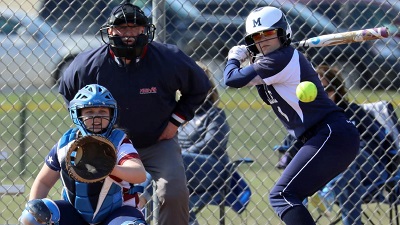
Brown, Jamison and Sharrow had interactions with Whymer as players and coaches. Brown also got to see Whymer as an official, as Whymer worked for more than three decades officiating basketball, baseball, softball and football games throughout the area.
“You can’t even get mad at the guy because he’s such a good guy,” Brown said with a laugh. “He was always square with you.”
Jamison also coached both of Whymer’s sons, and currently has Kyle as his junior varsity basketball coach at Northern. All of the Whymer children played sports at Northern, with Traci being part of an MHSAA title-winning tennis team and Joel setting records on the basketball court and earning a scholarship at Lake Superior State University. (He would later transfer to Grand Valley State.)
 “Jim’s always been more like family to me,” Jamison said. “I think everyone feels that way about him. He’s like your fun uncle that you love to talk to. Jim always did a nice job of keeping the story separate from him being the dad. In that respect, he made it easy on me. He was very, very supportive of his children. That’s something – as special as other people felt – that guy was truly all in for all three of his kids when it came to sports and school. I think he was an ultra-professional, and he didn’t want to overwrite about his kids.”
After leaving the Times Herald, Whymer began working in the athletic department at St. Clair County Community College, where he continued his quest to make things as special as possible for student athletes. His main duties included scheduling high school and middle school events at the college’s Fieldhouse – whether it be smaller local tournaments or a multi-day holiday basketball showcase that grew to more than 40 teams.
The Fieldhouse can fit more than 2,000 spectators, and Sharrow said if not for restrictions because of COVID-19, a memorial service for Whymer could fill it. That’s likely not an exaggeration.
“He might be showing up at your practice in the last 10 or 15 minutes, and he always walked in the gym with a smile on his face,” Sharrow said. “If he was ever having a bad day, you’d never know it. He made athletes feel important. Even watching him as a coach talking to my players, you could see their faces light up that they were going to be in the paper and that Jim Whymer wanted to talk to them.”
 Paul Costanzo served as a sportswriter at The Port Huron Times Herald from 2006-15, including three years as lead sportswriter, and prior to that as sports editor at the Hillsdale Daily News from 2005-06. He can be reached at [email protected] with story ideas for Genesee, Lapeer, St. Clair, Sanilac, Huron, Tuscola, Saginaw, Bay, Arenac, Midland and Gladwin counties.
PHOTOS: (Top) Longtime sportswriter Jim Whymer works the phones during his time at the Port Huron Times Herald. (Middle) Whymer also was an MHSAA-registered official for 35 years. (Below) Whymer is survived by his wife Patty and their three children. (Photos courtesy of the Whymer family.)