


Classes Still Create Hoosier Hysteria
July 27, 2017
By Rob Kaminski
MHSAA benchmarks editor
This is the fourth part in a series on MHSAA tournament classification, past and present, that will be published over the next two weeks. This series originally ran in this spring's edition of MHSAA benchmarks.
Twenty years ago, Bloomington North High School won the Indiana High School Athletic Association boys basketball championship, defeating Delta 75-54 at the RCA Dome in Indianapolis.
The date, March 22, 1997, is at the same time revered and disdained by traditionalists in the state who saw it as the last schoolboy championship game the state would ever host.
That’s how devout the game of basketball, particularly interscholastic basketball, had become in the Hoosier state during the 87 years a state champion – one state champion, to be precise – was crowned.
Following that 1997 season, the IHSAA moved to a four-class system for its roundball tournaments, like so many of its state association counterparts had done years earlier.
It would be shocking to find more than a small percentage of current high school basketball players around the country unfamiliar with the iconic movie Hoosiers, even though the film is now more than 30 years old.
And, the storyline for that blockbuster unfolded more than 30 years prior to its release, when small-town, undermanned Milan High School defeated Muncie Central High School 32-30 in the 1954 IHSAA title game.
Perhaps it’s because of the David vs Goliath notion, or the fame of the movie that replaced Milan with the fictional Hickory and real-life star Bobby Plump with Hollywood hero Jimmy Chitwood, or the simple fact that Indiana had something other states didn’t.
Whatever the reason, plenty of opposition remains to this day to basketball classification in the state.
The fact is, the small rural schools were regularly being beaten handily by the much larger suburban and city schools as the tournament progressed each season.
Small schools also were closing at a rapid rate following the state’s School Reorganization Act in 1959, as students converged on larger, centralized county schools. From 1960 to 2000, the number of schools entering the tournament dropped from 694 to 381, and in 1997 a total of 382 schools and 4,584 athletes began competition at the Sectional level (the first level of the IHSAA Basketball Tournament).
It was at the entry level of the tournament where school administrators felt the pain of the new class system, but not necessarily for the same nostalgic reasons as the fans who either attended or boycotted the tournament.
At the Sectional round of the tournament, the IHSAA was culling just 2 percent of the revenue, with the participating schools splitting the balance. So, when Sectional attendance dropped by 14 percent in that first year of class basketball, many schools realized a financial loss. It was money they had grown to count on in prior years to help fund various aspects of the department.
Schools cumulatively received more than $900,000 from Sectional competition in 1998, but that total was down from more than $1 million in the last year of the single-class tournament.
Yet, the current format provides a great deal more opportunity and realistic chances at championship runs for schools of all enrollments.
To date, 60 additional teams have championship or runner-up trophies on display in school trophy cases around Indiana.
That was the mission in front of then-IHSAA commissioner Bob Gardner (now National Federation executive director) once the board made its decision: to give thousands more student-athletes the opportunity for once-in-a-lifetime experiences.
As any statistician knows, figures can be manipulated to tell any side of a story. Declining attendance in year one of class basketball is such a number.
The truth is tournament attendance had been on a steady downward spiral since its peak of just over 1.5 million in 1962. By the last single-class event in 1997, the total attendance was half that.
The challenge then and today, as it is for all state associations, is to find that delicate balance for those holding onto tradition, those holding onto trophies, and the number of trophies to hand out.
Editor’s Note: Stories from the Fort Wayne Journal Gazette in 1998 and from a 2007 issue of Indianapolis Monthly provided facts in this article.
Familiar Name Home Again for Mona Shores
September 23, 2020
By Tom Kendra
Special for Second Half
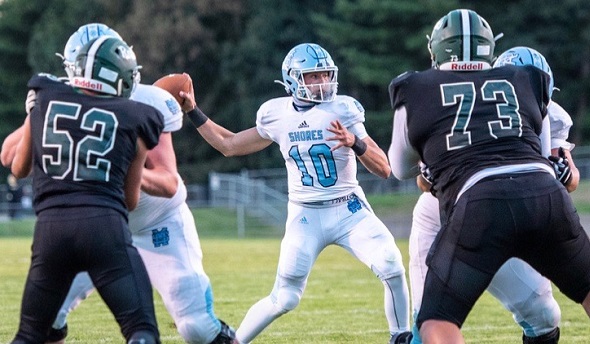
One of the biggest names in Muskegon Mona Shores football history is back at quarterback – after a 40-year hiatus.
 Mark Konecny, who went on to Alma College and then became the first Michigan Intercollegiate Athletic Association player to make it to the NFL, moved back home from Colorado in 2017. Now it’s his son (same name) who is connecting with receivers for the reigning Division 2 champion Sailors.
“It’s kind of cool to be here playing on the same field and practicing on the same field as him,” said Konecny, a 6-foot, 190-pound junior who wears No. 10, while his dad wore No. 11 at Shores. “I came here for a veer camp in the summer before my 8th-grade year and I liked Coach Koziak and the kids and thought it would be a good fit for me, and it has been.”
Konecny is the backup to senior Brady Rose (5-7, 172), a state Player of the Year candidate who powered the Sailors to a 35-26 upset of Detroit Martin Luther King in last year’s MHSAA Division 2 Final. But that doesn’t mean Konecny won’t play a key role in Friday’s showdown at crosstown rival Muskegon High.
Konecny threw a pair of first-half touchdown passes Friday as Shores picked up right where it left off with a 55-0 pounding of Muskegon Reeths-Puffer in an Ottawa-Kent Conference Green game.
While the explosive Rose is a magician running the veer offense, Koziak said having a backup like Konecny with a rocket arm adds another dimension to the attack.
“We want to get our best players on the field, but there can only be one quarterback, so it’s kind of a problem,” said Koziak, who led Mona Shores to its first-ever playoff berth in 2013 and then to the Finals three times in the past six years. “Brady is an amazing leader and high school football player, while Mark is more of a prototypical QB who can really spin it. So we’ll try to find unique ways to get them on the field at the same time.”
One of those unique ways came in the first quarter Friday, when Konecny lined up as a slot receiver and received a backwards toss from Rose. Konecny then fired his first-ever varsity pass, which a wide-open Elijah Farnum took 59 yards for a touchdown.
On the next possession, Konecny took over at quarterback and Rose moved to the slot, the position he played last year before stepping in for injured starting quarterback Caden Broersma early in the Semifinal against Walled Lake Western. With the Puffer defense focused on Rose, Konecny gunned a four-yard scoring pass to a sliding Keondre Pierce on a seam route.
 The two-quarterback attack might be required Friday at Muskegon, as Shores managed just 15 rushing yards and three first downs in last year’s humbling 53-0 loss to the Big Reds.
Muskegon holds a 32-7 all-time edge over Mona Shores, and had won 14 in a row before the Sailors broke through with back-to-back regular-season wins in 2014 and 2015. The Big Reds have since won five straight in the series, including a playoff victory in 2015.
Friday’s game will be the first on the new synthetic field turf at renovated Hackley Stadium, where the Big Reds have been playing since 1927.
Muskegon coach Shane Fairfield hinted before Monday’s practice that the Big Reds could also use multiple quarterbacks in Friday’s game. Projected starter Amari Crowley did not play in Muskegon’s 59-14 opening win at Holland, but is expected to be back Friday. Junior Myles Walton stepped in last week and rushed for 133 yards and completed 4-of-5 passes for 52 yards.
Konecny’s dad remembers classic battles against Muskegon back during his era, and leading the Sailors to a 20-7 win over Muskegon his senior year in 1980 before suffering a season-ending broken collarbone the following week at Traverse City.
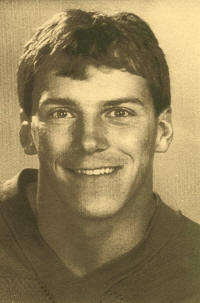
He was converted to running back at Alma College, where he became the first in school history to rush for more than 1,000 yards in a season with 1,059 in 1984 in earning all-MIAA honors. He played two years in the Canadian Football League, before realizing his dream of playing in the NFL in 1987 with the Miami Dolphins.
Konecny’s best NFL season came with the Philadelphia Eagles in 1988, when he returned 17 kickoffs for 276 yards and 32 punts for 226 yards.
After football, he worked as a fireman in Littleton, Colo., for 25 years, but fate led him back home to Mona Shores when Koziak invited him to speak at a team fundraiser in 2017. Later that year, the younger Konecny took part in the school’s veer camp and the family decided to come home for good.
Things have fallen into place ever since. Konecny got a job with the Norton Shores Fire Department; his wife, Lauri, landed a kindergarten teaching job at Campbell Elementary in the Mona Shores district; and their only child, Mark, quarterbacked the Sailors freshmen to a 7-1-1 record two years ago and the junior varsity to an 8-1 record last fall.
 The elder Konecny coached the Shores special teams the past two years, but stepped aside during the offseason to give his son some space and just be another dad in the stands.
“I want these next two years to be all about him and the work that he has put in,” said Konecny, who was inducted into the Muskegon Area Sports Hall of Fame in 2007. “I just want to be an advocate for him and do whatever I can, lend whatever knowledge or experience I can, to help him achieve his goals.”
The younger Konecny is always trying to learn – soaking in lessons from Koziak and offensive coordinator Aaron James about the nuances of the veer offense and working with his father and former MSU quarterback Ryan Van Dyke on the mechanics of quarterback play. But perhaps the best lessons of all come from Rose.
“We compete with each other, but we also encourage each other,” explained Konecny, who has played hockey in the past but plans to powerlift and play baseball this school year. “What Brady does on the field just logistically doesn’t make sense for someone his size. But you see him in the weight room and around our teammates, and he’s such a leader. He’s a great influence on me.”
Koziak said he has no doubt Konecny will be a college quarterback in a couple of years.
“One of the things I really like about Mark is that he has a very inquisitive football mind,” said Koziak. “He wants to know why we do certain things we do in terms of motion or blocking on a particular play – not just what he has to do, but why.”
Konecny also has an incredible work ethic, never missing a chance to throw with his teammates or to hit the weight room. He recently became a rare junior skill athlete to join the Mona Shores 1,000-pound club – meaning his combined best lift in the bench, squat and dead lift tops that weight.
And when he’s not doing one of those things, he can often be spotted at his dad’s old favorite workout spot: the giant Lake Michigan sand dunes at Lake Harbor Park.
“Every so often, we’ll be sitting around the house and he’ll be restless and go run the dunes,” the elder Konecny said with a smile. “Those are the same dunes that I used to run when I played at Shores, so that’s kind of neat. Like father, like son, I guess.”
 Tom Kendra worked 23 years at The Muskegon Chronicle, including five as assistant sports editor and the final six as sports editor through 2011. E-mail him at [email protected] with story ideas for Muskegon, Oceana, Mason, Lake, Oceola, Mecosta and Newaygo counties.
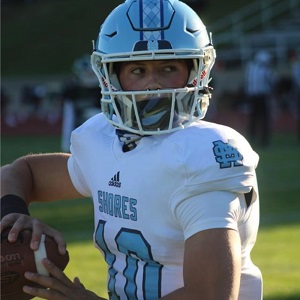
PHOTOS: (Top) Mona Shores junior quarterback Mark Konecny drops back to pass during Friday's game at Muskegon Reeths-Puffer. (Middle) Konecny warms up Friday. (Below) The elder Mark Konecny. (Mona Shores photos by Eric Sturr and Mike Meekhof, respectively. Head shot courtesy of the Muskegon Area Sports Hall of Fame.)