


Classes Still Create Hoosier Hysteria
July 27, 2017
By Rob Kaminski
MHSAA benchmarks editor
This is the fourth part in a series on MHSAA tournament classification, past and present, that will be published over the next two weeks. This series originally ran in this spring's edition of MHSAA benchmarks.
Twenty years ago, Bloomington North High School won the Indiana High School Athletic Association boys basketball championship, defeating Delta 75-54 at the RCA Dome in Indianapolis.
The date, March 22, 1997, is at the same time revered and disdained by traditionalists in the state who saw it as the last schoolboy championship game the state would ever host.
That’s how devout the game of basketball, particularly interscholastic basketball, had become in the Hoosier state during the 87 years a state champion – one state champion, to be precise – was crowned.
Following that 1997 season, the IHSAA moved to a four-class system for its roundball tournaments, like so many of its state association counterparts had done years earlier.
It would be shocking to find more than a small percentage of current high school basketball players around the country unfamiliar with the iconic movie Hoosiers, even though the film is now more than 30 years old.
And, the storyline for that blockbuster unfolded more than 30 years prior to its release, when small-town, undermanned Milan High School defeated Muncie Central High School 32-30 in the 1954 IHSAA title game.
Perhaps it’s because of the David vs Goliath notion, or the fame of the movie that replaced Milan with the fictional Hickory and real-life star Bobby Plump with Hollywood hero Jimmy Chitwood, or the simple fact that Indiana had something other states didn’t.
Whatever the reason, plenty of opposition remains to this day to basketball classification in the state.
The fact is, the small rural schools were regularly being beaten handily by the much larger suburban and city schools as the tournament progressed each season.
Small schools also were closing at a rapid rate following the state’s School Reorganization Act in 1959, as students converged on larger, centralized county schools. From 1960 to 2000, the number of schools entering the tournament dropped from 694 to 381, and in 1997 a total of 382 schools and 4,584 athletes began competition at the Sectional level (the first level of the IHSAA Basketball Tournament).
It was at the entry level of the tournament where school administrators felt the pain of the new class system, but not necessarily for the same nostalgic reasons as the fans who either attended or boycotted the tournament.
At the Sectional round of the tournament, the IHSAA was culling just 2 percent of the revenue, with the participating schools splitting the balance. So, when Sectional attendance dropped by 14 percent in that first year of class basketball, many schools realized a financial loss. It was money they had grown to count on in prior years to help fund various aspects of the department.
Schools cumulatively received more than $900,000 from Sectional competition in 1998, but that total was down from more than $1 million in the last year of the single-class tournament.
Yet, the current format provides a great deal more opportunity and realistic chances at championship runs for schools of all enrollments.
To date, 60 additional teams have championship or runner-up trophies on display in school trophy cases around Indiana.
That was the mission in front of then-IHSAA commissioner Bob Gardner (now National Federation executive director) once the board made its decision: to give thousands more student-athletes the opportunity for once-in-a-lifetime experiences.
As any statistician knows, figures can be manipulated to tell any side of a story. Declining attendance in year one of class basketball is such a number.
The truth is tournament attendance had been on a steady downward spiral since its peak of just over 1.5 million in 1962. By the last single-class event in 1997, the total attendance was half that.
The challenge then and today, as it is for all state associations, is to find that delicate balance for those holding onto tradition, those holding onto trophies, and the number of trophies to hand out.
Editor’s Note: Stories from the Fort Wayne Journal Gazette in 1998 and from a 2007 issue of Indianapolis Monthly provided facts in this article.
Nichols Lends Winning Past to West's Present
July 28, 2020
By Tom Spencer
Special for Second Half
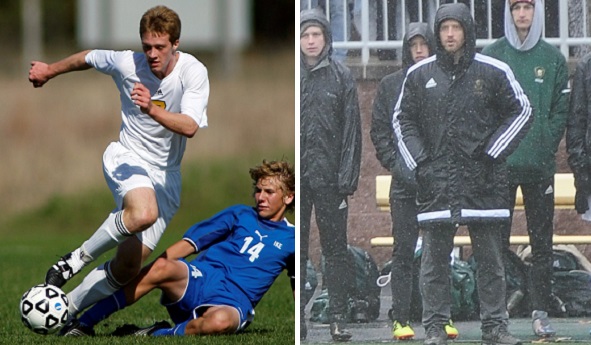
Thirteen Novembers ago, Drew Nichols, then a senior captain, took a bus ride home from Troy High School with the Traverse City West boys soccer team. The Division 1 boys soccer championship trophy was happily along for the ride as the Titans had just beaten Livonia Stevenson 1-0 in the Final.
 Last November only an overtime loss prevented the now-West assistant varsity coach from taking a very enjoyable similar bus ride. The loss was at the hands of Troy Athens, and the ride home departed this time from Comstock Park.
Perhaps this November he’ll get another shot from Comstock Park, one of two sites to be used for the coming season’s championship tilts. He plans to be on the sidelines again with head coach Matt Griesinger as the Titans dream of yet another long postseason run (COVID-19 permitting, of course).
While many would think there would be a world of difference in the two long November bus rides after a Division 1 Final with differing results, Nichols believes there really wasn’t.
“The way I saw it, both 2006 and 2019 bus rides had a bunch of exhausted players that fought hard in the pinnacle game of the year,” Nichols pointed out. “I'm not saying there wasn't some pain for the boys to be on the losing side, but in the end I think they still recognized the amazing achievement it was.
“I think everyone that played or watched that 2019 game recognized that it was a moment away from ending in a win,” he continued. “They held their heads high and should command the respect of the program for being only the second team in its history to reach that game.”
Nichols became the varsity assistant coach at West in 2015 after coaching the Titans’ JV two seasons. Griesinger took over the head coaching position at the same time from the Titans’ first coach – and now athletic director – Jason Carmien.
Nichols and Griesinger guided the Titans to Regional appearances in 2015, 2016 and 2019. Nichols said he doesn’t know what to expect in 2020 with all the uncertainties the nation and world are facing.
“The COVID interference has been disastrous on so many levels, and it will certainly disrupt the quality of play for the 2020 fall season,” Nichols said. “We had a strong result last year and have a lot of returning players, so on paper we have the potential for another great season.
“However, the landscape of fall sports and soccer in particular will be so different this year that it's impossible to know how everything plays out,” he continued. “There was a huge loss of development without club soccer or college camps over the spring and summer. From my perspective, the best way to help is to make sure players come into the season fit and focused.”
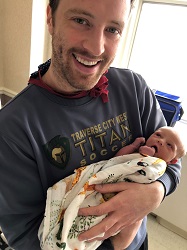
Nichols, whose wife Andrea gave birth to their daughter Quinn after last season, expects to have an impact on future generations regardless of how sports weather the impact of COVID-19.
“The game finds its way into the hearts of kids much earlier than they meet me, but I really enjoy being a positive influence on their growth and appreciation for what the game can offer,” he said. “I don't pretend to be the absolute authority on anything, but I have perspective to share and hopefully the time spent in our program will foster their appreciation of the game itself and the skills (and) values it can teach you.”
 The West program has produced two Michigan Mr. Soccer Award winners during the school’s 20-year history in the sport, Dalton Michael (2016) and Casey Townsend (2006 and 2007). Nichols has ties to both.
Michael and his twin brother Donovan are now playing at Western Michigan University, and both played under Nichols. Townsend went on to a stellar career at University of Maryland and played in Major League Soccer. He was the No. 5 overall pick in the 2012 MLS draft and played for Chivas USA and DC United. All of that came after he scored the only goal in that 2006 Division 1 Final, with Nichols a teammate.
Nichols, a midfielder who went on to play at Hope College, made the all-state third team with nine goals and five assists as a senior that fall at West. He and Townsend had played side by side since their beginning soccer days at Traverse Bay Area Youth Soccer and with its premier club, NorthStorm.
“I sometimes forget just how much Casey has accomplished because first and foremost he is just a goofball friend of mine,” Nichols said. “We played together in our formative years, so even though he was the difference-maker in a lot of games, it was hard for us to recognize just how high his ceiling was at the time. Clearly we found out when he progressed into college and the professional leagues, and it was a blast to watch.”
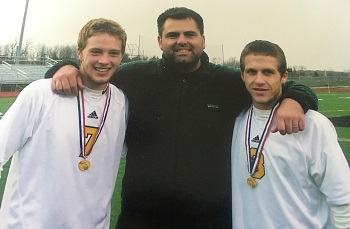
Carmien, the coach of the 2006 championship team, recalls the connection Nichols and Townsend had.
“Drew scored some big goals and really was an anchor to our team,” Carmien said. “Drew caused a lot of turnovers and created transition scoring opportunities by combining with Casey or playing balls in behind defenses.”
Carmien anticipates Nichols will continue with Griesinger to foster the Titans’ success.
“Drew was a great player, he was a key piece in some very good Titan teams,” Carmien said. “I am proud to see him on the sidelines, working with our kids at practice and still involved in the program. We have alumni that still follow us each fall, and last year was a lot of fun; (I’m) glad Drew was a part of it, and hopefully we can have continued success.”
Carmien and Griesinger have impacted Nichols’ coaching style, which is also linked to his studies abroad as a student at Hope. He played some soccer in the Spanish cities of Murcia and Pontevedra as he earned academic honor roll recognition all four years at Hope.
 “My expertise comes from my development as a player through high school, college, and afterwards playing and engaging the soccer community in a variety of countries,” Nichols said. “My coaching style comes heavily influenced by Jason Carmien, the founding father of the West soccer program.
“He trained me as a high school player and then again as a coach when I joined the staff around 2013,” Nichols elaborated. “Of course, more recently, head men's coach Matt Griesinger has challenged our staff and the program to exceed the high standards set by Jason.”
Nichols is not a school teacher. He manages payrolls for several companies as the director of operations for Integrative Payroll Services in Traverse City. Still, he intends to stay with coaching for the foreseeable future.
“My ‘career’ goal is to merely engage the soccer community where I live and stick around as long as I can offer value,” he said. “Obviously I was drawn to give back to the program I participated in as a player, and that's as far as it will likely go. With my daughter's birth this year, odds are good that you'll see me in the girls coaching pool in a few years.”
Rest assured, no matter where he is, Nichols will always remember the feeling of winning a state championship.
“It was amazing,” he said. We had a chip on our shoulder the whole playoff run since we were the nobodies from up north, so to win brought a mixed bag of feelings – excitement, accomplishment, relief, vindication,” he said.
“We didn't play particularly well, but most teams don't once they make it to that game. Nerves take their toll, just like with a big rivalry game, so anything can happen. That has become even clearer now that I have coached both rivalry games and a state Final. That day we were fortunate to have a future All-American to clinch it for us.”
But, as a coach, Nichols said he is “hoping to leave it one of many in the West program trophy case.”
Made in Michigan 2020
July 17: Miss Tennis Serving Now as 'Hero Coach' - Read
July 9: Joplin Always Has Known Value of Home - Read
June 24: Fracassa's Remarkable Records Still Rule - Read
June 16: Muskegon Grad Casts "Magic" in HBO Series - Read
 Tom Spencer is a longtime MHSAA-registered basketball and soccer official, and former softball and baseball official, and he also has coached in the northern Lower Peninsula area. He previously has written for the Saginaw News, Bay County Sports Page and Midland Daily News. He can be reached at [email protected] with story ideas for Manistee, Wexford, Missaukee, Roscommon, Ogemaw, Iosco, Alcona, Oscoda, Crawford, Kalkaska, Grand Traverse, Benzie, Leelanau, Antrim, Otsego, Montmorency, Alpena, Presque Isle, Cheboygan, Charlevoix and Emmet counties.
PHOTOS: (Top) Drew Nichols was a standout midfielder for Traverse City West during the mid-2000s, and led from the sideline as the Titans’ assistant varsity coach during last season's Division 1 Final. (Middle) Nichols, left, enjoys a celebratory photo in 2006 with then-West coach Jason Carmien and teammate Dan Kellogg. (Below) Nichols and his wife welcomed a daughter after last season. (Photos courtesy of Drew Nichols.)