


Classes Still Create Hoosier Hysteria
July 27, 2017
By Rob Kaminski
MHSAA benchmarks editor
This is the fourth part in a series on MHSAA tournament classification, past and present, that will be published over the next two weeks. This series originally ran in this spring's edition of MHSAA benchmarks.
Twenty years ago, Bloomington North High School won the Indiana High School Athletic Association boys basketball championship, defeating Delta 75-54 at the RCA Dome in Indianapolis.
The date, March 22, 1997, is at the same time revered and disdained by traditionalists in the state who saw it as the last schoolboy championship game the state would ever host.
That’s how devout the game of basketball, particularly interscholastic basketball, had become in the Hoosier state during the 87 years a state champion – one state champion, to be precise – was crowned.
Following that 1997 season, the IHSAA moved to a four-class system for its roundball tournaments, like so many of its state association counterparts had done years earlier.
It would be shocking to find more than a small percentage of current high school basketball players around the country unfamiliar with the iconic movie Hoosiers, even though the film is now more than 30 years old.
And, the storyline for that blockbuster unfolded more than 30 years prior to its release, when small-town, undermanned Milan High School defeated Muncie Central High School 32-30 in the 1954 IHSAA title game.
Perhaps it’s because of the David vs Goliath notion, or the fame of the movie that replaced Milan with the fictional Hickory and real-life star Bobby Plump with Hollywood hero Jimmy Chitwood, or the simple fact that Indiana had something other states didn’t.
Whatever the reason, plenty of opposition remains to this day to basketball classification in the state.
The fact is, the small rural schools were regularly being beaten handily by the much larger suburban and city schools as the tournament progressed each season.
Small schools also were closing at a rapid rate following the state’s School Reorganization Act in 1959, as students converged on larger, centralized county schools. From 1960 to 2000, the number of schools entering the tournament dropped from 694 to 381, and in 1997 a total of 382 schools and 4,584 athletes began competition at the Sectional level (the first level of the IHSAA Basketball Tournament).
It was at the entry level of the tournament where school administrators felt the pain of the new class system, but not necessarily for the same nostalgic reasons as the fans who either attended or boycotted the tournament.
At the Sectional round of the tournament, the IHSAA was culling just 2 percent of the revenue, with the participating schools splitting the balance. So, when Sectional attendance dropped by 14 percent in that first year of class basketball, many schools realized a financial loss. It was money they had grown to count on in prior years to help fund various aspects of the department.
Schools cumulatively received more than $900,000 from Sectional competition in 1998, but that total was down from more than $1 million in the last year of the single-class tournament.
Yet, the current format provides a great deal more opportunity and realistic chances at championship runs for schools of all enrollments.
To date, 60 additional teams have championship or runner-up trophies on display in school trophy cases around Indiana.
That was the mission in front of then-IHSAA commissioner Bob Gardner (now National Federation executive director) once the board made its decision: to give thousands more student-athletes the opportunity for once-in-a-lifetime experiences.
As any statistician knows, figures can be manipulated to tell any side of a story. Declining attendance in year one of class basketball is such a number.
The truth is tournament attendance had been on a steady downward spiral since its peak of just over 1.5 million in 1962. By the last single-class event in 1997, the total attendance was half that.
The challenge then and today, as it is for all state associations, is to find that delicate balance for those holding onto tradition, those holding onto trophies, and the number of trophies to hand out.
Editor’s Note: Stories from the Fort Wayne Journal Gazette in 1998 and from a 2007 issue of Indianapolis Monthly provided facts in this article.
2020 Class Honored Together, from Afar
By
Geoff Kimmerly
MHSAA.com senior editor
May 15, 2020
Ishpeming Westwood’s girls basketball team was two hours into a three-hour trip to its Division 3 Regional Final on March 12 when the Patriots were told to turn the bus around and come home.
In an instant, the 2019-20 school year – and with it all MHSAA sports across the state – had come to a halt. And two months later, the high school world and its sports community continue to wait for bits of normalcy to return.
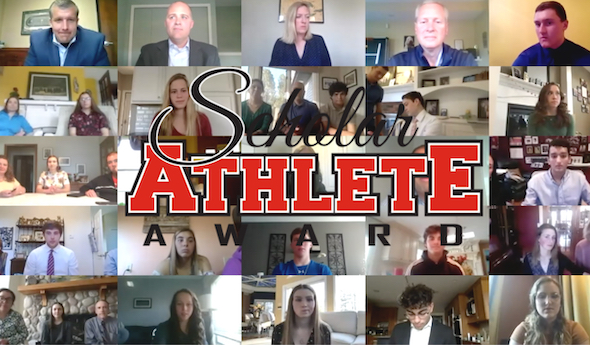
On Wednesday, we were able to enjoy a little bit of normal that’s been part of the annual MHSAA calendar for three decades. A Zoom call brought together 31 families from all over the state along with MHSAA staff and Farm Bureau Insurance CEO Don Simon to celebrate this year’s MHSAA/Farm Bureau Insurance Scholar-Athlete Award winners.
Living rooms, kitchens and home offices replaced Breslin Center as settings for this “virtual” ceremony. And yet, this ceremony may be remembered more than any other because of its necessity – due to the COVID-19 pandemic – and because of how it brought so many together, remotely, while the coronavirus has forced all of us to remain apart.
Below is the ceremony, in full, including words from Simon, MHSAA Executive Director Mark Uyl and Assistant Director Andy Frushour and, for the first time, a student speaker from the class – Ishpeming Westwood senior Madelyn Koski, who was part of that basketball team destined for Sault Ste. Marie. A brief Q&A with Koski follows.
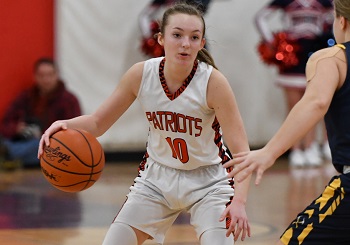
Koski was an all-stater on the court who would’ve finished her high school career with four varsity letters each for hoops, tennis and softball. She will continue at Ferris State University, where she’ll pursue a degree in pharmacy and continue her basketball career.
Second Half: How did you decide what you wanted to say? Was there a message you wanted to get across?
It was easy to write the sad part, because I know what happened – I was there. But it was hard for me to make a positive spin at the end because I don’t think anyone’s over it yet. I was glad to be able to turn it into something that was bigger than sports … more about our whole lives and less about our time in high school.
Second Half: It’s been two months. How have you been navigating the disappointment, the sadness? And is there advice you’d give to other people your age trying to do it?
As time went on, it got a little bit better. The day after was pretty sad; that’s all I could think about. Now there’s so many other things to do – the weather’s nicer, we can go outside. And I’m playing college basketball – not everyone has that chance – but at least I have that to practice for, look forward to.
I guess, it’s just … time heals.
Second Half: Even though you can’t be with them and hang out with them, I’m sure you’re talking a lot of your friends and teammates. What kind of conversations are you having? Is it looking ahead? Is it still thinking about, “We’d be playing softball right now?"
I think we kinda tried to leave the basketball stuff in the past because it was too sad to talk about. We made sure we do talk, obviously not in person, but on social media or FaceTime, we just talk about our memories and everything. That helped. It didn’t close the chapter, but it was nice to talk to them when we were all alone. And now we just don’t talk about that anymore. Nobody really wants to talk about it. We see memories popping up on Facebook and all these other things about, “Oh, we had a softball game last year at this time.” And it’s pretty sad. But no one else is playing. So it’s like we’re all in the same boat.
 Second Half: You can turn on the news and you can see what every adult has to say about what’s going on right now. … You’re 17, you’re finishing your last year of high school, you’re going through something no one has gone through in more than 100 years. How do you see everything that’s happening in the world right now, as you look at it from a 17-year-old’s point of view and see seasons end and school end?
I know we can’t help what happened. But obviously I think it’s unfair that it happened to our class. It stinks for every grade, but (as seniors) we’re missing out on our best parts of high school right now and it’s pretty horrible. We’ve been waiting years for our senior proms and graduations, banquets and award ceremonies, like the MHSAA one. So that kinda stinks.
Ever since March 12, I’ve been staying optimistic. But I’m proved wrong every time because things just keep getting canceled and canceled. … (But) I’m a pretty optimistic person, so I still have some left.
Second Half: What happens next? What does your summer look like? What happens for people who are in your shoes?
I’ll keep working out, and one of the girls on my high school basketball team is going to play at Michigan Tech so (eventually) we can work out together. … I think the biggest thing to do this summer, that I think I’ll do, is appreciate time with my family. I have gotten to spend a lot of time with them. And then maybe once summer rolls around and we’re allowed to be in bigger groups, I’ll be able to be with people other than my mom and dad, like my grandparents and cousins and my aunts and uncles. … (My sister Jillian and I) have been playing the same varsity sports for the last couple of years, and she’s been really successful. It’s been fun to win all these championships and stuff with her.
Second Half: What do you think you’re going to remember from this in five years, 10 years, when people ask you what your experience was like?
I’m probably going to say it’s a pretty bad experience. I guess it was an eye-opener that life can change at any moment. That’s kind’ve it. It didn’t change in a good way.
PHOTO: Westwood's Madelyn Koski sets up a play as Negaunee's Breanne Giotto defends her during their Jan. 24 game. (Photo by Cara Kamps.)