


Classes Still Create Hoosier Hysteria
July 27, 2017
By Rob Kaminski
MHSAA benchmarks editor
This is the fourth part in a series on MHSAA tournament classification, past and present, that will be published over the next two weeks. This series originally ran in this spring's edition of MHSAA benchmarks.
Twenty years ago, Bloomington North High School won the Indiana High School Athletic Association boys basketball championship, defeating Delta 75-54 at the RCA Dome in Indianapolis.
The date, March 22, 1997, is at the same time revered and disdained by traditionalists in the state who saw it as the last schoolboy championship game the state would ever host.
That’s how devout the game of basketball, particularly interscholastic basketball, had become in the Hoosier state during the 87 years a state champion – one state champion, to be precise – was crowned.
Following that 1997 season, the IHSAA moved to a four-class system for its roundball tournaments, like so many of its state association counterparts had done years earlier.
It would be shocking to find more than a small percentage of current high school basketball players around the country unfamiliar with the iconic movie Hoosiers, even though the film is now more than 30 years old.
And, the storyline for that blockbuster unfolded more than 30 years prior to its release, when small-town, undermanned Milan High School defeated Muncie Central High School 32-30 in the 1954 IHSAA title game.
Perhaps it’s because of the David vs Goliath notion, or the fame of the movie that replaced Milan with the fictional Hickory and real-life star Bobby Plump with Hollywood hero Jimmy Chitwood, or the simple fact that Indiana had something other states didn’t.
Whatever the reason, plenty of opposition remains to this day to basketball classification in the state.
The fact is, the small rural schools were regularly being beaten handily by the much larger suburban and city schools as the tournament progressed each season.
Small schools also were closing at a rapid rate following the state’s School Reorganization Act in 1959, as students converged on larger, centralized county schools. From 1960 to 2000, the number of schools entering the tournament dropped from 694 to 381, and in 1997 a total of 382 schools and 4,584 athletes began competition at the Sectional level (the first level of the IHSAA Basketball Tournament).
It was at the entry level of the tournament where school administrators felt the pain of the new class system, but not necessarily for the same nostalgic reasons as the fans who either attended or boycotted the tournament.
At the Sectional round of the tournament, the IHSAA was culling just 2 percent of the revenue, with the participating schools splitting the balance. So, when Sectional attendance dropped by 14 percent in that first year of class basketball, many schools realized a financial loss. It was money they had grown to count on in prior years to help fund various aspects of the department.
Schools cumulatively received more than $900,000 from Sectional competition in 1998, but that total was down from more than $1 million in the last year of the single-class tournament.
Yet, the current format provides a great deal more opportunity and realistic chances at championship runs for schools of all enrollments.
To date, 60 additional teams have championship or runner-up trophies on display in school trophy cases around Indiana.
That was the mission in front of then-IHSAA commissioner Bob Gardner (now National Federation executive director) once the board made its decision: to give thousands more student-athletes the opportunity for once-in-a-lifetime experiences.
As any statistician knows, figures can be manipulated to tell any side of a story. Declining attendance in year one of class basketball is such a number.
The truth is tournament attendance had been on a steady downward spiral since its peak of just over 1.5 million in 1962. By the last single-class event in 1997, the total attendance was half that.
The challenge then and today, as it is for all state associations, is to find that delicate balance for those holding onto tradition, those holding onto trophies, and the number of trophies to hand out.
Editor’s Note: Stories from the Fort Wayne Journal Gazette in 1998 and from a 2007 issue of Indianapolis Monthly provided facts in this article.
NFHS Voice: Nationally, Lost Spring Ends
May 8, 2020
By Karissa Niehoff
NFHS Executive Director
On Monday, the New Jersey State Interscholastic Athletic Association became the 51st and final NFHS member state high school association to cancel its spring sports championships due to the Coronavirus pandemic.
The cancellation announcements began in late March and stretched to early May as states made every attempt possible to conduct spring sports and other activity programs.
Driven by a desire to offer perhaps a few weeks of competition – particularly for graduating seniors – many states waited as long as possible to move from postponed to cancelled, ultimately forced to make decisions when schools were closed to in-person learning for the remainder of the academic year.
While the leaders of our state associations knew that spring activities could not occur if schools did not re-open, and that the health and safety of the millions of participants ultimately drove these decisions, having to make these announcements was perhaps the most difficult task they had experienced as state leaders.
“We are disappointed for the thousands of New Jersey student-athletes who will be unable to compete this spring,” said Larry White, executive director of the New Jersey State Interscholastic Athletic Association. “While we remained hopeful to the end, and left open every possibility, competition simply is not feasible given the circumstances. It has been a harrowing time for everyone, and we know our student-athletes are extremely disappointed. That said, these unfortunate circumstances may have put an intriguing challenge in the path of our young people. As New Jersey’s own Vince Lombardi once said, ‘It's not whether you get knocked down, it's whether you get up.’ We’re confident all our kids will get back up and stand tall.”
Rhonda Blanford-Green, commissioner of the Colorado High School Activities Association, showed her emotions in making the difficult decision in her state:
“This decision, unlike the many decisions our office makes over the course of a year, has been extremely difficult because we are personally connected as former participants and officials, current parents and grandparents of graduating seniors, as well as educators and members of our high school communities. Our hats are off to the many seniors who have shown maturity and resolve as their culminating year of high school has been impacted beyond activities and athletics due to the worldwide COVID-19 pandemic. The Class of 2020 will not be forgotten.”
Craig Anderson, executive director of the Illinois High School Association, said, “Our thoughts are with all the impacted students, coaches and communities, especially the seniors. It will be difficult for them to find a silver lining in all of this, but we stress that even if they don’t get the chance to compete again at the high school level, they are better for having been a part of their respective high school teams. They were exposed to life lessons in teamwork, leadership and overcoming adversity that are difficult to replicate elsewhere.”
What was at stake and who was affected by these cancellation announcements? More than 500 girls and boys spring sports championships in about 18 sports and involving about three million student-athletes. Along with multiple classes for both boys and girls in track & field, other sports affected this spring were baseball, softball, lacrosse, golf, tennis, soccer, flag football, boys volleyball, water polo, weightlifting, gymnastics, riflery, judo, Unified track & field and ultimate Frisbee. Also grounded were perhaps another million participants in band, choir, orchestra, speech, debate, robotics and other activity programs.
And last, but far from least, we remember the thousands of volunteers who make these events happen every year – ticket-takers, concession stand workers, booster club parents, meet officials and the leaders in communities throughout the country where these events were planned. We thank these individuals for their faithful service year after year, and we look forward to the day we are all back together again.
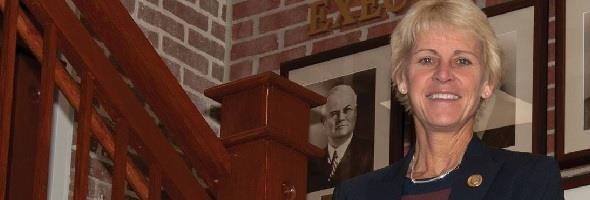
Dr. Karissa L. Niehoff is in her second year as executive director of the National Federation of State High School Associations (NFHS) in Indianapolis, Indiana. She is the first female to head the national leadership organization for high school athletics and performing arts activities and the sixth full-time executive director of the NFHS, which celebrated its 100th year of service during the 2018-19 school year. She previously was executive director of the Connecticut Association of Schools-Connecticut Interscholastic Athletic Conference for seven years.