


Classes Still Create Hoosier Hysteria
July 27, 2017
By Rob Kaminski
MHSAA benchmarks editor
This is the fourth part in a series on MHSAA tournament classification, past and present, that will be published over the next two weeks. This series originally ran in this spring's edition of MHSAA benchmarks.
Twenty years ago, Bloomington North High School won the Indiana High School Athletic Association boys basketball championship, defeating Delta 75-54 at the RCA Dome in Indianapolis.
The date, March 22, 1997, is at the same time revered and disdained by traditionalists in the state who saw it as the last schoolboy championship game the state would ever host.
That’s how devout the game of basketball, particularly interscholastic basketball, had become in the Hoosier state during the 87 years a state champion – one state champion, to be precise – was crowned.
Following that 1997 season, the IHSAA moved to a four-class system for its roundball tournaments, like so many of its state association counterparts had done years earlier.
It would be shocking to find more than a small percentage of current high school basketball players around the country unfamiliar with the iconic movie Hoosiers, even though the film is now more than 30 years old.
And, the storyline for that blockbuster unfolded more than 30 years prior to its release, when small-town, undermanned Milan High School defeated Muncie Central High School 32-30 in the 1954 IHSAA title game.
Perhaps it’s because of the David vs Goliath notion, or the fame of the movie that replaced Milan with the fictional Hickory and real-life star Bobby Plump with Hollywood hero Jimmy Chitwood, or the simple fact that Indiana had something other states didn’t.
Whatever the reason, plenty of opposition remains to this day to basketball classification in the state.
The fact is, the small rural schools were regularly being beaten handily by the much larger suburban and city schools as the tournament progressed each season.
Small schools also were closing at a rapid rate following the state’s School Reorganization Act in 1959, as students converged on larger, centralized county schools. From 1960 to 2000, the number of schools entering the tournament dropped from 694 to 381, and in 1997 a total of 382 schools and 4,584 athletes began competition at the Sectional level (the first level of the IHSAA Basketball Tournament).
It was at the entry level of the tournament where school administrators felt the pain of the new class system, but not necessarily for the same nostalgic reasons as the fans who either attended or boycotted the tournament.
At the Sectional round of the tournament, the IHSAA was culling just 2 percent of the revenue, with the participating schools splitting the balance. So, when Sectional attendance dropped by 14 percent in that first year of class basketball, many schools realized a financial loss. It was money they had grown to count on in prior years to help fund various aspects of the department.
Schools cumulatively received more than $900,000 from Sectional competition in 1998, but that total was down from more than $1 million in the last year of the single-class tournament.
Yet, the current format provides a great deal more opportunity and realistic chances at championship runs for schools of all enrollments.
To date, 60 additional teams have championship or runner-up trophies on display in school trophy cases around Indiana.
That was the mission in front of then-IHSAA commissioner Bob Gardner (now National Federation executive director) once the board made its decision: to give thousands more student-athletes the opportunity for once-in-a-lifetime experiences.
As any statistician knows, figures can be manipulated to tell any side of a story. Declining attendance in year one of class basketball is such a number.
The truth is tournament attendance had been on a steady downward spiral since its peak of just over 1.5 million in 1962. By the last single-class event in 1997, the total attendance was half that.
The challenge then and today, as it is for all state associations, is to find that delicate balance for those holding onto tradition, those holding onto trophies, and the number of trophies to hand out.
Editor’s Note: Stories from the Fort Wayne Journal Gazette in 1998 and from a 2007 issue of Indianapolis Monthly provided facts in this article.
'Coach Dad' Angers Takes Time to Be Fan
February 21, 2020
By Tom Spencer
Special for Second Half
For the second time in four years, Jerry Angers walked onto Ford Field last fall with his Maple City Glen Lake football team seeking an MHSAA Finals championship.
 It is not likely he’ll do so again.
The next time he sees those athletes play who he led to the Finals in 2016 and 2019, they will be suiting up all over the Midwest and possibly country for college football competition. It may even be in professional football stadiums, as some of his former players have experienced.
Angers announced his plans to step down as the Glen Lake head football coach at the end of an 11-year run with a 74-42 record. After the 7-0 loss to Monroe St. Mary in November’s Division 6 championship game, he made the difficult decision many MHSAA coaches face.
He’s putting his family, and in particular son Duke, first.
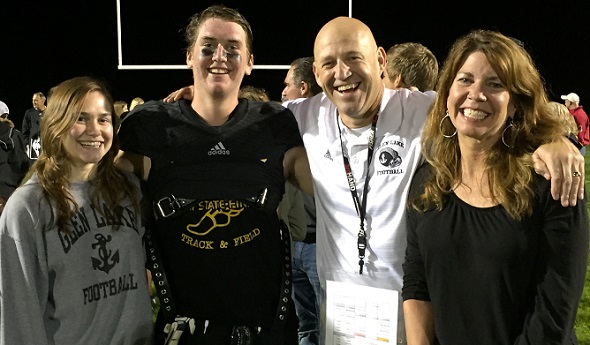
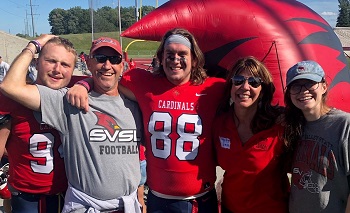
The younger Angers plays football for Saginaw Valley State University. He’ll be starting his junior campaign in August, and “Coach Dad” (as Duke calls him) will be there watching every game and supporting his son. At the same time, Jerry will watch several others he coached play with — and against — his son’s Cardinals team.
The younger Angers is one of 70 football players Coach Dad has mentored in high schools all over Michigan who have gone on to or will play college football. Duke plays H-back and tight end for the Cardinals. Two current Lakers, Ben Kroll and Jonathan Wright, are headed to SVSU next year to play with Duke. A few other Glen Lake grads from the team that fell in the 2016 Division 6 Final, 26-14 to Jackson Lumen Christi, also are playing at the college level. That gives Coach Dad lots of chances to see his former players compete.
In particular he’s excited to see Cade and Drew Peterson when Grand Valley State University and the Cardinals meet in Great Lakes Intercollegiate Athletic Association play, although the Peterson brothers will be on the opposing sideline.
Like many were, Duke was a little stunned by his Dad’s decision.
“His first comment was, ‘Dad, those kids need you more than I do,’” Jerry Angers recalled. “I told him I need to be there for you.”
Angers will continue as a teacher at Glen Lake and head up the Lakers’ strength and conditioning program and serve as the assistant track coach. He’s excited to have a little more time to travel with his wife Kathy, and to just watch football and visit his daughter Megan in Denver.
“Thankfully, Coach Angers isn't going anywhere,” said Lakers athletic director Mark Mattson. “He will still play a very important role in our school and for our students, regardless of whether or not they participate in sports. While I am still somewhat shocked by Jerry’s decision, I am not completely surprised because I know how hard it has been on him to not spend more time with his family. He has tried to give his all to Glen Lake and his family.”
 Mattson’s thoughts sum up the reaction to Anger’s decision, Coach Dad believes.
“Everyone has been very supportive here from the administration, the community, the players to the staff,” Angers said. “I am still here and will continue to do all the other things I’ve been doing.”
As Coach Dad looks to next football season, he is hoping to continue playing a special role for another one of his former players, Keegan Royston. Keegan’s father, Eric, a long-time MHSAA basketball and soccer referee and educator in the Lansing and Traverse City areas, died in 2019 after a lengthy battle with pancreatic cancer.
Angers is taking the senior long-snapper down to SVSU in the near future. The Cardinals have their eyes on him for next year’s team. Angers and Royston will be having dinner with the three other Cardinals football players with ties to Glen Lake.
“I am looking forward to it,” Angers said. “Before Eric passed away, he told me Keegan is going to need a strong role model to look up to. It’s pretty special for me as a coach to have this opportunity to help.”
Angers’ coaching career included stops at Bay City Handy, Traverse City Central, Traverse City West, Royal Oak and Waterford Kettering. A handful of his former players made it to the National Football League. He admits it is awesome to know he played a role in their development, but all of his former players are special to him.
“Ah, ‘Coach’ – that is the word, the label you always want and love to hear,” Angers said. “It is something to run into former players and get a greeting with ‘Hey coach!’”
And while Angers won’t be coaching Glen Lake in the fall, he is certain the Lakers will continue to raise the bar and find new ways to clear it.
“I believe the Lakers will continue to rise,” he predicted.
“They’re not going to fall off one bit. They are a great bunch of kids. And they want to compete.”
 Tom Spencer is a longtime MHSAA-registered basketball and soccer official, and former softball and baseball official, and he also has coached in the northern Lower Peninsula area. He previously has written for the Saginaw News, Bay County Sports Page and Midland Daily News. He can be reached at [email protected] with story ideas for Manistee, Wexford, Missaukee, Roscommon, Ogemaw, Iosco, Alcona, Oscoda, Crawford, Kalkaska, Grand Traverse, Benzie, Leelanau, Antrim, Otsego, Montmorency, Alpena, Presque Isle, Cheboygan, Charlevoix and Emmet counties.
PHOTOS: (Top) Recently-retired Maple City Glen Lake football coach Jerry Angers, with wife Kathy, son Duke and daughter Megan during Duke’s Lakers career. (Middle) Angers attends one of Duke’s games at Saginaw Valley State University with his family. Duke is No. 88 and his roommate Jake Dorn also is pictured. (Photos courtesy of the Angers family.)