


Classes Still Create Hoosier Hysteria
July 27, 2017
By Rob Kaminski
MHSAA benchmarks editor
This is the fourth part in a series on MHSAA tournament classification, past and present, that will be published over the next two weeks. This series originally ran in this spring's edition of MHSAA benchmarks.
Twenty years ago, Bloomington North High School won the Indiana High School Athletic Association boys basketball championship, defeating Delta 75-54 at the RCA Dome in Indianapolis.
The date, March 22, 1997, is at the same time revered and disdained by traditionalists in the state who saw it as the last schoolboy championship game the state would ever host.
That’s how devout the game of basketball, particularly interscholastic basketball, had become in the Hoosier state during the 87 years a state champion – one state champion, to be precise – was crowned.
Following that 1997 season, the IHSAA moved to a four-class system for its roundball tournaments, like so many of its state association counterparts had done years earlier.
It would be shocking to find more than a small percentage of current high school basketball players around the country unfamiliar with the iconic movie Hoosiers, even though the film is now more than 30 years old.
And, the storyline for that blockbuster unfolded more than 30 years prior to its release, when small-town, undermanned Milan High School defeated Muncie Central High School 32-30 in the 1954 IHSAA title game.
Perhaps it’s because of the David vs Goliath notion, or the fame of the movie that replaced Milan with the fictional Hickory and real-life star Bobby Plump with Hollywood hero Jimmy Chitwood, or the simple fact that Indiana had something other states didn’t.
Whatever the reason, plenty of opposition remains to this day to basketball classification in the state.
The fact is, the small rural schools were regularly being beaten handily by the much larger suburban and city schools as the tournament progressed each season.
Small schools also were closing at a rapid rate following the state’s School Reorganization Act in 1959, as students converged on larger, centralized county schools. From 1960 to 2000, the number of schools entering the tournament dropped from 694 to 381, and in 1997 a total of 382 schools and 4,584 athletes began competition at the Sectional level (the first level of the IHSAA Basketball Tournament).
It was at the entry level of the tournament where school administrators felt the pain of the new class system, but not necessarily for the same nostalgic reasons as the fans who either attended or boycotted the tournament.
At the Sectional round of the tournament, the IHSAA was culling just 2 percent of the revenue, with the participating schools splitting the balance. So, when Sectional attendance dropped by 14 percent in that first year of class basketball, many schools realized a financial loss. It was money they had grown to count on in prior years to help fund various aspects of the department.
Schools cumulatively received more than $900,000 from Sectional competition in 1998, but that total was down from more than $1 million in the last year of the single-class tournament.
Yet, the current format provides a great deal more opportunity and realistic chances at championship runs for schools of all enrollments.
To date, 60 additional teams have championship or runner-up trophies on display in school trophy cases around Indiana.
That was the mission in front of then-IHSAA commissioner Bob Gardner (now National Federation executive director) once the board made its decision: to give thousands more student-athletes the opportunity for once-in-a-lifetime experiences.
As any statistician knows, figures can be manipulated to tell any side of a story. Declining attendance in year one of class basketball is such a number.
The truth is tournament attendance had been on a steady downward spiral since its peak of just over 1.5 million in 1962. By the last single-class event in 1997, the total attendance was half that.
The challenge then and today, as it is for all state associations, is to find that delicate balance for those holding onto tradition, those holding onto trophies, and the number of trophies to hand out.
Editor’s Note: Stories from the Fort Wayne Journal Gazette in 1998 and from a 2007 issue of Indianapolis Monthly provided facts in this article.
Haslett Cancer Games Touch Close to Home
By
Rob Kaminski
MHSAA benchmarks editor
February 18, 2020
By Rob Kaminski
MHSAA benchmarks editor
By pure coincidence, it happened to be Valentine's Day.
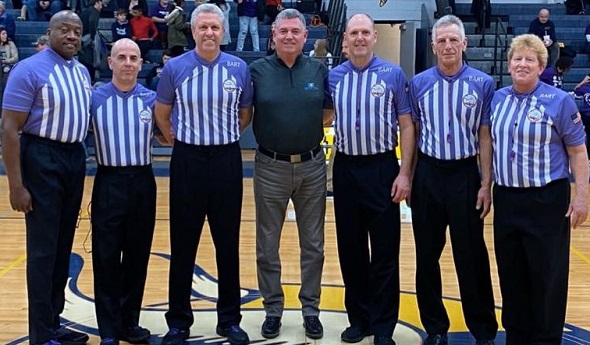
However, that date on the calendar served as the perfect backdrop when two schools and two officiating crews paired up for a "Coaches for Cancer" girls and boys basketball doubleheader Friday at Haslett High School.
Adding to the poignancy of this particular Feb. 14 were the still-raw emotions for the host school, which lost its longtime principal, Bart Wegenke, to pancreatic cancer a month earlier.
"This is our second year participating in a Coaches vs. Cancer event at a basketball game," said Haslett athletic director Darin Ferguson. "The event was actually planned before Bart’s passing."
Wegenke, 53, was widely recognized in educational circles for his excellence as an administrator, and also was an accomplished basketball official at the high school and collegiate levels, ascending to NCAA Division I status.
During a recent booster club meeting, there was discussion of the event, scheduled for the home doubleheader versus local rival Fowlerville. In attendance was Mike Conlin, whose son Jace is a member of the Haslett golf team. Conlin also assigns basketball officials for the Capital Area Activities Conference and is owner of Correct Call Officiating Outfitters, provider of licensed MHSAA officials apparel.
"They were displaying purple t-shirts that the teams would be wearing that night, and I thought, 'Why not have the officials join in that night?'" Conlin said. "Because of the situation with Bart and his positive influence and the respect given him by players, coaches and officials alike, we had patches created in his memory. So it seemed fitting to outfit the officials for this night with special shirts bearing Bart’s name."
Conlin and partner Joe DeRosa at Smitty Apparel had designed the commemorative patches for collegiate-style shirts that were worn in the Big Ten during a weekend shortly after Wegenke's passing. The shirts differ in style from MHSAA shirts; the area on the shoulder of the collegiate shirt provides greater visibility for the patch.
"I am not an advocate for high school officials wearing college shirts; that's not me," Conlin said. "But, in this case, we got to talking and thought the ragland sleeve would allow for a more prominent display. And, we wanted the shirts to be purple and white so that our crews that night could join in the cause."
Conlin contacted the MHSAA, and permission for the alternate gear – which also would include purple whistles – was granted. Following the games that night, Conlin collected the commemorative shirts to have them dry-cleaned. They were to be given to Bart's brother Brett, who will distribute them to family members.
There was another twist. When Conlin noticed who had been assigned – months before – to officiate the games that night, he decided that one more design would be needed.
 Working the girls game that night were Deb Traxinger, Rob Stanaway and Dennis Bickerstaff. The boys crew was Scott Barnes, Mike Maisner and Justin Terry. It was Terry's name that triggered additional response.
Terry lost his wife, Diana, last May 25 after a courageous fight with cancer.
"When I saw Justin as one of the officials for that night, it just made all the sense in the world to craft a special shirt for him with Diana's name on it since this hits so close to home," Conlin said. "We wanted something for him to take with him."
And Terry did just that, not only following the game, but for the game.
"I'm wearing that shirt for the game," Terry said the morning of the event. "Here it is, Valentine's Day, people exchanging cards, flowers, candy, and for the first time, I don't have that. But I'll be thinking about my honey when I take the floor, and she’ll be with me. My whole family will be there."
And he said he would be thinking of countless others enduring the same struggles his family experienced.
"My heart goes out to the Wegenke family. I know first-hand what it's like to lose the love of your life," Terry said. "I hope for this night to serve as a reminder that people need to be educated about cancer; about regular checkups and warning signs. Whether it's a spouse, child, uncle, aunt, these things creep into our lives and cause us to pause. Every one of us will be subjected to something similar someday. It's important to love hard and live life."
On a date signifying heart, there was plenty of adoration to go around.
PHOTOS: (Top) Mid-Michigan officials wear purple shirts for cancer awareness during Friday’s basketball games at Haslett. From left: Justin Terry, Scott Barnes, Mike Maisner, assigner Mike Conlin, Rob Stanaway, Dennis Bickerstaff and Deb Traxinger. (Middle) Terry wore this shirt honoring his late wife Diana, who died last May after a fight with cancer. (Photos courtesy of Mike Conlin.)