


Classes Still Create Hoosier Hysteria
July 27, 2017
By Rob Kaminski
MHSAA benchmarks editor
This is the fourth part in a series on MHSAA tournament classification, past and present, that will be published over the next two weeks. This series originally ran in this spring's edition of MHSAA benchmarks.
Twenty years ago, Bloomington North High School won the Indiana High School Athletic Association boys basketball championship, defeating Delta 75-54 at the RCA Dome in Indianapolis.
The date, March 22, 1997, is at the same time revered and disdained by traditionalists in the state who saw it as the last schoolboy championship game the state would ever host.
That’s how devout the game of basketball, particularly interscholastic basketball, had become in the Hoosier state during the 87 years a state champion – one state champion, to be precise – was crowned.
Following that 1997 season, the IHSAA moved to a four-class system for its roundball tournaments, like so many of its state association counterparts had done years earlier.
It would be shocking to find more than a small percentage of current high school basketball players around the country unfamiliar with the iconic movie Hoosiers, even though the film is now more than 30 years old.
And, the storyline for that blockbuster unfolded more than 30 years prior to its release, when small-town, undermanned Milan High School defeated Muncie Central High School 32-30 in the 1954 IHSAA title game.
Perhaps it’s because of the David vs Goliath notion, or the fame of the movie that replaced Milan with the fictional Hickory and real-life star Bobby Plump with Hollywood hero Jimmy Chitwood, or the simple fact that Indiana had something other states didn’t.
Whatever the reason, plenty of opposition remains to this day to basketball classification in the state.
The fact is, the small rural schools were regularly being beaten handily by the much larger suburban and city schools as the tournament progressed each season.
Small schools also were closing at a rapid rate following the state’s School Reorganization Act in 1959, as students converged on larger, centralized county schools. From 1960 to 2000, the number of schools entering the tournament dropped from 694 to 381, and in 1997 a total of 382 schools and 4,584 athletes began competition at the Sectional level (the first level of the IHSAA Basketball Tournament).
It was at the entry level of the tournament where school administrators felt the pain of the new class system, but not necessarily for the same nostalgic reasons as the fans who either attended or boycotted the tournament.
At the Sectional round of the tournament, the IHSAA was culling just 2 percent of the revenue, with the participating schools splitting the balance. So, when Sectional attendance dropped by 14 percent in that first year of class basketball, many schools realized a financial loss. It was money they had grown to count on in prior years to help fund various aspects of the department.
Schools cumulatively received more than $900,000 from Sectional competition in 1998, but that total was down from more than $1 million in the last year of the single-class tournament.
Yet, the current format provides a great deal more opportunity and realistic chances at championship runs for schools of all enrollments.
To date, 60 additional teams have championship or runner-up trophies on display in school trophy cases around Indiana.
That was the mission in front of then-IHSAA commissioner Bob Gardner (now National Federation executive director) once the board made its decision: to give thousands more student-athletes the opportunity for once-in-a-lifetime experiences.
As any statistician knows, figures can be manipulated to tell any side of a story. Declining attendance in year one of class basketball is such a number.
The truth is tournament attendance had been on a steady downward spiral since its peak of just over 1.5 million in 1962. By the last single-class event in 1997, the total attendance was half that.
The challenge then and today, as it is for all state associations, is to find that delicate balance for those holding onto tradition, those holding onto trophies, and the number of trophies to hand out.
Editor’s Note: Stories from the Fort Wayne Journal Gazette in 1998 and from a 2007 issue of Indianapolis Monthly provided facts in this article.
Blahas Building Lasting Owosso Legacy
February 5, 2020
By Tim Robinson
Special for Second Half
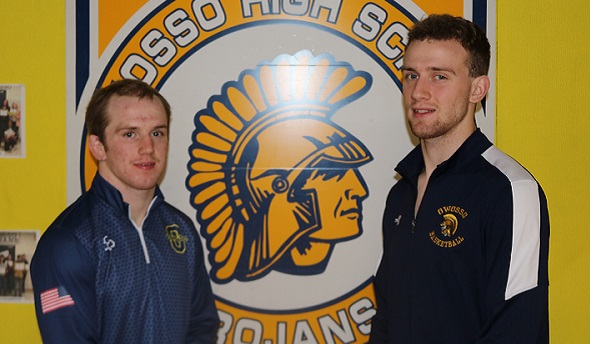
Owosso seniors Hunter and Colton Blaha, born 11 months apart, have been competing with each other nearly every day of their lives.
 “We’ve been competing forever,” said Colton, the younger of the brothers, with a laugh. “Sprinting down the road so you can get to the house first.”
Hunter agreed.
“We’re always competing, no matter what it is,” he said. “Board games, chores. It doesn’t matter.”
The Blaha brothers have channeled that competitiveness into a work ethic and sense of community that has helped lift the Owosso High School sports programs in which they’ve competed.
Both played football (Hunter at quarterback, Colton at running back), while Hunter plays basketball and runs track and Colton is an all-state wrestler who plays baseball in the spring.
Most of the programs they have played for have not had recent success. The brothers endured part of a 43-game losing streak in football, Hunter’s basketball team recently snapped a 30-game losing streak, and the Owosso baseball team has struggled in recent years.
And, to the Blahas, that doesn’t matter.
Competing does.
“I honestly don’t care what our record is,” Colton Blaha said. “We always had a close bond with the kids in our grade, and that means more than anything. It means more than any record we could have had in wins or losses.”
Trojans athletic director Dallas Lintner, who also is an assistant football coach, said what sets the Blahas apart is that selflessness – a willingness to help build a program despite an outward lack of success.
“What’s refreshing to see at the high school level is that they’re competitive, but they’re classy,” Lintner said. “They mean a lot to us at Owosso High School. They mean a lot to our community particularly with the relationships they’ve built with middle-school kids, with elementary school kids. They really do it all for us.”
Both Blahas have worked, assisting the coaches in their sports, with younger athletes at all levels to help them feel a part of the program.
“When we got here, the senior leadership was horrible,” Hunter Blaha said. “We got treated horribly by the upperclassmen, and that plays a big part in a program, having a bond and a relationship with the younger kids. We set that as a goal in the eighth grade, because we knew how important it was to our program if we got the youth program going at a young level and got them going at the same pace.”
And so Owosso football players at lower levels have seen the Blahas at their games or matches the last four years. Both attend youth level games and interact with future Owosso athletes as much as their schedules allow.
“They’re like rock stars to those kids,” football coach Devin Pringle said. “We do things at elementary schools like reading to kids, and we take the Blahas. They’re like NFL stars to those kids. They wrestle with them, give them high-fives, talk about grades.”
At one point during the football season, Hunter became involved with a troubled elementary school student as part of a class in social tolerance.
“I was chosen to help this kid,” he said. “My idea was to bring him to a game, come see a coin toss, maybe get him a signed football.”
Which he did. The youngster got to do all three and went home with a lasting memory.
“It was an awesome experience,” Hunter said. “I could tell he was really happy that he got the chance to do that.”
Another thing that makes the Blahas stand out, their coaches said, is their commitment to their hometown.
“A lot of kids transferred out of here to play on better sports teams,” Colton Blaha said. “My mom has always taught us to make a name for ourselves, and I feel that Hunter and I have both done that here. We’ve done the best we can to try to change the sports programs around, and we hope the kids under us have picked up on that.”
 Naturally, coaching and commitment by those younger players is critical, but there are signs of a turnaround in Owosso football. The Trojans varsity won two games last season and lost three more by a single point. The rest of the teams in the program all had winning records.
“We knew coming in it would take some time to get a new culture established,” Pringle said. “When it happens, it’s because these young men decided to stay.”
After his freshman year of football, Hunter Blaha was promoted to varsity. As a sophomore, he was a unanimous choice as a team captain and started at quarterback.
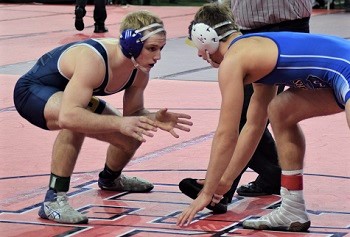
Colton finished third at 160 pounds at last year’s Division 2 Individual Wrestling Finals, a rise fueled by the competitive fires built during his youth.
“We used to have basement wrestling tournaments, and he used to kick my butt,” Colton said of Hunter. “I used to get so mad at him.”
The boys wrestled and sometimes fought at school, too.
“I always beat him,” Hunter said. “I remember one day I stopped and he came up to me and said, ‘I’m not going to let you whip my (butt) any more. It’s just not going to happen. That’s the day he started wrestling, and he’s been working his tail off ever since. It’s pushed me to work harder and get some goals in mind.”
As for the rivalry, “a year later, (Colton) started whipping my butt,” Hunter said, smiling. “It’s escalated from there.”
Both Blahas plan to compete in college, Hunter in football and Colton in wrestling. Both plan to become teachers, and Pringle has a not-so-subtle plan for Hunter.
“Colton is amazing in his own right,” Pringle said. “But Hunter, when he gets that degree, he’ll be head football coach at Owosso someday. We’re getting a new weight room, and I tell him, ‘I’ll have this ready for you when you take over.’ He’ll be a kid who impacts hundreds of kids before he’s done.”
But first, there’s a senior year to complete.
“It feels like it came up way too fast,” Hunter said. “It feels like yesterday I started at quarterback my sophomore year. I kind of get emotional about it. I don’t like talking about it. Most kids are ready to get out of here, to get their lives going. But I’ve been here since I was 6 years old, and it’s all I’ve ever known, playing with these kids.”
Colton Blaha is known as an athlete who’s the first to arrive at practice and the last to leave, almost to a fault.
“I have him in a fourth-hour class, and he always wants to get in a couple of extra sets,” Pringle said, chuckling. “He always leaves the room last, and sometimes I’m late for lunch because of it.”
A few lost minutes of lunch, though, has been a small price to pay.
“I know they’re going to do great things,” Lintner said. “They’re going to be great husbands. They’re going to be great fathers. They’re going to be great college athletes no matter what university they choose. We’re super proud of them, and as an educator, I’ve been fortunate to be with them the last four years of their journey.”
Asked what the most important thing is that they've gained through athletics, both brothers pause for several seconds before answering.
“Hard work can take you anywhere,” Colton said. “Always. Through hard work, you go through a lot of ups and downs, a lot of lefts and rights, but if you keep working hard, keep your head balanced, you can go anywhere.”
“Being a family, definitely,” Hunter said. “That’s what it’s all about. Life’s not always about football and athletics. You want to make your friendships and talk about these memories 20 years down the road.”
But the Blahas have done more than make memories. They’ve made an impact, one that will be felt ‘years down the road.’
PHOTOS: (Top) Colton, left, and brother Hunter Blaha. (Middle) Colton, left, begins his third-place match during last season’s Division 2 Individual Finals at Ford Field. (Middle photo by HighSchoolSportsScene.com.)