


Classes Still Create Hoosier Hysteria
July 27, 2017
By Rob Kaminski
MHSAA benchmarks editor
This is the fourth part in a series on MHSAA tournament classification, past and present, that will be published over the next two weeks. This series originally ran in this spring's edition of MHSAA benchmarks.
Twenty years ago, Bloomington North High School won the Indiana High School Athletic Association boys basketball championship, defeating Delta 75-54 at the RCA Dome in Indianapolis.
The date, March 22, 1997, is at the same time revered and disdained by traditionalists in the state who saw it as the last schoolboy championship game the state would ever host.
That’s how devout the game of basketball, particularly interscholastic basketball, had become in the Hoosier state during the 87 years a state champion – one state champion, to be precise – was crowned.
Following that 1997 season, the IHSAA moved to a four-class system for its roundball tournaments, like so many of its state association counterparts had done years earlier.
It would be shocking to find more than a small percentage of current high school basketball players around the country unfamiliar with the iconic movie Hoosiers, even though the film is now more than 30 years old.
And, the storyline for that blockbuster unfolded more than 30 years prior to its release, when small-town, undermanned Milan High School defeated Muncie Central High School 32-30 in the 1954 IHSAA title game.
Perhaps it’s because of the David vs Goliath notion, or the fame of the movie that replaced Milan with the fictional Hickory and real-life star Bobby Plump with Hollywood hero Jimmy Chitwood, or the simple fact that Indiana had something other states didn’t.
Whatever the reason, plenty of opposition remains to this day to basketball classification in the state.
The fact is, the small rural schools were regularly being beaten handily by the much larger suburban and city schools as the tournament progressed each season.
Small schools also were closing at a rapid rate following the state’s School Reorganization Act in 1959, as students converged on larger, centralized county schools. From 1960 to 2000, the number of schools entering the tournament dropped from 694 to 381, and in 1997 a total of 382 schools and 4,584 athletes began competition at the Sectional level (the first level of the IHSAA Basketball Tournament).
It was at the entry level of the tournament where school administrators felt the pain of the new class system, but not necessarily for the same nostalgic reasons as the fans who either attended or boycotted the tournament.
At the Sectional round of the tournament, the IHSAA was culling just 2 percent of the revenue, with the participating schools splitting the balance. So, when Sectional attendance dropped by 14 percent in that first year of class basketball, many schools realized a financial loss. It was money they had grown to count on in prior years to help fund various aspects of the department.
Schools cumulatively received more than $900,000 from Sectional competition in 1998, but that total was down from more than $1 million in the last year of the single-class tournament.
Yet, the current format provides a great deal more opportunity and realistic chances at championship runs for schools of all enrollments.
To date, 60 additional teams have championship or runner-up trophies on display in school trophy cases around Indiana.
That was the mission in front of then-IHSAA commissioner Bob Gardner (now National Federation executive director) once the board made its decision: to give thousands more student-athletes the opportunity for once-in-a-lifetime experiences.
As any statistician knows, figures can be manipulated to tell any side of a story. Declining attendance in year one of class basketball is such a number.
The truth is tournament attendance had been on a steady downward spiral since its peak of just over 1.5 million in 1962. By the last single-class event in 1997, the total attendance was half that.
The challenge then and today, as it is for all state associations, is to find that delicate balance for those holding onto tradition, those holding onto trophies, and the number of trophies to hand out.
Editor’s Note: Stories from the Fort Wayne Journal Gazette in 1998 and from a 2007 issue of Indianapolis Monthly provided facts in this article.
Breslin Bound: Girls Report Week 2
December 16, 2019
By Geoff Kimmerly
Second Half editor
By next Monday, many girls basketball teams in Michigan will have at least 20 percent of their regular-season games played.
 Given last season’s results and players expected back this winter, many of the most impressive performances were expected. But surprise teams are emerging already as well – and building toward what could be an exciting 2020.
This week’s “Breslin Bound” again highlights teams from both groups. “Breslin Bound” is powered by MI Student Aid and based on results and schedules posted for each school at MHSAA.com. Send corrections or missing scores to [email protected].
Week in Review
The countdown of last week’s five most intriguing results:
1. Detroit Renaissance 49, East Kentwood 47 – After defeating Wayne Memorial by 34 on Friday in a Best of Michigan Classic first-day game, the Phoenix further cemented their status as one of the early teams to watch in Division 1 by edging the Falcons during the event’s second day.
2. East Lansing 49, Williamson 30 – The Trojans have loaded their nonleague schedule with title contenders, and the Hornets are among teams with high Division 2 hopes this winter.
3. Detroit Edison 59, Bolingbrook, Ill. 52 – Edison opened its Best of Michigan Classic two-day run with an impressive win against one of Illinois’ annual powers.
4. Flint Carman-Ainsworth 58, Grass Lake 55 – Carman-Ainsworth also has Division 1 aspirations this season, while Grass Lake looks like a team to beat in Division 3.
5. Howell 50, DeWitt 46 OT – The Highlanders finished just above .500 last season but are well on their way after defeating Midland Dow to start last week and finishing by avenging last season’s 10-point loss to the Panthers.
Watch List
With an eye toward March, here are two teams in each division making sparks:
DIVISION 1
Ann Arbor Huron (5-0) Few if any teams can boast a more impressive group of early opponents, as Huron’s first five averaged 18 wins last season and included 2018-19 Division 1 semifinalists Muskegon and Wayne Memorial and Division 3 semifinalist Ypsilanti Arbor Prep. The River Rats finished 12-10 last season, but appear ready to make a major jump.
Muskegon Reeths-Puffer (4-0) The Rockets have been one of the best from a strong lakeshore area for a few seasons, and fell to eventual Division 1 semifinalist Muskegon by just four points in last year’s District Final. Last week’s win 52-43 win over annual power Grand Haven might be telling of what’s to come; Reeths-Puffer fell to the Buccaneers by 25 a year ago.
DIVISION 2
Battle Creek Harper Creek (3-0) Last season’s 15-8 run included a District title, but also two losses to Marshall and another to Battle Creek Central. Harper Creek’s perfect start this winter has included a one-point win over BCC and Friday’s 38-30 victory over Marshall – during which Maddie Alexander scored her 1,000th career point.
Sault Ste. Marie (3-0) The Blue Devils always are solid – last season’s 13 wins were their fewest since winning 12 games in 2012-13. The early returns this winter indicate something more could be in store – after losing last season to Escanaba and splitting with Gaylord, Sault Ste. Marie this time beat the Eskymos by seven and Gaylord’s Blue Devils by 45.
DIVISION 3
Ann Arbor Greenhills (4-0) The Gryphons are one of few if not the only team that already has surpassed last season’s win total, stacking up four after finishing 2018-19 at 3-14. All four this winter have been by nine points or more, with the 48-38 opening win over Westland Huron Valley Lutheran a 25-point swing from last season’s first-night meeting.
Gwinn (2-0) The Modeltowners opened their season last week, and what a week to remember. First came a 61-58 double-overtime win over Bark River-Harris – avenging last year’s 10-point loss. That was followed by Friday’s 50-40 victory over Iron Mountain – which the Marquette Mining Journal reported was Gwinn’s first win in a conference opener since 2010-11. The Modeltowners finished 12-10 last winter.
DIVISION 4
Plymouth Christian Academy (3-0) The initial spark may have lit during the 2018 postseason, as the Eagles entered 5-15 and advanced to a Regional Final. They improved to 12-8 overall last winter, and have opened this season in part by avenging last year’s losses to Division 1 Canton and Livonia Franklin.
St. Joseph Michigan Lutheran (4-0) Fast starts are nothing new to the Titans – they won their first 10 games last season and 11 of their first 12 in 2017-18. But that doesn’t make this early surge any less notable – four wins by an average of 31.5 points, a pretty great way to build on last season’s 18-3 finish.
Can't-Miss Contests
Be on the lookout for results of these games coming up:
Tuesday – Okemos (2-2) at Hartland (2-0) – The Eagles have opened with wins over two reigning Finals champions in Saginaw Heritage and Adrian Lenawee Christian, while Okemos’ two losses are by a combined five points.
Tuesday – Marquette (4-2) at Negaunee (3-1) – Marquette won 20 games last season and Negaunee won 16, with their first meeting going to the Miners by five and their second to the Redettes by a point.
Wednesday – Grass Lake (4-1) at Michigan Center (3-1) – Grass Lake was first and Michigan Center second in the Cascades Conference last season, but Michigan Center then defeated Grass Lake to win a District title.
Thursday – Midland Dow (2-1) at Midland (4-0) – Dow won last season’s three meetings by an average of 31 points, but Midland has nearly equaled last winter’s win total with an impressive start.
Friday – East Lansing (3-0) at DeWitt (2-1) – One of the state’s top rivalries saw the Division 1 powers split their two meetings and the Capital Area Activities Conference Blue title last season.
Second Half’s weekly “Breslin Bound” reports are powered by MI Student Aid, a part of the Office of Postsecondary Financial Planning located within the Michigan Department of Treasury. MI Student Aid encourages students to pursue postsecondary education by providing access to student financial resources and information. MI Student Aid administers the state’s 529 college savings programs (MET/MESP), as well as scholarship and grant programs that help make college Accessible, Affordable and Attainable for you. Connect with MI Student Aid at www.michigan.gov/mistudentaid and find more information on Facebook and Twitter @mistudentaid.
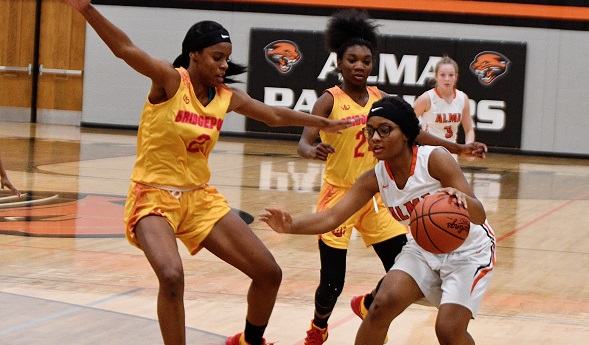
PHOTO: A pair of Bridgeport defenders wall off the lane during Friday’s 57-50 overtime loss to Alma. (Click for more from HighSchoolSportsScene.com.)