


Classes Still Create Hoosier Hysteria
July 27, 2017
By Rob Kaminski
MHSAA benchmarks editor
This is the fourth part in a series on MHSAA tournament classification, past and present, that will be published over the next two weeks. This series originally ran in this spring's edition of MHSAA benchmarks.
Twenty years ago, Bloomington North High School won the Indiana High School Athletic Association boys basketball championship, defeating Delta 75-54 at the RCA Dome in Indianapolis.
The date, March 22, 1997, is at the same time revered and disdained by traditionalists in the state who saw it as the last schoolboy championship game the state would ever host.
That’s how devout the game of basketball, particularly interscholastic basketball, had become in the Hoosier state during the 87 years a state champion – one state champion, to be precise – was crowned.
Following that 1997 season, the IHSAA moved to a four-class system for its roundball tournaments, like so many of its state association counterparts had done years earlier.
It would be shocking to find more than a small percentage of current high school basketball players around the country unfamiliar with the iconic movie Hoosiers, even though the film is now more than 30 years old.
And, the storyline for that blockbuster unfolded more than 30 years prior to its release, when small-town, undermanned Milan High School defeated Muncie Central High School 32-30 in the 1954 IHSAA title game.
Perhaps it’s because of the David vs Goliath notion, or the fame of the movie that replaced Milan with the fictional Hickory and real-life star Bobby Plump with Hollywood hero Jimmy Chitwood, or the simple fact that Indiana had something other states didn’t.
Whatever the reason, plenty of opposition remains to this day to basketball classification in the state.
The fact is, the small rural schools were regularly being beaten handily by the much larger suburban and city schools as the tournament progressed each season.
Small schools also were closing at a rapid rate following the state’s School Reorganization Act in 1959, as students converged on larger, centralized county schools. From 1960 to 2000, the number of schools entering the tournament dropped from 694 to 381, and in 1997 a total of 382 schools and 4,584 athletes began competition at the Sectional level (the first level of the IHSAA Basketball Tournament).
It was at the entry level of the tournament where school administrators felt the pain of the new class system, but not necessarily for the same nostalgic reasons as the fans who either attended or boycotted the tournament.
At the Sectional round of the tournament, the IHSAA was culling just 2 percent of the revenue, with the participating schools splitting the balance. So, when Sectional attendance dropped by 14 percent in that first year of class basketball, many schools realized a financial loss. It was money they had grown to count on in prior years to help fund various aspects of the department.
Schools cumulatively received more than $900,000 from Sectional competition in 1998, but that total was down from more than $1 million in the last year of the single-class tournament.
Yet, the current format provides a great deal more opportunity and realistic chances at championship runs for schools of all enrollments.
To date, 60 additional teams have championship or runner-up trophies on display in school trophy cases around Indiana.
That was the mission in front of then-IHSAA commissioner Bob Gardner (now National Federation executive director) once the board made its decision: to give thousands more student-athletes the opportunity for once-in-a-lifetime experiences.
As any statistician knows, figures can be manipulated to tell any side of a story. Declining attendance in year one of class basketball is such a number.
The truth is tournament attendance had been on a steady downward spiral since its peak of just over 1.5 million in 1962. By the last single-class event in 1997, the total attendance was half that.
The challenge then and today, as it is for all state associations, is to find that delicate balance for those holding onto tradition, those holding onto trophies, and the number of trophies to hand out.
Editor’s Note: Stories from the Fort Wayne Journal Gazette in 1998 and from a 2007 issue of Indianapolis Monthly provided facts in this article.
Davis Adding to Pittsford Winning Ways
December 13, 2019
By Doug Donnelly
Special for Second Half
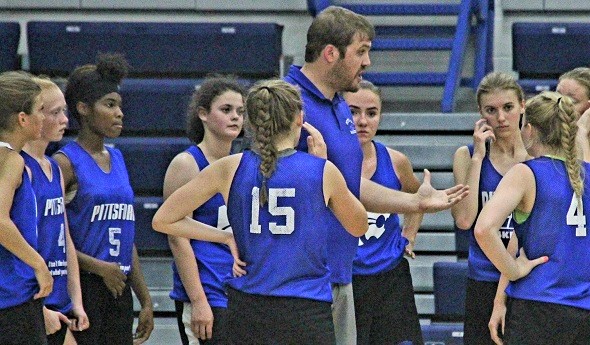
PITTSFORD – Aaron Davis doesn’t have to worry about rebuilding Pittsford girls basketball.
 While Davis is putting his own stamp on the program that has won two MHSAA Finals championships over the past five seasons, he knows the pieces already were in place when he was named the varsity head coach in June.
“There is a lot of ground work already in place at Pittsford,” said Davis. “It all starts with the youth level, and that’s already there. That is a blessing.”
Davis is in his first season at Pittsford and has the Wildcats off to a 3-0 start. He took over for Chris Hodos, who helped make Pittsford a household name in Class D girls basketball circles over the past decade.
“There are things that I do differently, but Chris and I shared a lot of the same philosophies about basketball,” said Davis, a 2007 graduate of North Adams-Jerome. “There are some things that we do that are from Chris. We still run some of the same presses.”
Davis was a three-sport athlete at North Adams-Jerome, playing basketball, football and baseball. He was a four-year varsity baseball player and spent a year on the Adrian College diamond, but an injury that dated back to his high school days cut his college career short.
“I tried it for a year, but it got to be too much stress on my body and arm,” he said.
Davis said that while growing up, his dad coached him in multiple sports. Davis also learned a lot from his high school coaches while playing at North Adams.
“My wife and I had always talked about me getting into coaching someday,” he said.
Davis got his start in coaching at his alma mater. He coached the junior varsity boys basketball team and had coached baseball with Hodos. In fact, when Hodos contacted him about coaching at Pittsford, Davis thought he was talking about baseball.
“After a few minutes, I was like, ‘Oh, you are talking about basketball,’” Davis said. “Chris was a great mentor. He helped me become a better coach.”
Davis spent three seasons as the Wildcats JV girls basketball coach. Hodos, he said, let him run the JV team as he wanted. That valuable experience has paid off in multiple ways early this winter.
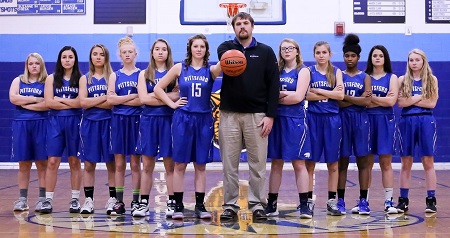
Pittsford’s 3-0 start includes wins over Hudson (41-25), Tekonsha (50-12) and Waldron (68-15). Thus far, the Wildcats are giving up just 17.3 points a game. That’s by design.
“We’re real athletic, and we play good defense,” Davis said. “I have a lot of great defenders. Everything starts with our defense.”
Davis said the team presses, often full-court, and likes to create havoc for the other team as it works to just get the ball over the timeline.
 “We are built to run, pressure and play fast,” he said. “We do a lot of trapping and try and force the other team into making bad passes. We like to try and create our offense with our defense.”
The Wildcats have 11 players: five seniors, four juniors and two sophomores. Jordyn Cole has been the team’s top scorer through three games. Another senior, Sara Cole, is right behind her. The other seniors are MaKayla McDaniel, Sam Leggett and Brooke Campbell.
“Jordyn and Sara, I’d say, take the majority of our shots,” Davis said, “but we really don’t have just one girl who can score for us. We don’t have that one player we rely on. We have girls up and down the line who are comfortable shooting. We like to spread it out.”
One thing that has helped in his transition is that every girl on the varsity roster played for Davis for at least a season. They all are familiar with him and his systems. He also brought on Greg Mallar to coach the Pittsford JV team. Mallar is also familiar to the girls because he has been coaching in the Wildcats youth program.
“He’s actually helped develop a lot of the girls,” Davis said.
Pittsford became a state power under Hodos. In his seven seasons as the head coach, the Wildcats went 156-14, including five consecutive 20-0 regular seasons and the Class D titles in 2016 and 2017. They fell just shy of Michigan’s record of 78 consecutive wins during that time frame.
Pittsford athletic director Mike Burger said the program is in good hands.
"I think that the way that he approaches coaching girls basketball fits quite nicely with the overall small-school athletics philosophy we have here at Pittsford,” Burger said.
The Wildcats play in the Southern Central Athletic Association with North Adams-Jerome, Jackson Christian, Hillsdale Academy and Camden-Frontier. Camden-Frontier and Hillsdale Academy both return several players from quality teams and also will play in the same District as Pittsford.
“It’s still early,” Davis said. “We’ve struggled at times offensively, but I’m not worried about that at this point. If we play up to our potential, we can make a run. But, like I said, it’s early. We’ll see what happens.”
 Doug Donnelly has served as a sports and news reporter and city editor over 25 years, writing for the Daily Chief-Union in Upper Sandusky, Ohio from 1992-1995, the Monroe Evening News from 1995-2012 and the Adrian Daily Telegram since 2013. He's also written a book on high school basketball in Monroe County and compiles record books for various schools in southeast Michigan. E-mail him at [email protected] with story ideas for Jackson, Washtenaw, Hillsdale, Lenawee and Monroe counties.
PHOTOS: (Top) First-year Pittsford varsity girls basketball coach Aaron Davis talks things over with his team during a practice this season. (Middle) Davis and his team are off to a 3-0 start. (Top photo courtesy of James Gensterblum; middle photo provided by Pittsford girls basketball program.)