


Classes Still Create Hoosier Hysteria
July 27, 2017
By Rob Kaminski
MHSAA benchmarks editor
This is the fourth part in a series on MHSAA tournament classification, past and present, that will be published over the next two weeks. This series originally ran in this spring's edition of MHSAA benchmarks.
Twenty years ago, Bloomington North High School won the Indiana High School Athletic Association boys basketball championship, defeating Delta 75-54 at the RCA Dome in Indianapolis.
The date, March 22, 1997, is at the same time revered and disdained by traditionalists in the state who saw it as the last schoolboy championship game the state would ever host.
That’s how devout the game of basketball, particularly interscholastic basketball, had become in the Hoosier state during the 87 years a state champion – one state champion, to be precise – was crowned.
Following that 1997 season, the IHSAA moved to a four-class system for its roundball tournaments, like so many of its state association counterparts had done years earlier.
It would be shocking to find more than a small percentage of current high school basketball players around the country unfamiliar with the iconic movie Hoosiers, even though the film is now more than 30 years old.
And, the storyline for that blockbuster unfolded more than 30 years prior to its release, when small-town, undermanned Milan High School defeated Muncie Central High School 32-30 in the 1954 IHSAA title game.
Perhaps it’s because of the David vs Goliath notion, or the fame of the movie that replaced Milan with the fictional Hickory and real-life star Bobby Plump with Hollywood hero Jimmy Chitwood, or the simple fact that Indiana had something other states didn’t.
Whatever the reason, plenty of opposition remains to this day to basketball classification in the state.
The fact is, the small rural schools were regularly being beaten handily by the much larger suburban and city schools as the tournament progressed each season.
Small schools also were closing at a rapid rate following the state’s School Reorganization Act in 1959, as students converged on larger, centralized county schools. From 1960 to 2000, the number of schools entering the tournament dropped from 694 to 381, and in 1997 a total of 382 schools and 4,584 athletes began competition at the Sectional level (the first level of the IHSAA Basketball Tournament).
It was at the entry level of the tournament where school administrators felt the pain of the new class system, but not necessarily for the same nostalgic reasons as the fans who either attended or boycotted the tournament.
At the Sectional round of the tournament, the IHSAA was culling just 2 percent of the revenue, with the participating schools splitting the balance. So, when Sectional attendance dropped by 14 percent in that first year of class basketball, many schools realized a financial loss. It was money they had grown to count on in prior years to help fund various aspects of the department.
Schools cumulatively received more than $900,000 from Sectional competition in 1998, but that total was down from more than $1 million in the last year of the single-class tournament.
Yet, the current format provides a great deal more opportunity and realistic chances at championship runs for schools of all enrollments.
To date, 60 additional teams have championship or runner-up trophies on display in school trophy cases around Indiana.
That was the mission in front of then-IHSAA commissioner Bob Gardner (now National Federation executive director) once the board made its decision: to give thousands more student-athletes the opportunity for once-in-a-lifetime experiences.
As any statistician knows, figures can be manipulated to tell any side of a story. Declining attendance in year one of class basketball is such a number.
The truth is tournament attendance had been on a steady downward spiral since its peak of just over 1.5 million in 1962. By the last single-class event in 1997, the total attendance was half that.
The challenge then and today, as it is for all state associations, is to find that delicate balance for those holding onto tradition, those holding onto trophies, and the number of trophies to hand out.
Editor’s Note: Stories from the Fort Wayne Journal Gazette in 1998 and from a 2007 issue of Indianapolis Monthly provided facts in this article.
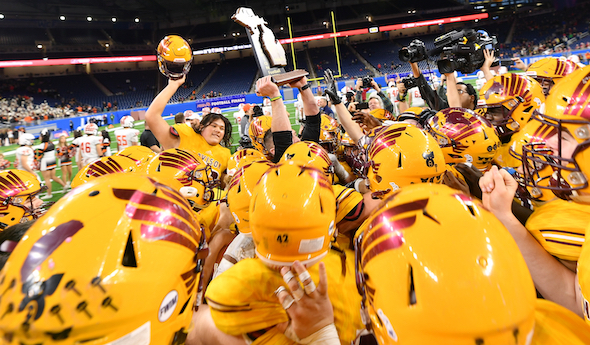
Davison Earns 1st-Time Football Glory
November 30, 2019
By Tom Kendra
Special for Second Half
DETROIT – Davison senior wide receiver Latrell Fordham strolled into the postgame press conference with his left arm in a sling, and an enormous smile on his face.
Fordham played a huge role in Davison’s 35-25 victory over Brighton in the MHSAA Division 1 Final on Saturday at Ford Field – before landing awkwardly and fracturing his left elbow late in the second quarter.
“It hurts a lot, and I need surgery, but winning a state championship overrides all of that,” said Fordham, a 6-foot-3 Ball State commit who had four catches for 88 yards before his injury, including an electrifying 74-yard sprint along the Davison sideline that helped his team assume control in the second quarter.
Davison (12-2) won the first football Finals championship in school history and the first title for a Saginaw Valley League school since 1999 Saginaw High, which was led by Charles Rogers and also featured LaMarr Woodley.
The Cardinals, who had won their first four playoff games in come-from-behind fashion powered by their running game, shifted gears completely Saturday.
Davison never trailed and pulled away behind an impressive passing attack, as 6-3 junior quarterback Brendan Sullivan completed 14-of-19 passes for 290 yards. He connected with six receivers.
Brighton coach Brian Lemons said after the game that his team was committed to shutting down the run, which made it susceptible through the air.
“We had to pick our poison,” said Lemons, whose team stunned top-ranked Belleville 22-19 in the Semifinals to earn its first Finals appearance. “We had some single coverage, and they did a great job of connecting in those situations.”
Sullivan opened the scoring on a one-yard plunge in the first quarter set up by a crucial two-yard, fourth-down completion to Fordham and a 14-yard pass to Harrison Terry on the next play. Terry led all receivers with six catches for 94 yards.
After a Brighton field goal narrowed the lead to 7-3 in the second quarter, second-year Davison coach Jake Weingartz seized on an opportunity to go for a home run.
“We had trips (three receivers) to one side and Latrell by himself on the other side,” explained Weingartz. “He had single coverage and the safety shaded to the trips side. We had to take a shot. We’re not going to beat our head against the wall and try to run against a loaded front.”
Fordham took off on a straight go route along the Davison sideline and Sullivan delivered a strike, which Fordham caught in stride as he sprinted the rest of the way for a 74-yard score and 14-3 lead.
 “We were waiting for the right moment, and on that play we had the matchup we wanted,” explained Fordham, who expects to miss a good portion of basketball season, but hopes to be back by March. “Brendan made a perfect throw. I just had to grab it and take it to the house.”
That play brought the huge crowd from Davison to its feet and seemingly opened the floodgates. The Cardinals scored on a one-yard run by Carter Cryderman before halftime and a 10-yard scramble run by Sullivan early in the third quarter to take a seemingly comfortable 28-3 lead.
Brighton (11-3) showed no quit, however, led by dual-threat senior quarterback Colby Newburg and junior running back Nicholas Nemecek.
The Bulldogs scored 16 points in a row – on a one-yard run by Nemecek and a 27-yard pass from Newburg to Nemecek (along with a pair of 2-point conversions) – to close to within 28-19 with four minutes remaining, bringing the orange-clad Brighton fans to life.
Newburg, a 6-0, 190-pound senior, completed 16-of-28 passes for 249 yards and two touchdowns, and also ran 22 times for 83 yards.
“All I can say is that I’m super proud of everybody,” said Newburg. “We fought to the end.”
With Brighton back within striking distance, Sullivan took his turn in the quarterback shootout.
He connected with senior Caleb Smith on a 63-yard pass down to the 1-yard line, which Cryderman took in on the next play to push the lead back to 35-19.
Even then, Brighton was still not done, as Newburg completed six passes on the next drive, including a three-yard TD connection with Austin Lin with 43 seconds remaining. It wasn’t until the ensuing 2-point conversion pass fell incomplete that the game was decided.
Davison finished with a slight 441-425 edge in total yardage, but it was the efficiency of Sullivan through the air which proved to be the difference.
“I told my coach to trust me in this game,” said Sullivan, who stepped up as a junior on the biggest stage. “I want the ball in my hands in those pressure situations.”
The game featured two schools making their first appearances in the Finals, which is becoming more and more rare after 45 years of MHSAA Playoffs, which began in 1975.
That first-time excitement was apparent as both communities turned out in droves at Ford Field, Brighton in orange and Davison in gold.
Adding to the excitement was the fact neither team was expected to make a long playoff run after finishing second in their respective conferences – Davison in the Saginaw Valley League Red (behind Lapeer) and Brighton in the Kensington Lakes Activities Association West (behind Plymouth).
Davison senior linebacker Logan Pasco was all over the field with a game-high 16 tackles, while Smith had nine tackles and defensive end Harry Unger made seven stops. Ian Hummel led Brighton with eight tackles, and Cole Riddle and Carson Billig each made six.
PHOTOS: (Top) Davison celebrates its first MHSAA Football Finals championship Saturday at Ford Field. (Middle) Brighton’s Ruben Salinas (1) keeps his eyes on a pass as Davison’s JayLen Murray Flowers works to deflect it.