


Classes Still Create Hoosier Hysteria
July 27, 2017
By Rob Kaminski
MHSAA benchmarks editor
This is the fourth part in a series on MHSAA tournament classification, past and present, that will be published over the next two weeks. This series originally ran in this spring's edition of MHSAA benchmarks.
Twenty years ago, Bloomington North High School won the Indiana High School Athletic Association boys basketball championship, defeating Delta 75-54 at the RCA Dome in Indianapolis.
The date, March 22, 1997, is at the same time revered and disdained by traditionalists in the state who saw it as the last schoolboy championship game the state would ever host.
That’s how devout the game of basketball, particularly interscholastic basketball, had become in the Hoosier state during the 87 years a state champion – one state champion, to be precise – was crowned.
Following that 1997 season, the IHSAA moved to a four-class system for its roundball tournaments, like so many of its state association counterparts had done years earlier.
It would be shocking to find more than a small percentage of current high school basketball players around the country unfamiliar with the iconic movie Hoosiers, even though the film is now more than 30 years old.
And, the storyline for that blockbuster unfolded more than 30 years prior to its release, when small-town, undermanned Milan High School defeated Muncie Central High School 32-30 in the 1954 IHSAA title game.
Perhaps it’s because of the David vs Goliath notion, or the fame of the movie that replaced Milan with the fictional Hickory and real-life star Bobby Plump with Hollywood hero Jimmy Chitwood, or the simple fact that Indiana had something other states didn’t.
Whatever the reason, plenty of opposition remains to this day to basketball classification in the state.
The fact is, the small rural schools were regularly being beaten handily by the much larger suburban and city schools as the tournament progressed each season.
Small schools also were closing at a rapid rate following the state’s School Reorganization Act in 1959, as students converged on larger, centralized county schools. From 1960 to 2000, the number of schools entering the tournament dropped from 694 to 381, and in 1997 a total of 382 schools and 4,584 athletes began competition at the Sectional level (the first level of the IHSAA Basketball Tournament).
It was at the entry level of the tournament where school administrators felt the pain of the new class system, but not necessarily for the same nostalgic reasons as the fans who either attended or boycotted the tournament.
At the Sectional round of the tournament, the IHSAA was culling just 2 percent of the revenue, with the participating schools splitting the balance. So, when Sectional attendance dropped by 14 percent in that first year of class basketball, many schools realized a financial loss. It was money they had grown to count on in prior years to help fund various aspects of the department.
Schools cumulatively received more than $900,000 from Sectional competition in 1998, but that total was down from more than $1 million in the last year of the single-class tournament.
Yet, the current format provides a great deal more opportunity and realistic chances at championship runs for schools of all enrollments.
To date, 60 additional teams have championship or runner-up trophies on display in school trophy cases around Indiana.
That was the mission in front of then-IHSAA commissioner Bob Gardner (now National Federation executive director) once the board made its decision: to give thousands more student-athletes the opportunity for once-in-a-lifetime experiences.
As any statistician knows, figures can be manipulated to tell any side of a story. Declining attendance in year one of class basketball is such a number.
The truth is tournament attendance had been on a steady downward spiral since its peak of just over 1.5 million in 1962. By the last single-class event in 1997, the total attendance was half that.
The challenge then and today, as it is for all state associations, is to find that delicate balance for those holding onto tradition, those holding onto trophies, and the number of trophies to hand out.
Editor’s Note: Stories from the Fort Wayne Journal Gazette in 1998 and from a 2007 issue of Indianapolis Monthly provided facts in this article.
Leader Re-Energizes Past Power Stevenson
By
Tom Markowski
Special for Second Half
November 22, 2019
Regardless of how one looks at it, Justin Newcomb is the right person for the right job at the right time.
 Newcomb, 33, is one of the youngest head football coaches in the Detroit area, and he’s causing a stir. He’s in his second season at Sterling Heights Stevenson and the person most responsible for the Titans playing in an MHSAA Division 1 Semifinal on Saturday for the first time in a decade.
Stevenson (8-4), as an additional playoff qualifier, has played the underdog role to a T throughout the playoffs. There’s an advantage to that role, and Stevenson will take it up again when it takes on Davison (10-2) at Troy Athens at 1 p.m.
Once a football power, Stevenson fell back to the middle of the pack in the highly competitive Macomb Area Conference Red from 2010-18. Four times previously the program had reached an MHSAA Final, the last in 2009 when the Titans lost to Detroit Catholic Central, 31-21, in the Division 1 title game.
That was Hall of Fame coach Rick Bye’s 35th and final season at Stevenson. Since then, the Titans qualified for the playoffs three times and didn’t win a playoff game. That is, until this season.
“You’ve got goals,” Newcomb said. “You set goals at the start (of the season), and you just want to get the most out of (your) team.”
When Newcomb took over, the program had won just three games over the previous two seasons. The Titans were 4-5 overall in 2018, and just 1-4 in the MAC Red, which was won by eventual Division 1 champion Clinton Township Chippewa Valley. The average margin of defeat in those four league losses was 25.5 points.
“We took our lumps (in the MAC Red),” Newcomb said. “The challenge was getting kids to come out. When we first came in there was some interest lost. We had to beg some to come out. Now that we’re winning, kids are saying they want to come out.”
Despite his young age, Newcomb has coached high school football for 14 seasons. He started as an assistant under Mike Powell at Warren Cousino in 2006 when Newcomb was a student at Wayne State University. For 10 seasons he was the head varsity baseball coach at Cousino, but he gave that up when he took over for Powell as Cousino’s head football coach in 2017.
Though Newcomb finds himself in the right position at Stevenson, don’t view Stevenson’s sudden success as luck. Newcomb possesses an insatiable appetite for knowledge. If there’s a clinic to attend, you’ll likely find Newcomb there. And his ego doesn’t prevent him from talking to more experienced coaches to pry loose valuable information. Most often you’ll find Bye on the Stevenson sideline, not as an assistant but someone there whom Newcomb can confide in.
“Justin is positive and energetic,” Bye said. “He’s definitely not a guy who thinks he knows it all. He’s bought into everything, the Stevenson history, everything. He’s up on technology, much more so than I ever was. And he doesn’t let little things bother him. His practices have a tempo, and there’s little time wasted.”
 Not lost in Newcomb’s system is his military background. After graduating from Wayne State with a teaching degree, he joined the U.S. Army Reserve in 2011. He continues to serve today in the Individual Ready Reserve (IRR).
“It has a lot to do with the way we coach,” Newcomb said of his military experience. “(Coaching) is a lot more than just what goes on on the field. There’s (teaching) leadership roles and being responsible. In our culture, it’s all about winning. It’s all about playing time. The kids get caught up in that.
“Their attitudes have changed. We had to address the group as a whole. We had guys that first year that said that they play linebacker, and that’s it. Others came in saying they just play one way. That’s not how we do it. You’re here to help the team. Now the kids are doing whatever we need them to.”
A prime example is junior Giovanni El-Hadi. A college prospect (committed to University of Michigan), El-Hadi had been told, by some outside of the program, that he was an offensive lineman and wouldn’t play defense. This season El-Hadi is starting on defense for the first time and said earlier this fall that his time spent on the defensive side has helped improve his speed.
Another two-way starter on the line is senior Sal Madonna. Madonna is a two-year starter, and he and his brother, sophomore Biagio Madonna, are the sons of assistant coach Carmine Madonna – who played for Bye during the late 1990s.
“For me, I’ve been a part of Stevenson football for a long time,” Sal Madonna said. “Last year’s team wasn’t as connected as much. This year we bonded together. We trusted Coach Newcomb’s style. Even last year as juniors (we knew) to be successful, we had to buy in. We didn’t have the same mindset last year. We’re playing with a lot more confidence now.
“This means a lot to me. I remember being in the stands (at Troy Athens) when Jason Fracassa threw a touchdown pass in the (2009) Semifinals. Just like this team, that team never gave up.”
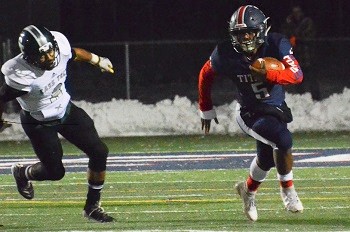
This team rebounded from a 2-3 start with a 13-7 comeback victory over Utica in Week 6. That game, more than others, was the turning point of the Titans’ season. Newcomb made a switch at quarterback, moving Biagio Madonna from linebacker and switching fellow sophomore Jordan Ramsey from quarterback to slot receiver and running back. With Ramsey, Newcomb was running a zone read offense. With Madonna, Stevenson is running an option attack.
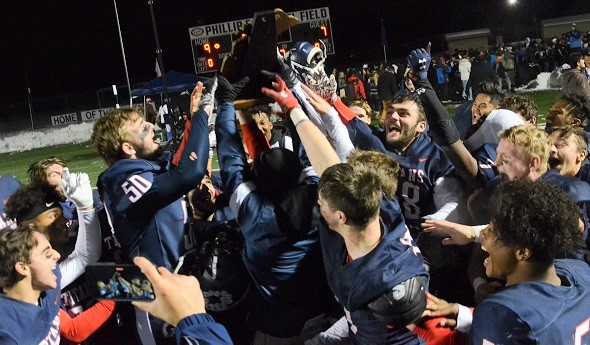
In the victory over Utica, Stevenson used a trick play to score the winning touchdown. Last week in the 9-7 Regional Final victory over Detroit Cass Tech, the Titans had a goal-line stand in the first half and scored the winning touchdown on a double pass. Madonna threw to Dylan Kleinedler, who threw to Ramsey for a touchdown early in the second half. A Ramsey interception ended the game with 14 seconds left.
The previous week against Macomb Dakota, Newcomb decided not to go for the tying field goal from 40 yards out, and instead called on Madonna to throw the winning touchdown pass to Ramsey with a minute to play. Stevenson won 38-35 against a team it had lost to, 40-14, during the regular season and before Newcomb had made the quarterback switch.
“We’ve been fortunate the last few weeks with trick plays,” Newcomb said. “(But) getting here is a testament on just how hard these kids have worked.”
 Tom Markowski is a correspondent for the State Champs! Sports Network and previously directed its web coverage. He also covered primarily high school sports for the The Detroit News from 1984-2014, focusing on the Detroit area and contributing to statewide coverage of football and basketball. Contact him at [email protected] with story ideas for Oakland, Macomb and Wayne counties.
PHOTOS: (Top) Sterling Heights Stevenson players hoist their Division 1 Regional championship trophy after defeating Detroit Cass Tech last week. (Middle) Jordan Ramsey (5) breaks into the open against the Technicians. (Photos courtesy of the Stevenson football program.)