


Classes Still Create Hoosier Hysteria
July 27, 2017
By Rob Kaminski
MHSAA benchmarks editor
This is the fourth part in a series on MHSAA tournament classification, past and present, that will be published over the next two weeks. This series originally ran in this spring's edition of MHSAA benchmarks.
Twenty years ago, Bloomington North High School won the Indiana High School Athletic Association boys basketball championship, defeating Delta 75-54 at the RCA Dome in Indianapolis.
The date, March 22, 1997, is at the same time revered and disdained by traditionalists in the state who saw it as the last schoolboy championship game the state would ever host.
That’s how devout the game of basketball, particularly interscholastic basketball, had become in the Hoosier state during the 87 years a state champion – one state champion, to be precise – was crowned.
Following that 1997 season, the IHSAA moved to a four-class system for its roundball tournaments, like so many of its state association counterparts had done years earlier.
It would be shocking to find more than a small percentage of current high school basketball players around the country unfamiliar with the iconic movie Hoosiers, even though the film is now more than 30 years old.
And, the storyline for that blockbuster unfolded more than 30 years prior to its release, when small-town, undermanned Milan High School defeated Muncie Central High School 32-30 in the 1954 IHSAA title game.
Perhaps it’s because of the David vs Goliath notion, or the fame of the movie that replaced Milan with the fictional Hickory and real-life star Bobby Plump with Hollywood hero Jimmy Chitwood, or the simple fact that Indiana had something other states didn’t.
Whatever the reason, plenty of opposition remains to this day to basketball classification in the state.
The fact is, the small rural schools were regularly being beaten handily by the much larger suburban and city schools as the tournament progressed each season.
Small schools also were closing at a rapid rate following the state’s School Reorganization Act in 1959, as students converged on larger, centralized county schools. From 1960 to 2000, the number of schools entering the tournament dropped from 694 to 381, and in 1997 a total of 382 schools and 4,584 athletes began competition at the Sectional level (the first level of the IHSAA Basketball Tournament).
It was at the entry level of the tournament where school administrators felt the pain of the new class system, but not necessarily for the same nostalgic reasons as the fans who either attended or boycotted the tournament.
At the Sectional round of the tournament, the IHSAA was culling just 2 percent of the revenue, with the participating schools splitting the balance. So, when Sectional attendance dropped by 14 percent in that first year of class basketball, many schools realized a financial loss. It was money they had grown to count on in prior years to help fund various aspects of the department.
Schools cumulatively received more than $900,000 from Sectional competition in 1998, but that total was down from more than $1 million in the last year of the single-class tournament.
Yet, the current format provides a great deal more opportunity and realistic chances at championship runs for schools of all enrollments.
To date, 60 additional teams have championship or runner-up trophies on display in school trophy cases around Indiana.
That was the mission in front of then-IHSAA commissioner Bob Gardner (now National Federation executive director) once the board made its decision: to give thousands more student-athletes the opportunity for once-in-a-lifetime experiences.
As any statistician knows, figures can be manipulated to tell any side of a story. Declining attendance in year one of class basketball is such a number.
The truth is tournament attendance had been on a steady downward spiral since its peak of just over 1.5 million in 1962. By the last single-class event in 1997, the total attendance was half that.
The challenge then and today, as it is for all state associations, is to find that delicate balance for those holding onto tradition, those holding onto trophies, and the number of trophies to hand out.
Editor’s Note: Stories from the Fort Wayne Journal Gazette in 1998 and from a 2007 issue of Indianapolis Monthly provided facts in this article.
Pirates' Football Voice Ends 30-Year Run
November 12, 2019
By Tim Robinson
Special for Second Half
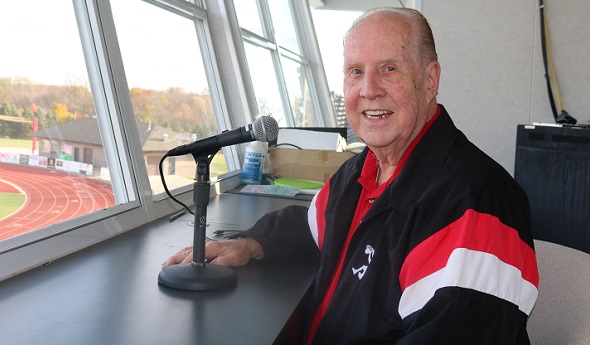
PINCKNEY — Bob Reason has been the voice of Pinckney High School football and basketball for more than 30 years.
 It’s his voice you heard over the public address system, good times and bad, through wins and losses.
He’s always played it down the middle, in the style of public address announcers at Michigan Stadium.
“I get excited when Pinckney scores,” he said in the Pinckney Stadium press box last week. ‘But I don’t want to take away from the athletes.”
Reason, a 1961 Pinckney graduate who moved back to the house he was born and grew up in during the mid-1980s, announced his last football game Oct. 11, Pinckney’s homecoming game.
Fittingly, it was against Dexter, where Reason lived for more than a decade and, with former Dreadnaughts athletic director Al Ritt, helped pass a bond issue in the 1970s that built a stadium now named for Ritt.
At 76, Reason decided it was time to retire.
“I just enjoyed doing it, but at 76, I feel it’s time,” he said.
He’ll still do Pinckney basketball for at least two more seasons. His son, Tom, is the boys coach and grandson Dylan is a junior.
“I’m going to try to sucker him into announcing for the girls program when my daughter is old enough to play,” Tom said, chuckling. “But he wants to sit in the stands, and sometimes it’s nice to sit there and be a grandpa.”
It will be a well-earned retirement for Reason, whose athletic career at Pinckney ended when he tore a knee ligament on the first play of his senior football season.
He became the Pirates public-address announcer after moving back to Pinckney from the Toledo area.
“One of his first games was announcing my brother’s games,” Tom Reason said. “I remember being a rug rat running around the stands. I thought it was pretty neat. When you’re a young one, you think your dad is the coolest dad in the world because his voice is coming out of the press box.
“To this day, my daughters love it. They always go up and visit him and he gives them candy. It’s a neat thing. I’ve been around Pinckney athletics for a long time, and it’s neat to hear his voice.”
Bob Reason has been active in the community too over the last 30-plus years. He’s served on the Pinckney athletic boosters board and spent a quarter-century running Saturday morning basketball programs at Pinckney, including enlisting varsity players as referees.
And it’s the athletes that kept bringing Bob Reason back to the microphone.
Well, that, and a slight bit of chicanery the last couple of years.
“He tried to retire, but I wouldn’t let him,” former Pinckney athletic director Tedd Bradley said.
“I was going to retire five years ago,” Reason said. “(Bradley) said, ‘OK, but we’ll have to find someone, so you have to do it this year. And then the next year, they didn’t find anyone.”
Current AD Brian Wardlow finally bent to Reason’s wishes this year, hiring Pat Allen, who worked the Pirates’ final home game against Jackson this season.
“There were a lot of people there (at homecoming), and people who had been around for decades got to hear one last game,” Wardlow said. “When I was in Pinckney, Bob was our football announcer, too, so he’s the only voice I’ve ever known in football and basketball.”
And, through his years working for Pinckney athletic programs, generations of Pinckney athletes know him and say hello.
“We went to Disney World as a family a few years ago, and three people came up to us. At Disney World,” Tom Reason said. “They come up and say, ‘Hey, Mr. Reason!’ We can’t go anywhere without someone knowing him.”
Bob Reason said part of the impetus toward retirement was his eyesight, which had been slowly failing due to cataracts the last couple of years. He credits his longtime spotter in the press box, Linda Lambert, with helping him credit the right athletes at the right time.
“Some of the teams that have played have white jerseys with white numbers outlined in black, and it’s hard to see the numbers,” he said. “I could not have done the games the last two years without her.”
The man in the PA booth, so calm with his delivery, is a Pinckney Pirate through and through.
Take the 1989 season, for example.
The Pirates had made the playoffs with an 8-1 record and had drawn a home game with East Grand Rapids in the first round. Below the “Welcome to Pinckney” sign outside of town, he and some co-conspirators hung a sign that said, “Welcome, East Grand Rapids. We’ve been waiting for you.”
East Grand Rapids won the game, 37-30 on a touchdown in the final minutes, and Reason went to Flint to see the Pioneers play Oxford in the next round.
“I had a Pinckney hat on,” Reason said, “and a guy from East Grand Rapids saw my hat and talked to me about the sign.”
The gentleman, as it turned out, was more than a little chapped about the sign.
“I said, ‘We just wanted to welcome you,’” Reason said, laughing at the memory.
After all these years, he said, the games and players all roll together in memory, but the lure of high school sports remains.
“I still think high school athletes give all they’ve got,” Reason said, “every game they play, regardless of position. Athletics is not just about winning. It’s about learning to play with your teammates, developing your skills, trying to be the best you can be and learning life lessons. I think one of the most important things high school athletics gives all of our kids is never to give up. Regardless of what happens in your life, there’s tomorrow, and never give up. Keep trying and keep working, and I think that carries forward into life itself.”
“He’s always super-complimentary about every kid who’s out there trying,” said Wardlow, who grew up in Pinckney and has been employed by the school district since 2002. “It’s important in a community like Pinckney to have that guy you can always count on, and the community knows what it’s going to get.”
Reason said he’s not going anywhere.
“I don’t have any interest in moving,” he said. “I talked about moving to Florida once. I said to my kids, ‘Do any of you want to buy the house? I’ll sell it for $500,000.’ I was joking, of course, and they said, ‘No, Dad. It’s too much. We’ll give you a dollar.’”
So Bob and his wife, Dorothy, are staying in Pinckney.
“The football team gave me a cushioned seat for the stands,” he said. ‘I’ll go to the home games. I love it. I like to watch the band play at halftime.”
Bradley, who retired in 2015, looks forward to attending games with his friend next fall.
“I will enjoy standing next to him at those games,” he said. “Bob is a tremendous gentlemen. He and his family are special people.”
PHOTO: Longtime Pinckney announcer Bob Reason takes his familiar seat in the stadium’s press box. (Photo by Tim Robinson.)