


Classes Still Create Hoosier Hysteria
July 27, 2017
By Rob Kaminski
MHSAA benchmarks editor
This is the fourth part in a series on MHSAA tournament classification, past and present, that will be published over the next two weeks. This series originally ran in this spring's edition of MHSAA benchmarks.
Twenty years ago, Bloomington North High School won the Indiana High School Athletic Association boys basketball championship, defeating Delta 75-54 at the RCA Dome in Indianapolis.
The date, March 22, 1997, is at the same time revered and disdained by traditionalists in the state who saw it as the last schoolboy championship game the state would ever host.
That’s how devout the game of basketball, particularly interscholastic basketball, had become in the Hoosier state during the 87 years a state champion – one state champion, to be precise – was crowned.
Following that 1997 season, the IHSAA moved to a four-class system for its roundball tournaments, like so many of its state association counterparts had done years earlier.
It would be shocking to find more than a small percentage of current high school basketball players around the country unfamiliar with the iconic movie Hoosiers, even though the film is now more than 30 years old.
And, the storyline for that blockbuster unfolded more than 30 years prior to its release, when small-town, undermanned Milan High School defeated Muncie Central High School 32-30 in the 1954 IHSAA title game.
Perhaps it’s because of the David vs Goliath notion, or the fame of the movie that replaced Milan with the fictional Hickory and real-life star Bobby Plump with Hollywood hero Jimmy Chitwood, or the simple fact that Indiana had something other states didn’t.
Whatever the reason, plenty of opposition remains to this day to basketball classification in the state.
The fact is, the small rural schools were regularly being beaten handily by the much larger suburban and city schools as the tournament progressed each season.
Small schools also were closing at a rapid rate following the state’s School Reorganization Act in 1959, as students converged on larger, centralized county schools. From 1960 to 2000, the number of schools entering the tournament dropped from 694 to 381, and in 1997 a total of 382 schools and 4,584 athletes began competition at the Sectional level (the first level of the IHSAA Basketball Tournament).
It was at the entry level of the tournament where school administrators felt the pain of the new class system, but not necessarily for the same nostalgic reasons as the fans who either attended or boycotted the tournament.
At the Sectional round of the tournament, the IHSAA was culling just 2 percent of the revenue, with the participating schools splitting the balance. So, when Sectional attendance dropped by 14 percent in that first year of class basketball, many schools realized a financial loss. It was money they had grown to count on in prior years to help fund various aspects of the department.
Schools cumulatively received more than $900,000 from Sectional competition in 1998, but that total was down from more than $1 million in the last year of the single-class tournament.
Yet, the current format provides a great deal more opportunity and realistic chances at championship runs for schools of all enrollments.
To date, 60 additional teams have championship or runner-up trophies on display in school trophy cases around Indiana.
That was the mission in front of then-IHSAA commissioner Bob Gardner (now National Federation executive director) once the board made its decision: to give thousands more student-athletes the opportunity for once-in-a-lifetime experiences.
As any statistician knows, figures can be manipulated to tell any side of a story. Declining attendance in year one of class basketball is such a number.
The truth is tournament attendance had been on a steady downward spiral since its peak of just over 1.5 million in 1962. By the last single-class event in 1997, the total attendance was half that.
The challenge then and today, as it is for all state associations, is to find that delicate balance for those holding onto tradition, those holding onto trophies, and the number of trophies to hand out.
Editor’s Note: Stories from the Fort Wayne Journal Gazette in 1998 and from a 2007 issue of Indianapolis Monthly provided facts in this article.
Reading 'Nightmare' 2-Way Gamechanger
November 8, 2019
By Doug Donnelly
Special for Second Half
READING – Nick Affholter didn’t score a point for the Reading Rangers this season. No touchdowns, no extra points, no 2-point conversions.
 But, when it came time to vote for the Most Valuable Player in the Big 8, the conference coaches left no doubt that Affholter – an offensive and defensive lineman – was the best player in the conference.
“As a coach, he has been my nightmare,” Concord coach Max Clark said.
“When game-planning for the last three years, we’ve had to begin our planning based on how we can avoid him,” said Matt Schwartzkopf, head coach at Springport.
Frank Keller of Jonesville recalled a specific play that painted the picture of Affholter’s impact.
“I remember one time we ran a sweep on the other side of the field, and he tackled our running back for a two-yard loss – on a sweep,” Keller said. “He was just dominant on both sides of the ball. He’s the best kid on the field.”
Those coaches are happy they won’t have to worry about Affholter anymore. Tonight, he’ll lead his 9-1 Rangers in a District Final against the undefeated Cassopolis Rangers. For Reading, it’s a chance to continue a journey that could the program back-to-back Division 8 championships. Both coaches will tell you the game starts up front, and that’s where Affholter excels.
“He’s been dominant the last couple of years,” Reading head coach Rick Bailey said. “I think last year our running back (Ethan LoPresto) stole a lot of the spotlight, but people knew how good Nick was. He’s the most dominant one-on-one football player that I’ve ever seen at the high school level. This is the first time I can remember in my 35 years that an offensive lineman was selected the league MVP.”
Affholter is a multi-sport, four-year varsity football player, a class officer at Reading – where he carries a 4.0 grade point average – and a member of the National Honor Society and leader of the school’s chapter of Fellowship of Christian Athletes.
“He’s humble and kind,” Bailey said. “He’s a total team player.”
Clark also saw something else in Affholter.
“He has never been anything but an amazing sport and leader,” the Concord coach said. “He stayed after, cleaning up the bench after a basketball game at our court when most of his team was all out chatting with family and friends.”
Reading is in the midst of a dominant run in football. When Affholter was a freshman, the Rangers had their second consecutive 3-6 season. As a sophomore they improved to 8-3, before bowing out of the Division 7 playoffs with a loss to Cassopolis. Last season, Reading ran the table, going 14-0 while scoring 678 points and giving up just 114 in finishing the season at Ford Field.
This year, Reading had to replace last year’s league MVP in LoPresto and started the season with a 14-0 loss to 2018 Division 7 champion Pewamo-Westphalia. Since then, however, the Rangers have been incredible, winning nine straight games while shutting out four opponents and outscoring all of them by a combined 449-38. Reading averages 420 yards rushing a game.
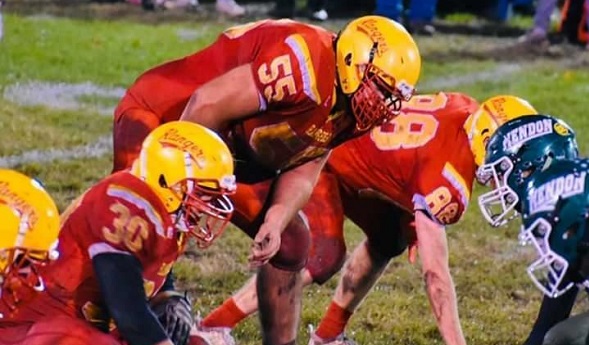
Affholter is a two-way starting lineman. On offense, he plays tackle and gives Bailey the closest thing to a sure thing.
“We’ve been able to dominate teams on his side. We just count on Nick’s block as a win,” Bailey said. “His technique is good, but I think people would be surprised of how athletic he is. If they watch him, they’ll see he can run. People are always surprised with his quickness and foot speed. It’s hard to simulate what he’s going to do.”
 Affholter is also a difference-maker on defense.
“Two of our opponents simply chose not to run the football, and only a few tried to run it on his side,” Bailey said. “One team just lined up and threw the ball on every single play, except the last play of the game when they ran the ball when he was out.”
Clark said Concord tried something completely different against Reading.
“I showed up to Reading with a completely different offense because of him and his brother,” Clark said.
Reading still pulled out a 44-12 win.
Affholter has taken the postseason accolades in stride.
“I worked really hard for it,” he said. “It’s nice to see offensive lineman get some love. Just because we don’t touch the ball doesn’t mean we aren’t impacting the game.
“I don’t know how many offensive linemen get recognized like that. I figured I’d get all-conference, and that would be that. Seeing other people notice me and not just a running back or quarterback is pretty awesome.”
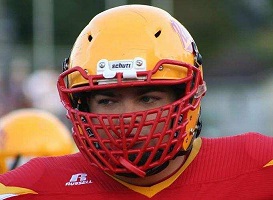
Affholter said he is 6-foot-3, 300 pounds, which makes him a half-inch taller and 20 pounds heavier than his twin brother Ben.
“I love playing football with my brother,” Nick said. “We do everything together. My little brother is up on the team now. He’s 6-foot, 230. He’s still growing.”
Their dad was an All-American offensive lineman at Hillsdale College, and their mom played volleyball there. Nick started playing football in grade school, where his grandfather began teaching him footwork.
“I love finishing my blocks,” he said. “I get excited when I get a pancake block. That was always special to me.”
He’s a student of the game, too, spending hours each week studying film of his opponent.
“I watch a lot of film of the defensive linemen or the offensive linemen,” Affholter said. “You can figure out what they are going to do in certain situations, see what their favorite move is. You know what to look for when the play starts. It definitely gives you an edge.”
Reading is sure to lean on Affholter tonight. The visiting Rangers have been just as stout as the home Rangers, outscoring opponents 403-17 this season.
“It’s going to be a great game,” Bailey said. “They are a big play waiting to happen.”
Affholter says the Reading home crowd will be rocking at Barre Field.
“Being out there on the football field is home,” he said. “It’s amazing. Every Friday night the stands are always full. I think it rivals any small-town football community anywhere.”
 Doug Donnelly has served as a sports and news reporter and city editor over 25 years, writing for the Daily Chief-Union in Upper Sandusky, Ohio from 1992-1995, the Monroe Evening News from 1995-2012 and the Adrian Daily Telegram since 2013. He's also written a book on high school basketball in Monroe County and compiles record books for various schools in southeast Michigan. E-mail him at [email protected] with story ideas for Jackson, Washtenaw, Hillsdale, Lenawee and Monroe counties.
FOOTBALL: (Top) Reading’s Nick Affholter lines up against Mendon during last week’s 38-0 playoff win. (Middle) Affholter, who also has a twin and younger brother on the varsity. (Photos courtesy of the Reading athletic department.)