


Classes Still Create Hoosier Hysteria
July 27, 2017
By Rob Kaminski
MHSAA benchmarks editor
This is the fourth part in a series on MHSAA tournament classification, past and present, that will be published over the next two weeks. This series originally ran in this spring's edition of MHSAA benchmarks.
Twenty years ago, Bloomington North High School won the Indiana High School Athletic Association boys basketball championship, defeating Delta 75-54 at the RCA Dome in Indianapolis.
The date, March 22, 1997, is at the same time revered and disdained by traditionalists in the state who saw it as the last schoolboy championship game the state would ever host.
That’s how devout the game of basketball, particularly interscholastic basketball, had become in the Hoosier state during the 87 years a state champion – one state champion, to be precise – was crowned.
Following that 1997 season, the IHSAA moved to a four-class system for its roundball tournaments, like so many of its state association counterparts had done years earlier.
It would be shocking to find more than a small percentage of current high school basketball players around the country unfamiliar with the iconic movie Hoosiers, even though the film is now more than 30 years old.
And, the storyline for that blockbuster unfolded more than 30 years prior to its release, when small-town, undermanned Milan High School defeated Muncie Central High School 32-30 in the 1954 IHSAA title game.
Perhaps it’s because of the David vs Goliath notion, or the fame of the movie that replaced Milan with the fictional Hickory and real-life star Bobby Plump with Hollywood hero Jimmy Chitwood, or the simple fact that Indiana had something other states didn’t.
Whatever the reason, plenty of opposition remains to this day to basketball classification in the state.
The fact is, the small rural schools were regularly being beaten handily by the much larger suburban and city schools as the tournament progressed each season.
Small schools also were closing at a rapid rate following the state’s School Reorganization Act in 1959, as students converged on larger, centralized county schools. From 1960 to 2000, the number of schools entering the tournament dropped from 694 to 381, and in 1997 a total of 382 schools and 4,584 athletes began competition at the Sectional level (the first level of the IHSAA Basketball Tournament).
It was at the entry level of the tournament where school administrators felt the pain of the new class system, but not necessarily for the same nostalgic reasons as the fans who either attended or boycotted the tournament.
At the Sectional round of the tournament, the IHSAA was culling just 2 percent of the revenue, with the participating schools splitting the balance. So, when Sectional attendance dropped by 14 percent in that first year of class basketball, many schools realized a financial loss. It was money they had grown to count on in prior years to help fund various aspects of the department.
Schools cumulatively received more than $900,000 from Sectional competition in 1998, but that total was down from more than $1 million in the last year of the single-class tournament.
Yet, the current format provides a great deal more opportunity and realistic chances at championship runs for schools of all enrollments.
To date, 60 additional teams have championship or runner-up trophies on display in school trophy cases around Indiana.
That was the mission in front of then-IHSAA commissioner Bob Gardner (now National Federation executive director) once the board made its decision: to give thousands more student-athletes the opportunity for once-in-a-lifetime experiences.
As any statistician knows, figures can be manipulated to tell any side of a story. Declining attendance in year one of class basketball is such a number.
The truth is tournament attendance had been on a steady downward spiral since its peak of just over 1.5 million in 1962. By the last single-class event in 1997, the total attendance was half that.
The challenge then and today, as it is for all state associations, is to find that delicate balance for those holding onto tradition, those holding onto trophies, and the number of trophies to hand out.
Editor’s Note: Stories from the Fort Wayne Journal Gazette in 1998 and from a 2007 issue of Indianapolis Monthly provided facts in this article.
Rivals Share D1 Title, Baylis Ends on Top
October 19, 2019
By Perry A. Farrell
Special for Second Half
MIDLAND – Tom Pullen was just glad to be in the hunt.
The 28-year Ann Arbor Pioneer head coach, who is 75½ years old, had his team in a dead heat with rival Huron for the MHSAA Lower Peninsula Division 1 boys tennis title Saturday at the Midland Tennis Center. They were separated by one point, 21-20, going into semifinal play.
“I don’t care whether we win or lose,’’ Pullen said at that point. “This is a Cinderella group. We’re young. I’m losing three great net players, but it has been a long time since we’ve been in contention. This keeps me revitalized. We’ve had a great year. We knew Huron would be here. They’re a powerful team. We’ve beaten them a few times, and they’ve beaten us. We don’t really care about rankings. The kids have beaten teams ranked higher than them, so it doesn’t matter.
“No matter what, it has been a great year.’’
Two rounds later, the rivals finished in a tie and as co-champions. Pioneer won its last three matches to deadlock the score 27-27, capturing a share of the crown.
The key match late in the day was at No. 3 doubles with top-seeded Huron pair Sammy Clyde and Jacob Hejazi against Pioneer’s Drake Malcolm and Evan Roopas for the fourth time this year.
Clyde had been part of a doubles title last year and needed a win with Hejazi to clinch the team championship.
“We tied the first match because we couldn’t finish,’’ said Hejazi of the rivalry with Pioneer. “We won one and they won one, so this is the tie breaker. It’s easier because we know their weaknesses, but they also know ours.’’
Pioneer prevailed, 6-2, 5-7, 6-3 to pave the way for a possible team tie.
While No. 3 doubles was fighting it out, Isaac Herrenkohl also kept Pioneer’s hopes alive with a 1-6, 7-5, 6-3 victory over top seed Noah Fascewski of Clarkston in No. 3 singles.
Pioneer and Huron have not only battled in conference play, but on the big stage.
Bloomfield Hills won back-to-back titles in 2017 and 2018, but before that the River Rats won in 2013, 2012, 2011 and 2008.
Pullen, who started playing tennis when he was 35, and Pioneer won the fall and spring team title in 2007 along with championships in 2006, 2005, 2004, 2003 and 2002. Pioneer tied for first in 2001 with Birmingham Brother Rice.
Despite being out of the team picture, Clarkston had three players make it to a singles final at Nos. 1, 2 and 3.
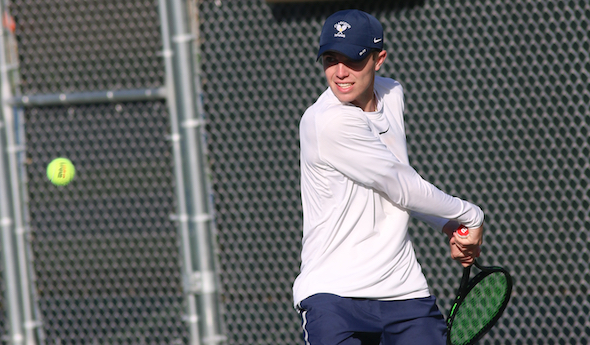
At No. 1 singles, Clarkston’s Luke Baylis took advantage of a fatigued J.J. Etterbeek of Birmingham Rice to capture the crown, 6-2, 6-0. He joined his sister Lexi as a Finals champ, as she won No. 2 singles in 2011. Luke Baylis had made the No. 1 semifinals the last two seasons and finished No. 2 runner-up as a freshman.
“I tried to play my game and not focus on what was going on around me,’’ said Luke Baylis. “I could tell he was a little tired. I just worked the points really well and tried to stay in every point. This was my last match, so I tried to grind out every point.’’
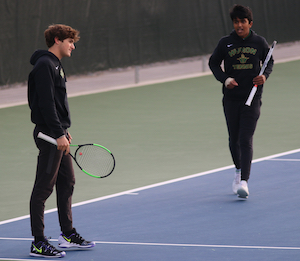 Huron’s first flight title of the tournament came in No. 2 doubles as Nick Grosh and TJ Bai downed Pioneer’s Brendan Karsch and Aditya Abbaraju 6-1, 6-2.
“We’ve played them five times this year and five times last year,’’ said Bai, a junior. “We’ve been the top seed the last three years, and I think the past two years we choked. We got beat in the semis.
“This was important for my team. I thought we controlled the match from the start. Because the team title was at stake, the pressure was on.’’
Moments after their victory, Huron’s top-seeded No. 4 doubles team of Nikhil Gandikota and Vincent Tremonti finished defeating Northville’s Rachit Jain and Rohith Kesamneni, 6-3, 6-4.
“We beat them during the regular season, but during the state tournament anything can happen,’’ said Tremonti.
Said Gandikota: “They were hard, but both matches against Northville and (in the semifinal Detroit) CC were tough. The Catholic Central match went three sets and that was rough; we started out slow. Against Northville we upped our energy and maintained it.’’
Old friends battled it out in No. 2 singles with second-seed Frank Piana from Clarkston facing top seed Jan Nallani from Troy. Nallani made it two wins on the year against Piana with a 7-5, 6-1 victory.
“We’ve known each other since we were 10 years old,’’ said Piana, the No. 3 singles champ in 2018. “I’ve had just one loss this season, and it was to him. We’re good friends. It puts a different spin on the match.’’
Okemos’ No. 1 doubles team of Druv Talluri and Siddharth Nagisetty formed an experienced duo. Talluri and Nagisetty both won 2017 doubles titles in Division 2 with different teammates – Nagisetty with Rohan Shah at No. 2 and Talluri with Deniz Kalfa at No. 3. In 2018, Talluri won No. 2 with Shrey Patel and Nagisetty was runner-up at No. 3 with Aditya Kandula.
This time, Talluri and Nagisetty teamed up to form the top seed in the top flight and in the final defeated Huron’s Max Brodkey and Anvit Rao 6-1, 6-3.
“After my win freshman year in 2017, some of the players changed positions and I lost my then-partner to a singles position” said Nagisetty. “We lost in the finals in 2018, so this year I was a little more focused on my fitness and conditioning. I cramped up last year in the finals. I was not going to let it happen again.
“It was a higher flight, one doubles. Druv is great. He has a great forehand and backhand and has a super good volley. That was awesome to end the season this way!’’
PHOTOS: (Top) Clarkston’s Luke Baylis returns a volley during his No. 1 singles semifinal at Midland Tennis Center. (Middle) Ann Arbor Huron’s Max Brodkey and Anvit Rao get together during their No. 1 doubles semifinal win. (Click to see more from HighSchoolSportsScene.com.)