


Classes Still Create Hoosier Hysteria
July 27, 2017
By Rob Kaminski
MHSAA benchmarks editor
This is the fourth part in a series on MHSAA tournament classification, past and present, that will be published over the next two weeks. This series originally ran in this spring's edition of MHSAA benchmarks.
Twenty years ago, Bloomington North High School won the Indiana High School Athletic Association boys basketball championship, defeating Delta 75-54 at the RCA Dome in Indianapolis.
The date, March 22, 1997, is at the same time revered and disdained by traditionalists in the state who saw it as the last schoolboy championship game the state would ever host.
That’s how devout the game of basketball, particularly interscholastic basketball, had become in the Hoosier state during the 87 years a state champion – one state champion, to be precise – was crowned.
Following that 1997 season, the IHSAA moved to a four-class system for its roundball tournaments, like so many of its state association counterparts had done years earlier.
It would be shocking to find more than a small percentage of current high school basketball players around the country unfamiliar with the iconic movie Hoosiers, even though the film is now more than 30 years old.
And, the storyline for that blockbuster unfolded more than 30 years prior to its release, when small-town, undermanned Milan High School defeated Muncie Central High School 32-30 in the 1954 IHSAA title game.
Perhaps it’s because of the David vs Goliath notion, or the fame of the movie that replaced Milan with the fictional Hickory and real-life star Bobby Plump with Hollywood hero Jimmy Chitwood, or the simple fact that Indiana had something other states didn’t.
Whatever the reason, plenty of opposition remains to this day to basketball classification in the state.
The fact is, the small rural schools were regularly being beaten handily by the much larger suburban and city schools as the tournament progressed each season.
Small schools also were closing at a rapid rate following the state’s School Reorganization Act in 1959, as students converged on larger, centralized county schools. From 1960 to 2000, the number of schools entering the tournament dropped from 694 to 381, and in 1997 a total of 382 schools and 4,584 athletes began competition at the Sectional level (the first level of the IHSAA Basketball Tournament).
It was at the entry level of the tournament where school administrators felt the pain of the new class system, but not necessarily for the same nostalgic reasons as the fans who either attended or boycotted the tournament.
At the Sectional round of the tournament, the IHSAA was culling just 2 percent of the revenue, with the participating schools splitting the balance. So, when Sectional attendance dropped by 14 percent in that first year of class basketball, many schools realized a financial loss. It was money they had grown to count on in prior years to help fund various aspects of the department.
Schools cumulatively received more than $900,000 from Sectional competition in 1998, but that total was down from more than $1 million in the last year of the single-class tournament.
Yet, the current format provides a great deal more opportunity and realistic chances at championship runs for schools of all enrollments.
To date, 60 additional teams have championship or runner-up trophies on display in school trophy cases around Indiana.
That was the mission in front of then-IHSAA commissioner Bob Gardner (now National Federation executive director) once the board made its decision: to give thousands more student-athletes the opportunity for once-in-a-lifetime experiences.
As any statistician knows, figures can be manipulated to tell any side of a story. Declining attendance in year one of class basketball is such a number.
The truth is tournament attendance had been on a steady downward spiral since its peak of just over 1.5 million in 1962. By the last single-class event in 1997, the total attendance was half that.
The challenge then and today, as it is for all state associations, is to find that delicate balance for those holding onto tradition, those holding onto trophies, and the number of trophies to hand out.
Editor’s Note: Stories from the Fort Wayne Journal Gazette in 1998 and from a 2007 issue of Indianapolis Monthly provided facts in this article.
White Pigeon Building On 2018 Surge
By
Wes Morgan
Special for MHSAA.com
September 10, 2019
There won’t be any halftime ceremonies years from now celebrating the White Pigeon football team’s accomplishments in 2018. There’s no engraved award to display in the trophy case.
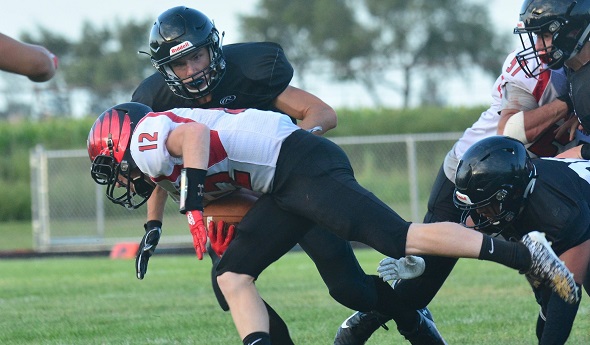
 But the Chiefs’ 7-3 season certainly rejuvenated the program and its supporters.
That it will spark prolonged success remains to be seen, admitted second-year head coach Shawn Strawser, who isn’t interested in making bold predictions. What he can say with certainty is his players are committed, disciplined, physical and hungry for another taste.
Leading up to last fall, White Pigeon had just one winning season (5-4 in 2014) since its last playoff appearance in 2009, a year that resulted in a 9-2 mark with a Division 7 Pre-District win over Decatur. Last year, the schedule paired the Chiefs with what would turn out to be the top two teams in the Southwest 10 Conference during the first three weeks of the season. Losses to Centreville (22-12) and Cassopolis (28-12) sandwiched a 38-8 victory over Marcellus. But White Pigeon went on to win its final six regular-season games to qualify for the postseason, a march which included the program’s first win over Mendon in 20 years (although the Hornets got revenge in the Division 8 Pre-District round with an 8-6 win over White Pigeon).
It all happened quickly from Strawser’s perspective. When Joseph Morsaw resigned as the head coach at the end of 2017, administrators turned to Strawser and Mike Gropp — a duo with past varsity experience who had spent recent years guiding the middle school program. Strawser was just about to leave for a vacation in St. Lucia and needed to think about whether he wanted to deal with everything that comes with the top spot at the varsity level.
“I called Mike and I was like, ‘We’re going to have to do this, aren’t we?’” Strawser said. “Mike was like, ‘Yep.’
“We had a nice group of seniors. I had actually coached those kids when they were in Rocket. I knew them all real well.”
Strawser also knew he needed to do a little recruiting, starting with then-junior Stone Kemp, who turned his focus as a freshman and sophomore to leading a Bible study after school rather than playing football.
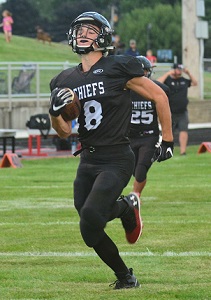 “He’s very persuasive, and so he got me back into it,” said Kemp, who finished with 398 rushing yards on 82 carries (4.9 per carry) and seven touchdowns as the Chiefs’ second back behind senior Carlos Castro in 2018. “I decided it would be a good place to be, and I think that’s where God wanted me.”
The benefits were twofold, Strawser said. It was obvious what Kemp brought to the team in terms of production, but Strawser noticed the positive impact Kemp had on his teammates as well.
“He’s a great athlete and an even better kid,” Strawser explained. “He is truly an all-around football player. Last year he played defensive end and outside linebacker. We stuck him out to cover one-on-one. This year we moved him back to safety. He has great hands and can pretty much do anything we ask him to do. He’s such a versatile player. He picked it up pretty fast for being out a couple years. He popped right back in like he didn’t miss a beat.”
To open the 2019 season, Kemp rushed for three touchdowns and returned the opening kickoff for a score in a 54-0 White Pigeon victory over Bloomingdale. He caught a touchdown pass in Week 2 in the Chiefs’ 14-8 win at Decatur, which required a goal-line stand during the final minute.
“It has been very enjoyable,” Strawser said of the program’s turnaround. “That was the whole point. On the bubble wasn’t good enough. We really wanted these kids to buy in, believe what we were doing and reap the rewards of their hard work. We preached every day mental toughness.
“Each time we had a successful game the confidence just grew. It has been a real fun ride. They were eager to do well. It paid off. We haven’t earned anything or proved anything this year yet, so we just have to keep grinding away.”
Though the Chiefs lost a ton of talent to graduation, people familiar with the program believed they could fill those voids. With 19 players on the roster, including three sophomores, the Chiefs have been able to do that, including a great effort from an offensive line that consists of a mix of experience and youth.
Captain and three-year starter Kobie DeBruine, a tackle who can play guard, sets the tone for a group that includes capable tight ends Dominick Pant – who has packed on 20 pounds of muscle since last season – and Chris Bontrager, guards Beau Freedline and Luke Gropp, and sophomore center Lane Esarey.
“That was the biggest question mark going into this season is that we were pretty young on the offensive line,” said Strawser, whose son, Lincoln Strawser, is back as a senior to guide the offense at quarterback. “They really got to work and made a lot of improvement from the scrimmage to Week 1.”
Now the Chiefs are after their first playoff victory since 2009 and fourth since 1990.
“We’re just looking for big things this year,” Kemp said. “This year I know it’s my last year to do it, so I just want to make the most out of every opportunity I get. I kind of like how people underrate us because it gives us a chance to show what we’ve got.”
 Wes Morgan has reported for the Kalamazoo Gazette, ESPN and ESPNChicago.com, 247Sports and Blue & Gold Illustrated over the last 12 years and is the publisher of JoeInsider.com. He can be reached at [email protected] with story ideas for Berrien, Cass, St. Joseph and Branch counties.
PHOTOS: (Top) White Pigeon defenders track down a ball carrier during their Week 1 win over Bloomingdale. (Middle) Stone Kemp breaks away on a long run. (Photos by John Gentry.)