


Classes Still Create Hoosier Hysteria
July 27, 2017
By Rob Kaminski
MHSAA benchmarks editor
This is the fourth part in a series on MHSAA tournament classification, past and present, that will be published over the next two weeks. This series originally ran in this spring's edition of MHSAA benchmarks.
Twenty years ago, Bloomington North High School won the Indiana High School Athletic Association boys basketball championship, defeating Delta 75-54 at the RCA Dome in Indianapolis.
The date, March 22, 1997, is at the same time revered and disdained by traditionalists in the state who saw it as the last schoolboy championship game the state would ever host.
That’s how devout the game of basketball, particularly interscholastic basketball, had become in the Hoosier state during the 87 years a state champion – one state champion, to be precise – was crowned.
Following that 1997 season, the IHSAA moved to a four-class system for its roundball tournaments, like so many of its state association counterparts had done years earlier.
It would be shocking to find more than a small percentage of current high school basketball players around the country unfamiliar with the iconic movie Hoosiers, even though the film is now more than 30 years old.
And, the storyline for that blockbuster unfolded more than 30 years prior to its release, when small-town, undermanned Milan High School defeated Muncie Central High School 32-30 in the 1954 IHSAA title game.
Perhaps it’s because of the David vs Goliath notion, or the fame of the movie that replaced Milan with the fictional Hickory and real-life star Bobby Plump with Hollywood hero Jimmy Chitwood, or the simple fact that Indiana had something other states didn’t.
Whatever the reason, plenty of opposition remains to this day to basketball classification in the state.
The fact is, the small rural schools were regularly being beaten handily by the much larger suburban and city schools as the tournament progressed each season.
Small schools also were closing at a rapid rate following the state’s School Reorganization Act in 1959, as students converged on larger, centralized county schools. From 1960 to 2000, the number of schools entering the tournament dropped from 694 to 381, and in 1997 a total of 382 schools and 4,584 athletes began competition at the Sectional level (the first level of the IHSAA Basketball Tournament).
It was at the entry level of the tournament where school administrators felt the pain of the new class system, but not necessarily for the same nostalgic reasons as the fans who either attended or boycotted the tournament.
At the Sectional round of the tournament, the IHSAA was culling just 2 percent of the revenue, with the participating schools splitting the balance. So, when Sectional attendance dropped by 14 percent in that first year of class basketball, many schools realized a financial loss. It was money they had grown to count on in prior years to help fund various aspects of the department.
Schools cumulatively received more than $900,000 from Sectional competition in 1998, but that total was down from more than $1 million in the last year of the single-class tournament.
Yet, the current format provides a great deal more opportunity and realistic chances at championship runs for schools of all enrollments.
To date, 60 additional teams have championship or runner-up trophies on display in school trophy cases around Indiana.
That was the mission in front of then-IHSAA commissioner Bob Gardner (now National Federation executive director) once the board made its decision: to give thousands more student-athletes the opportunity for once-in-a-lifetime experiences.
As any statistician knows, figures can be manipulated to tell any side of a story. Declining attendance in year one of class basketball is such a number.
The truth is tournament attendance had been on a steady downward spiral since its peak of just over 1.5 million in 1962. By the last single-class event in 1997, the total attendance was half that.
The challenge then and today, as it is for all state associations, is to find that delicate balance for those holding onto tradition, those holding onto trophies, and the number of trophies to hand out.
Editor’s Note: Stories from the Fort Wayne Journal Gazette in 1998 and from a 2007 issue of Indianapolis Monthly provided facts in this article.
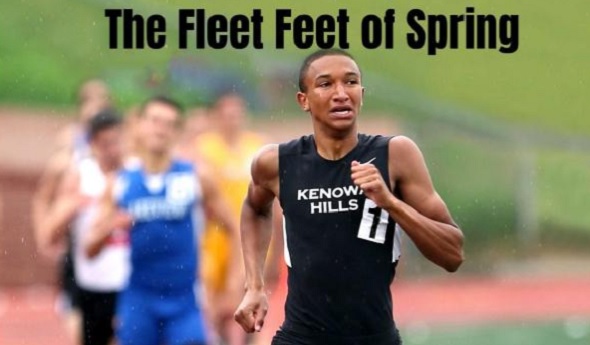
'Fleet Feet' Tells Story of State HS Track
August 30, 2019
By Geoff Kimmerly
Second Half editor
As a Hall of Fame radio broadcaster, Jim Moyes has told stories of high school sports for more than 50 years – and helped others do the same with his contributions as an authority on Michigan high school track & field history.
In the latter role, Moyes decades ago endeavored to uncover the names of every champion in MHSAA Finals history. And amid that research, he uncovered stories he knew he must share from the state’s rich tradition.
Moyes’ initial inspiration added to the expertise of another of the state’s foremost historians in the sport – Michtrack.org creator and Track & Field News associate editor Jeff Hollobaugh – has culminated in a 439-page must-have tome covering more than a century of the state’s best.
“The Fleet Feet of Spring: Michigan’s High School State Championships in Track & Field, 1895-2018” is co-authored by Moyes and Hollobaugh and tackles exactly that – more than 100 years of track & field results, beginning with an era before the MHSAA was created during 1924-25, with summations of championship meets, photos and features along the way that paint an all-encompassing picture.
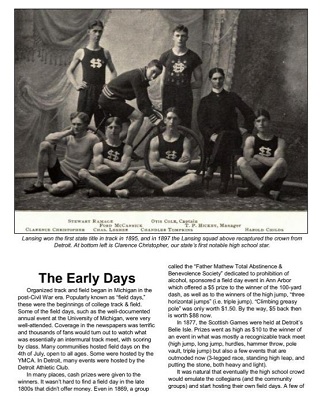 “My initial project was simply to develop a data base of state champions in track & field, but it soon mushroomed into much more. While delving into the research I was inspired by many of the vast accomplishments dating back over the years,” Moyes said. “It wasn’t long before I realized that this was a story that should be told, and it soon became a labor of love.
“Before my research, I had never heard of many of these great athletes of the past. I was dumbfounded to learn that Alan Smith, an eight-time state champion, was killed in action in World War II, as well as deeds of others both on and off the athletic fields.”
Moyes said he first was “piqued” to write during his days as a student at North Muskegon, where at his school library he picked up a copy of “Athletics in Michigan High Schools: The First Hundred Years” by Lewis L. Forsythe, the first president of the MHSAA Representative Council.
Moyes’ gathering of names began long before the internet and led him to libraries all over our state. He also wrote hundreds of letters as he tracked down thousands of names – mostly first names, as often only the last names of competitors were listed in newspaper reports during the early eras.
With Hollobaugh’s imprint, all of those years of research became not just an encyclopedia, but a story.
“What Jeff has accomplished with this book cannot be thanked enough with just words,” Moyes said. “Jeff took this data base and created a format for state champs that took him many hours, days, weeks, months and even a couple of years to finalize.
“He laboriously fact-checked this entire book and created many of those amazing ‘nuggets’ that gave this publication the character that goes beyond boring our readers with just stats.”
“The Fleet Feet of Spring” is available from Amazon for $24.99. The first 268 pages are filled with stories of every meet dating back to events conducted by the Michigan Inter-School Athletic Association. The next 170 pages are packed with every championship listing imaginable, including names of contributors to winning relays through the years and a list of total individual champions per school.