


Classes Still Create Hoosier Hysteria
July 27, 2017
By Rob Kaminski
MHSAA benchmarks editor
This is the fourth part in a series on MHSAA tournament classification, past and present, that will be published over the next two weeks. This series originally ran in this spring's edition of MHSAA benchmarks.
Twenty years ago, Bloomington North High School won the Indiana High School Athletic Association boys basketball championship, defeating Delta 75-54 at the RCA Dome in Indianapolis.
The date, March 22, 1997, is at the same time revered and disdained by traditionalists in the state who saw it as the last schoolboy championship game the state would ever host.
That’s how devout the game of basketball, particularly interscholastic basketball, had become in the Hoosier state during the 87 years a state champion – one state champion, to be precise – was crowned.
Following that 1997 season, the IHSAA moved to a four-class system for its roundball tournaments, like so many of its state association counterparts had done years earlier.
It would be shocking to find more than a small percentage of current high school basketball players around the country unfamiliar with the iconic movie Hoosiers, even though the film is now more than 30 years old.
And, the storyline for that blockbuster unfolded more than 30 years prior to its release, when small-town, undermanned Milan High School defeated Muncie Central High School 32-30 in the 1954 IHSAA title game.
Perhaps it’s because of the David vs Goliath notion, or the fame of the movie that replaced Milan with the fictional Hickory and real-life star Bobby Plump with Hollywood hero Jimmy Chitwood, or the simple fact that Indiana had something other states didn’t.
Whatever the reason, plenty of opposition remains to this day to basketball classification in the state.
The fact is, the small rural schools were regularly being beaten handily by the much larger suburban and city schools as the tournament progressed each season.
Small schools also were closing at a rapid rate following the state’s School Reorganization Act in 1959, as students converged on larger, centralized county schools. From 1960 to 2000, the number of schools entering the tournament dropped from 694 to 381, and in 1997 a total of 382 schools and 4,584 athletes began competition at the Sectional level (the first level of the IHSAA Basketball Tournament).
It was at the entry level of the tournament where school administrators felt the pain of the new class system, but not necessarily for the same nostalgic reasons as the fans who either attended or boycotted the tournament.
At the Sectional round of the tournament, the IHSAA was culling just 2 percent of the revenue, with the participating schools splitting the balance. So, when Sectional attendance dropped by 14 percent in that first year of class basketball, many schools realized a financial loss. It was money they had grown to count on in prior years to help fund various aspects of the department.
Schools cumulatively received more than $900,000 from Sectional competition in 1998, but that total was down from more than $1 million in the last year of the single-class tournament.
Yet, the current format provides a great deal more opportunity and realistic chances at championship runs for schools of all enrollments.
To date, 60 additional teams have championship or runner-up trophies on display in school trophy cases around Indiana.
That was the mission in front of then-IHSAA commissioner Bob Gardner (now National Federation executive director) once the board made its decision: to give thousands more student-athletes the opportunity for once-in-a-lifetime experiences.
As any statistician knows, figures can be manipulated to tell any side of a story. Declining attendance in year one of class basketball is such a number.
The truth is tournament attendance had been on a steady downward spiral since its peak of just over 1.5 million in 1962. By the last single-class event in 1997, the total attendance was half that.
The challenge then and today, as it is for all state associations, is to find that delicate balance for those holding onto tradition, those holding onto trophies, and the number of trophies to hand out.
Editor’s Note: Stories from the Fort Wayne Journal Gazette in 1998 and from a 2007 issue of Indianapolis Monthly provided facts in this article.
Freeland Girls Realizing Fast-Pace Potential
By
Paul Costanzo
Special for MHSAA.com
August 14, 2019
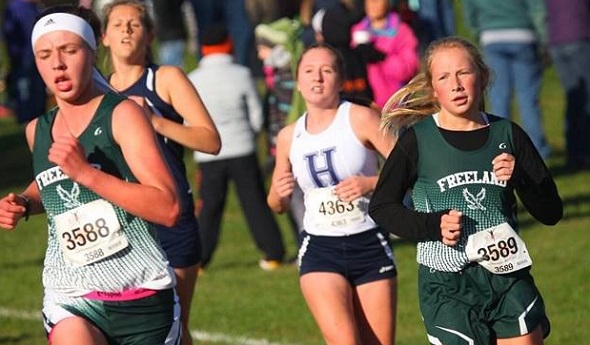
Runners on the Freeland girls cross country team had no idea how good they could be a year ago, mainly because most of them were entering their first year in the program.
 Two of the Falcons’ newly formed top seven – Kiera and Peyton Hansen – had just moved into the district from Ogemaw Heights. Three others – Whitney Farrell, Allyson Harvey and Mara Longenecker – were freshmen.
“Everyone was kind of new,” said Peyton Hansen, who is now entering her senior year. “My sister and I were new, and there were a lot of incoming freshmen, so it was a blank slate, and that made it easier for us all to get along and work together. That’s what kick-started us to performing very well. You’re not going to want to train and run with people every day if you don’t like them.”
The Falcons got to know each other and got to know their immense talent throughout the season, winning a Regional title and finishing 15th at the MHSAA Lower Peninsula Division 2 Finals. Now six of the top seven are back, and hopes are high for the upcoming season.
“I think it was Regionals, because we weren’t really supposed to win that, but we did and that’s when we realized we could really be good,” sophomore Mara Longenecker said. “Before then, we didn’t really realize it. I think we can definitely go to states again as a team, and hopefully place in the top 10 this year.”
As far as preseason proclamations go, Longenecker’s is fairly mild considering what she and her teammates already have done and what they bring back.
With a tough conference season ahead – Tri-Valley Conference rival Frankenmuth also qualified for the Finals a year ago and could bring back six of its top seven racers – and a region that features Frankenmuth, Corunna and Flint Powers Catholic, nothing is guaranteed. But the numbers are in their favor.
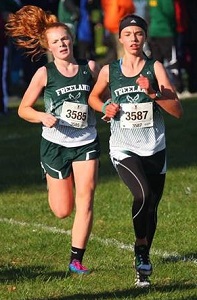
Kiera Hansen was an all-state performer, Saginaw County and Regional champion as a freshman, clocking in with a personal best of 18 minutes, 32.7 seconds. Farrell and Peyton Hansen each were sub-20 runners last year, while Harvey (20:07.9), juniors Caitlyn Mieske (21:10.8) and Longenecker (21:12.7) weren’t far behind.
Of the 14 teams that finished ahead of Freeland at the 2018 Finals, only four (champion East Grand Rapids, Petoskey, St. Johns and Cadillac) are expected to return six of their top seven runners.
 Only one other school in the top 15 (Otsego, which placed ninth with two seniors leading the way) had four freshmen in the lineup at the Finals.
“I think that we gained a lot of experience,” Farrell said. “We all didn’t run our best times at that race, but now we know the course and it can be a bit more familiar. There was a ton of people; it was really crazy.”
But modesty is something coach George Drown said runs throughout the team, whether that’s in setting individual goals, team goals or even applying to be one of the team’s captains this season.
“I don’t know if it’s that they don’t want the pressure, so they’re not expressing they know how good they are, but I do think they’re slowly understanding that,” said Drown, who is entering his third season at Freeland. “I think they’re excited for the season and excited for the new challenges we face with a different conference. We go from the team that was the darkhorse in the Regional to the team that has a target on their back.”
While the girls on the team said they didn’t see the success coming prior to last year, Drown did. His wife is the middle school coach in Freeland, giving him extra insight into the upcoming talent. And even though he’s fairly new to Freeland, he spent the previous 10 years coaching in nearby Hemlock.
“I think we did see it coming up,” Drown said. “Did we think they were going to be as good as they were their freshman year? No. But they bought in. We train to make the team good. We did a lot of group runs, and we had times with Kiera and Whitney where we knew they could run faster, but we held them back, and we used our top two girls to elevate our three through six and really pull them through the longer workouts. They bought in, and that’s how we did it. We really focused on the thought the team is only as good as the sum of its parts.”
Drown said his team is capable of stretching well beyond the top seven this season when it comes to being competitive at the varsity level, predicting he has 14 girls who are capable of running a 5K in less than 22 minutes.
So while the hopes are high and the season figures to be competitive, perhaps the modesty at the top of the lineup comes from knowing no breaks can be taken, even in practice.
“It’s really good for me, because I have people to base off of how fast I should be going,” said Longenecker, who joins Mieske as a team captain. “I’m never by myself on a run. I don’t want to say it’s a competition, but it really is at practice. You don’t want to finish last.”
 Paul Costanzo served as a sportswriter at The Port Huron Times Herald from 2006-15, including three years as lead sportswriter, and prior to that as sports editor at the Hillsdale Daily News from 2005-06. He can be reached at [email protected] with story ideas for Genesee, Lapeer, St. Clair, Sanilac, Huron, Tuscola, Saginaw, Bay, Arenac, Midland and Gladwin counties.
PHOTOS: (Top) Freeland’s Allyson Harvey, right, and Peyton Hansen pace a pack around a bend during a race last season. (Middle) Whitney Farrell, left, and Kiera Hansen also were among Freeland’s top runners in 2018. (Photos courtesy of the Freeland girls cross country program.)