


Classes Still Create Hoosier Hysteria
July 27, 2017
By Rob Kaminski
MHSAA benchmarks editor
This is the fourth part in a series on MHSAA tournament classification, past and present, that will be published over the next two weeks. This series originally ran in this spring's edition of MHSAA benchmarks.
Twenty years ago, Bloomington North High School won the Indiana High School Athletic Association boys basketball championship, defeating Delta 75-54 at the RCA Dome in Indianapolis.
The date, March 22, 1997, is at the same time revered and disdained by traditionalists in the state who saw it as the last schoolboy championship game the state would ever host.
That’s how devout the game of basketball, particularly interscholastic basketball, had become in the Hoosier state during the 87 years a state champion – one state champion, to be precise – was crowned.
Following that 1997 season, the IHSAA moved to a four-class system for its roundball tournaments, like so many of its state association counterparts had done years earlier.
It would be shocking to find more than a small percentage of current high school basketball players around the country unfamiliar with the iconic movie Hoosiers, even though the film is now more than 30 years old.
And, the storyline for that blockbuster unfolded more than 30 years prior to its release, when small-town, undermanned Milan High School defeated Muncie Central High School 32-30 in the 1954 IHSAA title game.
Perhaps it’s because of the David vs Goliath notion, or the fame of the movie that replaced Milan with the fictional Hickory and real-life star Bobby Plump with Hollywood hero Jimmy Chitwood, or the simple fact that Indiana had something other states didn’t.
Whatever the reason, plenty of opposition remains to this day to basketball classification in the state.
The fact is, the small rural schools were regularly being beaten handily by the much larger suburban and city schools as the tournament progressed each season.
Small schools also were closing at a rapid rate following the state’s School Reorganization Act in 1959, as students converged on larger, centralized county schools. From 1960 to 2000, the number of schools entering the tournament dropped from 694 to 381, and in 1997 a total of 382 schools and 4,584 athletes began competition at the Sectional level (the first level of the IHSAA Basketball Tournament).
It was at the entry level of the tournament where school administrators felt the pain of the new class system, but not necessarily for the same nostalgic reasons as the fans who either attended or boycotted the tournament.
At the Sectional round of the tournament, the IHSAA was culling just 2 percent of the revenue, with the participating schools splitting the balance. So, when Sectional attendance dropped by 14 percent in that first year of class basketball, many schools realized a financial loss. It was money they had grown to count on in prior years to help fund various aspects of the department.
Schools cumulatively received more than $900,000 from Sectional competition in 1998, but that total was down from more than $1 million in the last year of the single-class tournament.
Yet, the current format provides a great deal more opportunity and realistic chances at championship runs for schools of all enrollments.
To date, 60 additional teams have championship or runner-up trophies on display in school trophy cases around Indiana.
That was the mission in front of then-IHSAA commissioner Bob Gardner (now National Federation executive director) once the board made its decision: to give thousands more student-athletes the opportunity for once-in-a-lifetime experiences.
As any statistician knows, figures can be manipulated to tell any side of a story. Declining attendance in year one of class basketball is such a number.
The truth is tournament attendance had been on a steady downward spiral since its peak of just over 1.5 million in 1962. By the last single-class event in 1997, the total attendance was half that.
The challenge then and today, as it is for all state associations, is to find that delicate balance for those holding onto tradition, those holding onto trophies, and the number of trophies to hand out.
Editor’s Note: Stories from the Fort Wayne Journal Gazette in 1998 and from a 2007 issue of Indianapolis Monthly provided facts in this article.
#TBT: 2002 Ends with Lights-Out Finals
July 12, 2019
By Rob Kaminski
MHSAA benchmarks editor
The Flint IMA had been to the MHSAA Ice Hockey Finals what Joe Louis Arena was to the Detroit Red Wings since it began hosting high school championships in the state in 1977.
For parts of four decades, the facility set the scene for many memorable moments on ice for scholastic skaters.
So it would have been fitting as the curtain was closing on an era March 9, 2002, if there’d been an overtime championship game or two to commemorate the last MHSAA Finals at the building.
In 2003, the MHSAA Semifinals and Finals would move to Compuware Arena in Plymouth – now USA Hockey Arena – where the event has been played ever since.
There would be no overtimes during the IMA’s swan song, but the arena wasn’t about to let go without a fight. Following the morning’s Division 2 Final, won by Grosse Pointe North over local qualifier Davison, things got strange.
As if by divine intervention, a significant power outage hit the Flint area between the first and second periods of the Division 3 Final, necessitating a return to the building for an encore performance that Monday.
Following is an account from then-MHSAA Assistant Director Randy Allen, administrator of the sport at that time.
 “East Grand Rapids and (Dearborn) Divine Child were between the first and second periods when the power went out at what must’ve been around three in the afternoon. Some of the house lights went on, but there was no huge generator. The power company told us it could be quite a while before the power came back, so the decision was made pretty quickly to come back Monday. (Editor’s Note: MHSAA regulations at that time prohibited Sunday competition, thus play would resume Monday)
“Finishing the game in progress Monday was really a no-brainer, but now there were a couple of immediate challenges. First, how were we going to let people know, and second, what was going to happen to the (Detroit) Catholic Central-Marquette Division 1 game coming up later in the day?
“Well, knowing what I knew about the TV business (Allen’s background in Wisconsin included sportscasting), I grabbed one of the television reporters there, probably from Grand Rapids, and asked him to come down to the ice with me. It was totally dark; I figured once he put his camera lights on, it would get the attention of the crowd, which it did. So there’s about 2 or 3 thousand people in the arena – in the dark – and I’m standing in front of a light from a TV camera, and at the top of my voice I explain the situation and let them know we’re coming back Monday.
“Anyone wanting to come back, admission was free of charge, and we’d trust they were at the game. If they wanted a refund, they could mail their ticket stub to MHSAA and we'd send a refund. We obviously couldn’t use the box office without power. I don’t recall more than a couple dozen refund requests coming to our office later.
“Now the real challenge is the Division 1 game. Marquette very, very much wanted to go home and come back a week later. They’d been on the road all week (Marquette won a Quarterfinal in Traverse City that Wednesday). Jack (Roberts, former MHSAA executive director) was there, and he and Marquette’s AD (Scott Koski) and their superintendent debated a bit. In the end, the regulations of the day were upheld, and the game would be Monday.
“As it turned out, someone in the Marquette entourage had a contact in the Detroit Pistons front office, so the team was entertained in a suite at The Palace of Auburn Hills on Sunday night, so that was quite a happy ending from their standpoint.
“Many of the Marquette people were either in the arena or at a single hotel or two in the area, so alerting them to the change was not difficult.
“But then we started to think, ‘What about the Detroit CC people who would be driving up for their game later? Remember, social media was not as prevalent as it is today, or even the dependence on the internet.
“So, Saturday night, I sat there at the entrance to the IMA with my car running and lights on to inform the CC fans and anyone else who pulled up that the game had changed ... ‘Power’s out; game’s on Monday.’ They'd say thanks, and out they'd go. No one really got angry; there wasn’t anything anyone could do. I sat there an hour and a half with a steady stream, and shortly after the scheduled game time I called it a night.”
And, the IMA called it the end of an era, but not before hanging on for one more night, when Divine Child and Detroit CC would raise the last trophies in that building ... under the lights.
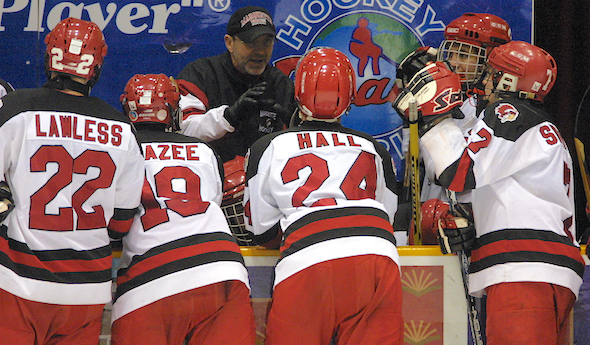
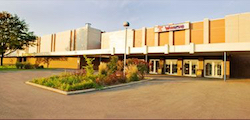
PHOTOS: (Top) Marquette was among teams that needed to stick around Flint two more days to play in the 2002 MHSAA Ice Hockey Finals. (Middle) Flint’s IMA arena.