


Classes Still Create Hoosier Hysteria
July 27, 2017
By Rob Kaminski
MHSAA benchmarks editor
This is the fourth part in a series on MHSAA tournament classification, past and present, that will be published over the next two weeks. This series originally ran in this spring's edition of MHSAA benchmarks.
Twenty years ago, Bloomington North High School won the Indiana High School Athletic Association boys basketball championship, defeating Delta 75-54 at the RCA Dome in Indianapolis.
The date, March 22, 1997, is at the same time revered and disdained by traditionalists in the state who saw it as the last schoolboy championship game the state would ever host.
That’s how devout the game of basketball, particularly interscholastic basketball, had become in the Hoosier state during the 87 years a state champion – one state champion, to be precise – was crowned.
Following that 1997 season, the IHSAA moved to a four-class system for its roundball tournaments, like so many of its state association counterparts had done years earlier.
It would be shocking to find more than a small percentage of current high school basketball players around the country unfamiliar with the iconic movie Hoosiers, even though the film is now more than 30 years old.
And, the storyline for that blockbuster unfolded more than 30 years prior to its release, when small-town, undermanned Milan High School defeated Muncie Central High School 32-30 in the 1954 IHSAA title game.
Perhaps it’s because of the David vs Goliath notion, or the fame of the movie that replaced Milan with the fictional Hickory and real-life star Bobby Plump with Hollywood hero Jimmy Chitwood, or the simple fact that Indiana had something other states didn’t.
Whatever the reason, plenty of opposition remains to this day to basketball classification in the state.
The fact is, the small rural schools were regularly being beaten handily by the much larger suburban and city schools as the tournament progressed each season.
Small schools also were closing at a rapid rate following the state’s School Reorganization Act in 1959, as students converged on larger, centralized county schools. From 1960 to 2000, the number of schools entering the tournament dropped from 694 to 381, and in 1997 a total of 382 schools and 4,584 athletes began competition at the Sectional level (the first level of the IHSAA Basketball Tournament).
It was at the entry level of the tournament where school administrators felt the pain of the new class system, but not necessarily for the same nostalgic reasons as the fans who either attended or boycotted the tournament.
At the Sectional round of the tournament, the IHSAA was culling just 2 percent of the revenue, with the participating schools splitting the balance. So, when Sectional attendance dropped by 14 percent in that first year of class basketball, many schools realized a financial loss. It was money they had grown to count on in prior years to help fund various aspects of the department.
Schools cumulatively received more than $900,000 from Sectional competition in 1998, but that total was down from more than $1 million in the last year of the single-class tournament.
Yet, the current format provides a great deal more opportunity and realistic chances at championship runs for schools of all enrollments.
To date, 60 additional teams have championship or runner-up trophies on display in school trophy cases around Indiana.
That was the mission in front of then-IHSAA commissioner Bob Gardner (now National Federation executive director) once the board made its decision: to give thousands more student-athletes the opportunity for once-in-a-lifetime experiences.
As any statistician knows, figures can be manipulated to tell any side of a story. Declining attendance in year one of class basketball is such a number.
The truth is tournament attendance had been on a steady downward spiral since its peak of just over 1.5 million in 1962. By the last single-class event in 1997, the total attendance was half that.
The challenge then and today, as it is for all state associations, is to find that delicate balance for those holding onto tradition, those holding onto trophies, and the number of trophies to hand out.
Editor’s Note: Stories from the Fort Wayne Journal Gazette in 1998 and from a 2007 issue of Indianapolis Monthly provided facts in this article.
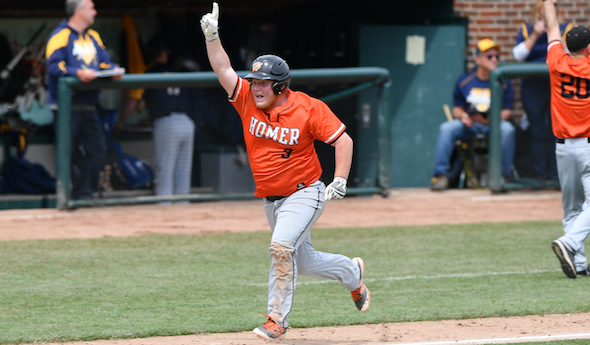
Homer, Liggett Set Up Saturday Meeting
By
Paul Costanzo
Special for MHSAA.com
June 14, 2019
EAST LANSING – Jacob Wilson just wanted to start jumping up and down Friday after his game-winning single sent Homer to the MHSAA Division 3 Baseball Final.
But before he could fully celebrate, he had to make it to first base, something he admitted he had to be reminded to do.
“The coach told me to (run to first),” Wilson said.
He made it without issue and was mobbed by his teammates as Homer defeated Pewamo-Westphalia 2-1 in nine innings at McLane Baseball Stadium on the campus of Michigan State University. The Trojans advanced to Saturday’s Final against Grosse Pointe Woods University Liggett, which defeated Gladstone 5-0 in the other Semifinal.
“What an unbelievable setting, and to have a 2-1 walkoff in the bottom of the ninth at Michigan State, that’s stuff you dream of at the beginning of the season,” Homer coach Scott Salow said. “It was an unbelievable ballgame. Two great teams.”
Wilson’s hit down the third-base line ended a game dominated by pitching and defense, as he and Pewamo-Westphalia starter Brendan Thelen kept hitters off balance for the majority.
In the ninth inning, however, Homer was able to load the bases with no outs, and Wilson drove in Zach Butters for the walk-off win.
“I was up to bat and I was looking at my teammates while they were on base, and they were just looking at me smiling, giving me a thumbs up,” Wilson said. “I just had faith in myself that I could get it down.”
Butters’ run was the first since the second inning, and ended one of the few Homer threats. Thelen threw 7 2/3 innings prior to reaching his pitch-count maximum, striking out five and allowing three walks, two hits and one run. He allowed just one Homer runner to get to third base.
“Their coach, Scott Salow, has a great program, and he said that’s the best pitcher they’ve seen all year,” Pewamo-Westphalia coach Mark Rademacher said. “They only got two hits on him, and he said that’s the best pitcher they’ve seen. Brendan rose up to the occasion. He kept us in the game when we were leaving guys stranded on base, and our defense was helping him out. It was just a great performance on his part.”
Wilson put together a gem of his own, allowing six hits and two walks while striking out five in 6 2/3 innings, also leaving the game because of his pitch count. He pitched out of a jam in the sixth inning, as Pewamo-Westphalia had a runner at third with one out. Wilson was able to get a strikeout and a popout to end the threat.
“Just survive,” Salow said of Wilson. “I don’t know how many chances they had with leadoff guys on. It seemed like we were fighting fires most of the game, especially in the middle innings.”
Pewamo-Westphalia opened the scoring in the second inning, as Aaron Bearss drove in Ethan Thelen with a single.
Homer responded in the bottom of the second, as Kyle Compton stole home on a designed play. Wilson, who was on first, purposefully fell on a steal attempt, forcing a throw to first and allowing Compton to head home.
“We spend a lot of time on our first-and-third offense, trying to put balls in play without the aid of a bat,” Salow said. “It’s a play that we practice all the time, and it worked out almost to perfection.”
Compton finished with two hits and two walks for Homer (32-3). Butters picked up the win in relief, striking out one and allowing two hits in 2 1/3 innings.
Tanner Wirth and Ethan Thelen each had two hits for the Pirates (31-3).
Grosse Pointe Woods University Liggett 5, Gladstone 0
Alec Azar had all the run support he needed before he stepped on the mound.
 The Liggett senior pitcher threw his first pitch with a 2-0 lead, which was more than enough as he put together a dominant outing to lead the Knights into the Division 3 Final, their first since 2016.
“That’s what I like about being away,” Azar said. “You get ahead, and then I can come out on the mound and get really comfortable and throw my game.”
Azar carried a no-hitter into the sixth inning and finished the game with 12 strikeouts and two hits allowed.
“He was lights out,” Liggett coach Dan Cimini said. “I told him this was going to be his last start as a senior at Liggett and I need his best, and he gave us his best. He almost had a no-hitter, threw the ball really well, had his best stuff, great slider, fastball. He just did everything he could for our team today to get us a W.”
Logan King hit a two-run home run with two outs in the top of the first inning, which Gladstone coach Kelly Shea said stunned his team. The Braves remained stunned as Azar struck out the first four batters he faced.
“Our pitcher got them with two ground balls to start the first inning, and I thought we’re going to get out of the inning,” Shea said. “Then they had a kind of so-so base hit, then he hangs that next pitch and they pounded it over the fence. It kind of took the wind out of our sails, and we never got back.”
Azar added two hits at the plate, while Nick Post had two hits, including an RBI double for the Knights. King finished with three RBI on the day.
Carson Shea, who started on the mound for Gladstone, broke up Azar’s no-hitter with two outs in the sixth inning. Jared Crow added a double for the Braves in the seventh.
PHOTOS: (Top) Homer’s Zach Butters heads home for the game-winning run in Friday’s first Semifinal against Pewamo-Westphalia. (Middle) Liggett's Alec Azar makes his move toward the plate.