


Classes Still Create Hoosier Hysteria
July 27, 2017
By Rob Kaminski
MHSAA benchmarks editor
This is the fourth part in a series on MHSAA tournament classification, past and present, that will be published over the next two weeks. This series originally ran in this spring's edition of MHSAA benchmarks.
Twenty years ago, Bloomington North High School won the Indiana High School Athletic Association boys basketball championship, defeating Delta 75-54 at the RCA Dome in Indianapolis.
The date, March 22, 1997, is at the same time revered and disdained by traditionalists in the state who saw it as the last schoolboy championship game the state would ever host.
That’s how devout the game of basketball, particularly interscholastic basketball, had become in the Hoosier state during the 87 years a state champion – one state champion, to be precise – was crowned.
Following that 1997 season, the IHSAA moved to a four-class system for its roundball tournaments, like so many of its state association counterparts had done years earlier.
It would be shocking to find more than a small percentage of current high school basketball players around the country unfamiliar with the iconic movie Hoosiers, even though the film is now more than 30 years old.
And, the storyline for that blockbuster unfolded more than 30 years prior to its release, when small-town, undermanned Milan High School defeated Muncie Central High School 32-30 in the 1954 IHSAA title game.
Perhaps it’s because of the David vs Goliath notion, or the fame of the movie that replaced Milan with the fictional Hickory and real-life star Bobby Plump with Hollywood hero Jimmy Chitwood, or the simple fact that Indiana had something other states didn’t.
Whatever the reason, plenty of opposition remains to this day to basketball classification in the state.
The fact is, the small rural schools were regularly being beaten handily by the much larger suburban and city schools as the tournament progressed each season.
Small schools also were closing at a rapid rate following the state’s School Reorganization Act in 1959, as students converged on larger, centralized county schools. From 1960 to 2000, the number of schools entering the tournament dropped from 694 to 381, and in 1997 a total of 382 schools and 4,584 athletes began competition at the Sectional level (the first level of the IHSAA Basketball Tournament).
It was at the entry level of the tournament where school administrators felt the pain of the new class system, but not necessarily for the same nostalgic reasons as the fans who either attended or boycotted the tournament.
At the Sectional round of the tournament, the IHSAA was culling just 2 percent of the revenue, with the participating schools splitting the balance. So, when Sectional attendance dropped by 14 percent in that first year of class basketball, many schools realized a financial loss. It was money they had grown to count on in prior years to help fund various aspects of the department.
Schools cumulatively received more than $900,000 from Sectional competition in 1998, but that total was down from more than $1 million in the last year of the single-class tournament.
Yet, the current format provides a great deal more opportunity and realistic chances at championship runs for schools of all enrollments.
To date, 60 additional teams have championship or runner-up trophies on display in school trophy cases around Indiana.
That was the mission in front of then-IHSAA commissioner Bob Gardner (now National Federation executive director) once the board made its decision: to give thousands more student-athletes the opportunity for once-in-a-lifetime experiences.
As any statistician knows, figures can be manipulated to tell any side of a story. Declining attendance in year one of class basketball is such a number.
The truth is tournament attendance had been on a steady downward spiral since its peak of just over 1.5 million in 1962. By the last single-class event in 1997, the total attendance was half that.
The challenge then and today, as it is for all state associations, is to find that delicate balance for those holding onto tradition, those holding onto trophies, and the number of trophies to hand out.
Editor’s Note: Stories from the Fort Wayne Journal Gazette in 1998 and from a 2007 issue of Indianapolis Monthly provided facts in this article.

Wykons Sweep UPD2 Boys Championships
May 30, 2019
By Adam Niemi
Special for Second Half
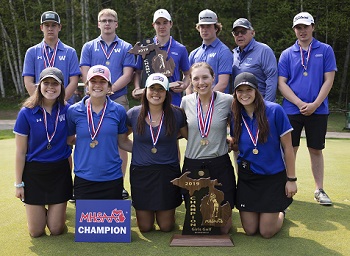
IRON RIVER – West Iron County defended its home turf, sweeping the boys and girls MHSAA Upper Peninsula Division 2 Finals on Thursday.
The Wykons' boys carded a team score of 319 at George Young Resort, located 10 miles east of Iron River.
Norway (366) took second place, followed by Hancock (362), St. Ignace (366) and Newberry (388) to round out the top five.
Trey Bociek paced West Iron County with a first-place 74. Norway's Drew Anderson (77) was second, and teammate Jeff VanHolla (78) tied with the Wykons' Nathan Thomson for third.
The team championship was West Iron’s second straight and third in five seasons.
"Obviously No. 1, very pleased," West Iron County head coach Mark Martini said. "No. 2, I think it's overlooked how both teams (boys and girls) started poorly and fought through it like a fourth-quarter football game. They fought right back, and I'm kind of proud of that. That was really good."
West Iron County's girls team won with a 433.
Norway head coach Joby Sullivan said the UP Finals bring out the best in the team aspect of golf.
"I know that some of the boys thought they weren't playing a great round of golf. But holistically, that's what’s great about these individual-dual sports is you may not be doing so well but the overall team, the big picture of it, can come around," Sullivan said. "A couple West Iron kids might have triple-bogeyed a par-3, and then one of their other kids on 15 had a bad hole. That opened the door for us to make a push down the stretch. We didn't capitalize on that, which would've been what we needed to do to make it close.
 "It's exciting. When there's something that's happening, it's like the mile relay in a track meet where one team can end up winning it based on the results of that. Down the stretch, it was going to be close for that. It would've been nice to capitalize on that stretch on 13 through 18."
Sullivan said Anderson's 77 was his personal best.
"Drew came in with a 77, which was I think that's his best round ever," Sullivan said. "He was one under all the way through until a double bogey on 16 for his back-nine score. Which was great. Jeff (VanHolla) came in and played well with a 78. He had a couple putts at the end to finish out. He really played some good golf. He and Drew really did a nice job.”
The course was personally designed by the late George Young, a millionaire and passionate golfer whose design for each hole on the Iron County course was derived from the favorite holes he played from different courses around the world.
A wet course from recent rains slowed the greens and made various parts of multiple fairways a mud hazard of sorts. But the sand traps were dry and fooled golfers who landed in bunkers from a wet fairway, causing some to anticipate a heavy sand impact and instead overshoot the green.
If that wasn't enough, the woods hug most fairways. Some tee shots resulted in the echoing sound of a ball bouncing off tree branches, trunks and a heavy sigh from golfers.
The course difficulty and conditions meant Thursday was simply about limiting mistakes.
Austin Salani placed eighth for Hancock with an 85. His brother Colton tied for 12th with a 92. Brimley's Justin Carrick and St. Ignace's Reid Marshall also carded a 92.
PHOTOS: (Top) West Iron County's Nathan Thomson fires an iron shot during Thursday's championship round. (Middle) The Wykons girls and boys championship teams. (Photos by Adam Niemi.)