


Classes Still Create Hoosier Hysteria
July 27, 2017
By Rob Kaminski
MHSAA benchmarks editor
This is the fourth part in a series on MHSAA tournament classification, past and present, that will be published over the next two weeks. This series originally ran in this spring's edition of MHSAA benchmarks.
Twenty years ago, Bloomington North High School won the Indiana High School Athletic Association boys basketball championship, defeating Delta 75-54 at the RCA Dome in Indianapolis.
The date, March 22, 1997, is at the same time revered and disdained by traditionalists in the state who saw it as the last schoolboy championship game the state would ever host.
That’s how devout the game of basketball, particularly interscholastic basketball, had become in the Hoosier state during the 87 years a state champion – one state champion, to be precise – was crowned.
Following that 1997 season, the IHSAA moved to a four-class system for its roundball tournaments, like so many of its state association counterparts had done years earlier.
It would be shocking to find more than a small percentage of current high school basketball players around the country unfamiliar with the iconic movie Hoosiers, even though the film is now more than 30 years old.
And, the storyline for that blockbuster unfolded more than 30 years prior to its release, when small-town, undermanned Milan High School defeated Muncie Central High School 32-30 in the 1954 IHSAA title game.
Perhaps it’s because of the David vs Goliath notion, or the fame of the movie that replaced Milan with the fictional Hickory and real-life star Bobby Plump with Hollywood hero Jimmy Chitwood, or the simple fact that Indiana had something other states didn’t.
Whatever the reason, plenty of opposition remains to this day to basketball classification in the state.
The fact is, the small rural schools were regularly being beaten handily by the much larger suburban and city schools as the tournament progressed each season.
Small schools also were closing at a rapid rate following the state’s School Reorganization Act in 1959, as students converged on larger, centralized county schools. From 1960 to 2000, the number of schools entering the tournament dropped from 694 to 381, and in 1997 a total of 382 schools and 4,584 athletes began competition at the Sectional level (the first level of the IHSAA Basketball Tournament).
It was at the entry level of the tournament where school administrators felt the pain of the new class system, but not necessarily for the same nostalgic reasons as the fans who either attended or boycotted the tournament.
At the Sectional round of the tournament, the IHSAA was culling just 2 percent of the revenue, with the participating schools splitting the balance. So, when Sectional attendance dropped by 14 percent in that first year of class basketball, many schools realized a financial loss. It was money they had grown to count on in prior years to help fund various aspects of the department.
Schools cumulatively received more than $900,000 from Sectional competition in 1998, but that total was down from more than $1 million in the last year of the single-class tournament.
Yet, the current format provides a great deal more opportunity and realistic chances at championship runs for schools of all enrollments.
To date, 60 additional teams have championship or runner-up trophies on display in school trophy cases around Indiana.
That was the mission in front of then-IHSAA commissioner Bob Gardner (now National Federation executive director) once the board made its decision: to give thousands more student-athletes the opportunity for once-in-a-lifetime experiences.
As any statistician knows, figures can be manipulated to tell any side of a story. Declining attendance in year one of class basketball is such a number.
The truth is tournament attendance had been on a steady downward spiral since its peak of just over 1.5 million in 1962. By the last single-class event in 1997, the total attendance was half that.
The challenge then and today, as it is for all state associations, is to find that delicate balance for those holding onto tradition, those holding onto trophies, and the number of trophies to hand out.
Editor’s Note: Stories from the Fort Wayne Journal Gazette in 1998 and from a 2007 issue of Indianapolis Monthly provided facts in this article.
Blind Vaulter Builds on Promising Launch
By
Paul Costanzo
Special for MHSAA.com
May 24, 2019
When Bradly Rainwater’s family members learned he was born blind, they decided to not put any limits on him.
 As it turned out, Bradly had the same mindset.
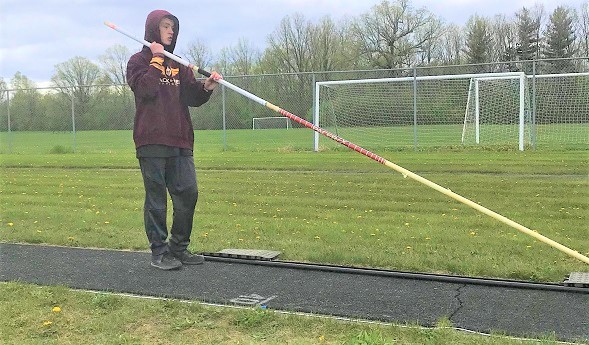
The Davison sophomore is a pole vaulter on the track & field team. It’s an event that he took up not just because his father and uncle were former all-state pole vaulters, but because it was one of the most difficult events in any sport.
“I have always gone after the hardest things,” Rainwater said. “I thought this would be another thing that I would see if I could do it.”
Rainwater, who also is a member of the marching band and wrestling teams at Davison, recently finished his first full season competing as a vaulter and has proven that he can do it, with a personal best of 8 feet, 6 inches. But he’s not satisfied with simply clearing a height in competition – he wants to go higher.
“In the end, I’d like to go to state and get a reasonable placing,” Rainwater said of his career goals. “That would be good for me. I’d enjoy that. For someone in a situation like mine, or a situation similar, you have to work twice as hard to get things where you want them to be. But I am dedicated to it.”
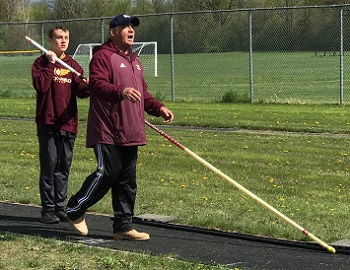
Davison pole vaulting coach Brad Rainwater, Bradly’s grandfather, is also dedicated to it, and is doing all he can to help his grandson reach his goals. Brad Rainwater has been coaching for four decades, but had to teach himself some new tricks when Bradly came along.
“It’s a learning process for us, as well,” Brad Rainwater said. “We started by putting our heads together, my sons and I, and I took it basically like I would coach anyone, but we had to be more hands-on. Basically, it’s step-by-step. It’s the same way when he wrestles; they have to literally do every movement like step, step, step, step. Everything on the vault is done by steps, so we start him with doing three steps, then four steps, then five steps. We’re thinking of ways to teach him to turn, so we use a lot of rings and high bar so he can get that feel.
“What it’s done for me is made me a better coach, because I have to break everything down. Now I’m a little more technical with them all.”
Recently, Bradly began using a track on the runway to help guide his pole to the box, which allows him to start his run farther back. He’s made steady improvement throughout the season, setting his personal best May 13 during a dual meet against Flint Carman-Ainsworth and matching it two days later at the Heritage Hawks Last Chance Invitational.
During practices with a bungee cord, he has cleared more than 10 feet. He’s also started imparting wisdom on other vaulters.
“If I have young vaulters, he teaches them the first three steps and a plant,” Brad Rainwater said. “If people are around (Bradly) and they didn’t know he was blind, because he’s actually doing the drills or showing kids how to do drills, they go, ‘He’s blind?’”
Bradly said the reaction from teammates and opponents alike has been great.
 “They work with me some, like they’ll say, ‘You didn’t turn correctly,’ or ‘You didn’t do this correctly,’ which I appreciate, because criticism like that I can’t necessarily see on film,” he said. “Opponents, some of them come up to me and say thank you to me, and that I inspired them. It’s still hard for me to grasp, because I’m not as good as I should be, but I appreciate people saying that.”
While there’s no official number of blind individuals who have competed in the pole vault, it is rare.
“I know that he’s only one of maybe three others in the state (history), and the other three had some sight,” Brad Rainwater said. “We try not to limit him; we try not to put him in a box that he can or can’t do that. As far as I know, he’s one of the very few in the country that’s doing this. We love it, because we hope it opens doors for other kids that have desire to do other things.”
Bradly, however, said he hasn’t quite grappled with the fact that what he’s doing is special, as he feels he still needs to get better. That’s his focus now, and it’s reflective of someone who has played sports his entire life, from T-ball to soccer to basketball, and now wrestling and track.
He’s not a blind pole vaulter; he’s simply a pole vaulter. And when he’s done, he wants to be known as a great one.
“I’ve always had the attitude of why not,” he said. “Why not work extra hard to be as good as they are?”
 Paul Costanzo served as a sportswriter at The Port Huron Times Herald from 2006-15, including three years as lead sportswriter, and prior to that as sports editor at the Hillsdale Daily News from 2005-06. He can be reached at [email protected] with story ideas for Genesee, Lapeer, St. Clair, Sanilac, Huron, Tuscola, Saginaw, Bay, Arenac, Midland and Gladwin counties.
PHOTOS: (Top) Davison pole vaulter Bradly Rainwater lines up for an attempt this spring. (Middle) Rainwater works with his grandfather Brad Rainwater, the school’s longtime pole vaulting coach. (Photos and video provided by the Rainwater family.)