


Classes Still Create Hoosier Hysteria
July 27, 2017
By Rob Kaminski
MHSAA benchmarks editor
This is the fourth part in a series on MHSAA tournament classification, past and present, that will be published over the next two weeks. This series originally ran in this spring's edition of MHSAA benchmarks.
Twenty years ago, Bloomington North High School won the Indiana High School Athletic Association boys basketball championship, defeating Delta 75-54 at the RCA Dome in Indianapolis.
The date, March 22, 1997, is at the same time revered and disdained by traditionalists in the state who saw it as the last schoolboy championship game the state would ever host.
That’s how devout the game of basketball, particularly interscholastic basketball, had become in the Hoosier state during the 87 years a state champion – one state champion, to be precise – was crowned.
Following that 1997 season, the IHSAA moved to a four-class system for its roundball tournaments, like so many of its state association counterparts had done years earlier.
It would be shocking to find more than a small percentage of current high school basketball players around the country unfamiliar with the iconic movie Hoosiers, even though the film is now more than 30 years old.
And, the storyline for that blockbuster unfolded more than 30 years prior to its release, when small-town, undermanned Milan High School defeated Muncie Central High School 32-30 in the 1954 IHSAA title game.
Perhaps it’s because of the David vs Goliath notion, or the fame of the movie that replaced Milan with the fictional Hickory and real-life star Bobby Plump with Hollywood hero Jimmy Chitwood, or the simple fact that Indiana had something other states didn’t.
Whatever the reason, plenty of opposition remains to this day to basketball classification in the state.
The fact is, the small rural schools were regularly being beaten handily by the much larger suburban and city schools as the tournament progressed each season.
Small schools also were closing at a rapid rate following the state’s School Reorganization Act in 1959, as students converged on larger, centralized county schools. From 1960 to 2000, the number of schools entering the tournament dropped from 694 to 381, and in 1997 a total of 382 schools and 4,584 athletes began competition at the Sectional level (the first level of the IHSAA Basketball Tournament).
It was at the entry level of the tournament where school administrators felt the pain of the new class system, but not necessarily for the same nostalgic reasons as the fans who either attended or boycotted the tournament.
At the Sectional round of the tournament, the IHSAA was culling just 2 percent of the revenue, with the participating schools splitting the balance. So, when Sectional attendance dropped by 14 percent in that first year of class basketball, many schools realized a financial loss. It was money they had grown to count on in prior years to help fund various aspects of the department.
Schools cumulatively received more than $900,000 from Sectional competition in 1998, but that total was down from more than $1 million in the last year of the single-class tournament.
Yet, the current format provides a great deal more opportunity and realistic chances at championship runs for schools of all enrollments.
To date, 60 additional teams have championship or runner-up trophies on display in school trophy cases around Indiana.
That was the mission in front of then-IHSAA commissioner Bob Gardner (now National Federation executive director) once the board made its decision: to give thousands more student-athletes the opportunity for once-in-a-lifetime experiences.
As any statistician knows, figures can be manipulated to tell any side of a story. Declining attendance in year one of class basketball is such a number.
The truth is tournament attendance had been on a steady downward spiral since its peak of just over 1.5 million in 1962. By the last single-class event in 1997, the total attendance was half that.
The challenge then and today, as it is for all state associations, is to find that delicate balance for those holding onto tradition, those holding onto trophies, and the number of trophies to hand out.
Editor’s Note: Stories from the Fort Wayne Journal Gazette in 1998 and from a 2007 issue of Indianapolis Monthly provided facts in this article.
Jenison Reaches 1,000 Wins & Surging
May 23, 2019
By Dean Holzwarth
Special for Second Half
JENISON – The Jenison softball team wrapped up an Ottawa-Kent Conference Black outright title Tuesday night by sweeping Muskegon Reeths-Puffer.
 The championship shouldn’t come as much of a surprise because the Wildcats have racked up wins at a consistent pace for the past 45 years.
Jenison has experienced another successful campaign thus far, and reached a program milestone earlier in the season.
The Wildcats notched the program’s 1,000th win by beating Zeeland East in mid-April.
Longtime coach Kari Kossen has been a part of several of those victories, as a former player and now in her 19th season at the helm.
“Our players had an idea, and it was told to them at the beginning of the season that it was coming up,” Kossen said. “We really didn’t make it known, but for us coaches and the whole program it was a really cool thing. They knew about it, but not enough to count it down.”
Jenison began as a program in 1974 and emerged as a perennial powerhouse during the late 1980s and mid 1990s.
Under the direction of legendary coach Jerry Hoag, who collected 529 wins from 1981-1999, the Wildcats won six MHSAA Class A titles over a nine-year span.
They’ve appeared in seven Finals, also including a runner-up finish to Okemos in 1999. Only five teams in MHSAA history have played in more.
Jenison stockpiled state crowns with superb pitching and defense, posting five shutouts in its six championship game wins and allowing only one run overall.
Back then, Georgetown Little League opened up a new facility and was the feeder program.
 Kossen, a pitcher who helped the team win back-to-back titles in 1987 and 1988, said pitching guru Ray Sheler had a huge impact in producing a dominant pitching staff.
“He taught the windmill (style),” Kossen said. “Slingshot was well known, but we learned from him and he taught us how to pitch like that and that played a big role in Jenison’s success, just learning how to do the windmill pitching. A lot of other schools didn’t know how to do it back then.”
The Wildcats continue to seek their first Finals appearance since 1999, but have continued to churn out quality players and competitive teams.
A change during the past eight years has been the development of the Wildcat Pride Program, and it has paid dividends on the diamond over the last four.
While various travel teams are abundant throughout the state and include players from different high schools, the Wildcat Pride program is designed to keep girls playing together on the same team in the Jenison community.
“The parent support has really helped with this and has helped make an impact in our success the last two or three years,” Kossen said. “It was something everybody had to buy into eight years ago.
“My sister (Karla Wojtas) and I had a vision to just play together as a community and see if we can learn how to win together, because eventually they’re going to have to do that anyway in high school. We just wanted to come back as a community, and parents have helped coach these teams.”
The idea is to have the girls playing together for several years and creating a bond and trust, much like what occurred in the past.
“We just played so well together because we played together since we were 10 years old,” Kossen said. “In today’s culture girls are playing for different teams, so it feels good to go back to that.”
Former Jenison standout Alexis Hylarides, a 1991 grad and member of the 1990 Class A championship team, said elite coaching in little league with the likes of Ed Kiscorni and Sheler, and then in high school with Hoag, helped catapult the program into a dynasty.
“It starts with good coaching and Ray Sheler took it to a whole other level because without him then they don’t have all those great pitchers,” she said. “The whole goal growing up was to play for Jenison softball because they were the dynamo, and if you played for them then you made it to the big show. It was an honor to play for them, and they don’t make coaches like that anymore.”
 Hylarides wasn’t shocked to learn that the program had surpassed 1,000 wins.
“Not one bit,” she said. “This has been such a strong program for many years.”
Jenison produces elite talent as several girls have gone on to play at various levels in college, but fundamentals are the main focus of the current program.
“We’re scrappy, and we teach fundamentals,” Kossen said. “We do the little things that allow us to be that much better, and we do what we need to do to be in every ball game.”
The Wildcats improved to 30-3 with Tuesday’s wins and earned honorable mention in the latest Division 1 rankings.
Jenison has been led by seniors Evelyn Blood, Addison Hansen and Emily Mouat, juniors Kassidi Hill and Emily Siler and freshman Maria Griffore.
“I think we’ve been playing so well together as a group, and they know their roles,” Kossen said. “I can count on all of them to come in and get a hit when they need to or play good defense. They get along so well and are just fun. They want to win, and they have goals.”
 Dean Holzwarth covered primarily high school sports for the Grand Rapids Press and MLive for 16 years and more recently served as sports editor of the Ionia Sentinel and as a sports photojournalist for WZZM. Contact him at[email protected] with story ideas for Allegan, Kent and Ottawa counties.
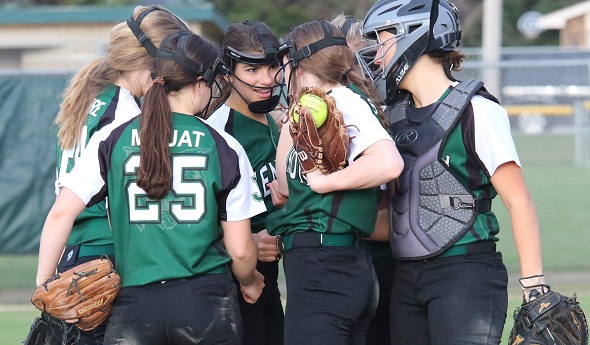
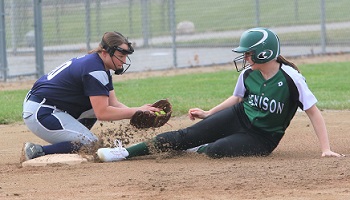
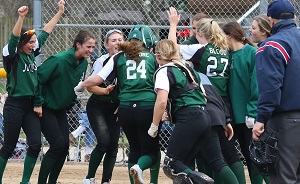
PHOTOS: (Top) Jenison players huddle on the field during a game this season. (Middle) A Jenison base runner slides safely into third base. (Below) The Wildcats welcome a teammate crossing the plate. (Photos courtesy of the Jenison athletic department.)