


Classes Still Create Hoosier Hysteria
July 27, 2017
By Rob Kaminski
MHSAA benchmarks editor
This is the fourth part in a series on MHSAA tournament classification, past and present, that will be published over the next two weeks. This series originally ran in this spring's edition of MHSAA benchmarks.
Twenty years ago, Bloomington North High School won the Indiana High School Athletic Association boys basketball championship, defeating Delta 75-54 at the RCA Dome in Indianapolis.
The date, March 22, 1997, is at the same time revered and disdained by traditionalists in the state who saw it as the last schoolboy championship game the state would ever host.
That’s how devout the game of basketball, particularly interscholastic basketball, had become in the Hoosier state during the 87 years a state champion – one state champion, to be precise – was crowned.
Following that 1997 season, the IHSAA moved to a four-class system for its roundball tournaments, like so many of its state association counterparts had done years earlier.
It would be shocking to find more than a small percentage of current high school basketball players around the country unfamiliar with the iconic movie Hoosiers, even though the film is now more than 30 years old.
And, the storyline for that blockbuster unfolded more than 30 years prior to its release, when small-town, undermanned Milan High School defeated Muncie Central High School 32-30 in the 1954 IHSAA title game.
Perhaps it’s because of the David vs Goliath notion, or the fame of the movie that replaced Milan with the fictional Hickory and real-life star Bobby Plump with Hollywood hero Jimmy Chitwood, or the simple fact that Indiana had something other states didn’t.
Whatever the reason, plenty of opposition remains to this day to basketball classification in the state.
The fact is, the small rural schools were regularly being beaten handily by the much larger suburban and city schools as the tournament progressed each season.
Small schools also were closing at a rapid rate following the state’s School Reorganization Act in 1959, as students converged on larger, centralized county schools. From 1960 to 2000, the number of schools entering the tournament dropped from 694 to 381, and in 1997 a total of 382 schools and 4,584 athletes began competition at the Sectional level (the first level of the IHSAA Basketball Tournament).
It was at the entry level of the tournament where school administrators felt the pain of the new class system, but not necessarily for the same nostalgic reasons as the fans who either attended or boycotted the tournament.
At the Sectional round of the tournament, the IHSAA was culling just 2 percent of the revenue, with the participating schools splitting the balance. So, when Sectional attendance dropped by 14 percent in that first year of class basketball, many schools realized a financial loss. It was money they had grown to count on in prior years to help fund various aspects of the department.
Schools cumulatively received more than $900,000 from Sectional competition in 1998, but that total was down from more than $1 million in the last year of the single-class tournament.
Yet, the current format provides a great deal more opportunity and realistic chances at championship runs for schools of all enrollments.
To date, 60 additional teams have championship or runner-up trophies on display in school trophy cases around Indiana.
That was the mission in front of then-IHSAA commissioner Bob Gardner (now National Federation executive director) once the board made its decision: to give thousands more student-athletes the opportunity for once-in-a-lifetime experiences.
As any statistician knows, figures can be manipulated to tell any side of a story. Declining attendance in year one of class basketball is such a number.
The truth is tournament attendance had been on a steady downward spiral since its peak of just over 1.5 million in 1962. By the last single-class event in 1997, the total attendance was half that.
The challenge then and today, as it is for all state associations, is to find that delicate balance for those holding onto tradition, those holding onto trophies, and the number of trophies to hand out.
Editor’s Note: Stories from the Fort Wayne Journal Gazette in 1998 and from a 2007 issue of Indianapolis Monthly provided facts in this article.
Garden City Tackles Turnaround Together
May 17, 2019
By Geoff Kimmerly
Second Half editor
Few would argue that the formula for a successful high school baseball team usually includes hard throwers, slick fielders and a lineup stacked with guys who can move runs across the plate.
 But team chemistry is an often-overlooked part of that formula that this spring has meant everything to Garden City, one of the best turnaround stories in the state this season and the MHSAA/Applebee’s Team of the Month for April.
A year ago, the Cougars were on their way to an 8-20 finish. This spring, Garden City is 22-3 with a share of the Western Wayne Athletic Conference title and a No. 12 ranking in this week’s Division 1 state coaches poll.
“It sounds like something simple and an easy thing (to say), but team chemistry wasn’t there – it truly was an issue the last few years,” first-year varsity coach Jon Evans said. “They’d start out hot, and just out of nowhere the team would fall off the cliff. … They’d have tight ballgames, but they couldn’t win a one-run game.
“This year, it seems like the team is a lot closer. They play for each other. That’s helping us. When we’re in close games, we’re winning them now. Every day in practice, every day on the field, the kids are playing for each other.”
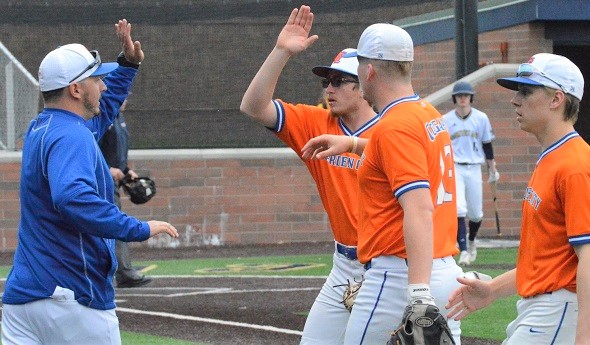
It’s impossible to argue with the results. Garden City equaled last season’s win total by April 8 and earned one of its best victories of the season by just a run, 1-0 over preseason Division 2 No. 1 Detroit Country Day.
Chemistry on the field no doubt has been cultivated in part from familiarity with the coach. Evans graduated from Garden City when his seniors were in junior high, in 2014, and after a year playing at Defiance College in Ohio coached the Cougars’ junior varsity the last three seasons while finishing his studies at Eastern Michigan University.
“It's nice because they know when I can say I can relate to them, they know that's true,” Evans said. “I was just in their shoes five years ago, even in the classroom, with things they go through inside the school. I had all the teachers. They have assignments, and I look at the assignment and say I remember doing this. It’s easy for me to help them, and it’s good for players building trust with their coach to know their coach just went through this.”
He took over the varsity in February and previously coached 15 of 18 players on this spring’s roster. Evans’ JV went 15-7 a year ago – a nice sign for this season and the next few to come.
 He also had paid attention to behind-the-scenes workings of running a varsity program over the last few years, and all of that familiarity made for a smooth transition when he took over.
“(The success) is not because of me, but having the same coach, I saw them every game they played freshman and sophomore year and I know what their tendencies are, what’s going through their minds,” he said. “It’s tougher competition, but I know how the kids are going respond. It didn’t take a few weeks for me – I knew right away what they were going to do, and the kids knew my coaching style and knew me stepping up to varsity was not going to change who I was.”
A trio of seniors has led the way offensively. First baseman Kevin Widner is hitting .457 with a .636 on-base percentage and 15 RBI, while catcher Trevor McCorry comes in at .438 with six doubles and Jacob Grant is hitting .426 with seven extra-base hits, 17 RBI, 28 runs scored and a .614 on-base percentage. Junior second and third baseman and pitcher Jacob May is adding a .379 average, 29 runs scored and 19 RBI to the offensive output.
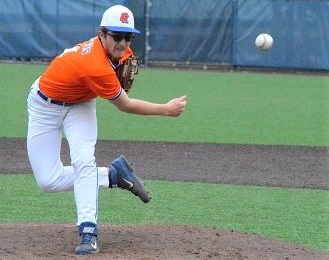
Grant is the ace on the mound with a 6-0 record and 1.04 ERA over 34 innings. A number of other pitchers fill out a deep staff of contributors – Widner again stands out with a perfect ERA and 19 strikeouts over 10 innings pitched.
The program had postseason success as recently as 2016, when it won a District title. There is reason to be excited with this spring’s District less than two weeks away, but the Cougars are being cautious – the District opener is against Livonia Franklin, one of just two teams to beat Garden City this season (they split; the other losses came in a sweep by Trenton), and the bracket is competitive throughout.
Evans had a feeling this group would do the little things that, combined with their talent, have sparked a memorable run. Regardless of how this spring finishes up, it’s fair to say it’s been unforgettable so far.
“I had a feeling we’d have a good year this year – it’s a talented group, and when they play hard, when they do the little things right, they succeed,” Evans said. “I saw it on JV – when they played good defense, ran the bases well, put the ball in play, those teams did well.”
Past Teams of the Month, 2018-19
March: Holland West Ottawa boys swimming & diving – Read
February: Lowell wrestling – Read
January: Farmington United gymnastics – Read
December: Warren Woods-Tower wrestling – Read
November: Rochester Adams girls swimming & diving – Read
October: Leland boys soccer – Read
September: Pickford football – Read
August: Northville girls golf – Read
PHOTOS: (Top) Garden City celebrates during a win over Detroit Country Day last month. (Middle) Senior Jacob Grant fires a pitch – he’s 6-0 this spring. (Photos courtesy of State Champs Sports Network.)