


Classes Still Create Hoosier Hysteria
July 27, 2017
By Rob Kaminski
MHSAA benchmarks editor
This is the fourth part in a series on MHSAA tournament classification, past and present, that will be published over the next two weeks. This series originally ran in this spring's edition of MHSAA benchmarks.
Twenty years ago, Bloomington North High School won the Indiana High School Athletic Association boys basketball championship, defeating Delta 75-54 at the RCA Dome in Indianapolis.
The date, March 22, 1997, is at the same time revered and disdained by traditionalists in the state who saw it as the last schoolboy championship game the state would ever host.
That’s how devout the game of basketball, particularly interscholastic basketball, had become in the Hoosier state during the 87 years a state champion – one state champion, to be precise – was crowned.
Following that 1997 season, the IHSAA moved to a four-class system for its roundball tournaments, like so many of its state association counterparts had done years earlier.
It would be shocking to find more than a small percentage of current high school basketball players around the country unfamiliar with the iconic movie Hoosiers, even though the film is now more than 30 years old.
And, the storyline for that blockbuster unfolded more than 30 years prior to its release, when small-town, undermanned Milan High School defeated Muncie Central High School 32-30 in the 1954 IHSAA title game.
Perhaps it’s because of the David vs Goliath notion, or the fame of the movie that replaced Milan with the fictional Hickory and real-life star Bobby Plump with Hollywood hero Jimmy Chitwood, or the simple fact that Indiana had something other states didn’t.
Whatever the reason, plenty of opposition remains to this day to basketball classification in the state.
The fact is, the small rural schools were regularly being beaten handily by the much larger suburban and city schools as the tournament progressed each season.
Small schools also were closing at a rapid rate following the state’s School Reorganization Act in 1959, as students converged on larger, centralized county schools. From 1960 to 2000, the number of schools entering the tournament dropped from 694 to 381, and in 1997 a total of 382 schools and 4,584 athletes began competition at the Sectional level (the first level of the IHSAA Basketball Tournament).
It was at the entry level of the tournament where school administrators felt the pain of the new class system, but not necessarily for the same nostalgic reasons as the fans who either attended or boycotted the tournament.
At the Sectional round of the tournament, the IHSAA was culling just 2 percent of the revenue, with the participating schools splitting the balance. So, when Sectional attendance dropped by 14 percent in that first year of class basketball, many schools realized a financial loss. It was money they had grown to count on in prior years to help fund various aspects of the department.
Schools cumulatively received more than $900,000 from Sectional competition in 1998, but that total was down from more than $1 million in the last year of the single-class tournament.
Yet, the current format provides a great deal more opportunity and realistic chances at championship runs for schools of all enrollments.
To date, 60 additional teams have championship or runner-up trophies on display in school trophy cases around Indiana.
That was the mission in front of then-IHSAA commissioner Bob Gardner (now National Federation executive director) once the board made its decision: to give thousands more student-athletes the opportunity for once-in-a-lifetime experiences.
As any statistician knows, figures can be manipulated to tell any side of a story. Declining attendance in year one of class basketball is such a number.
The truth is tournament attendance had been on a steady downward spiral since its peak of just over 1.5 million in 1962. By the last single-class event in 1997, the total attendance was half that.
The challenge then and today, as it is for all state associations, is to find that delicate balance for those holding onto tradition, those holding onto trophies, and the number of trophies to hand out.
Editor’s Note: Stories from the Fort Wayne Journal Gazette in 1998 and from a 2007 issue of Indianapolis Monthly provided facts in this article.
Talented Escanaba Pursuing Title Repeat
May 14, 2019
By Dennis Grall
Special for Second Half
ESCANABA – Ever since softball became part of the Escanaba High School athletic program in 1997, it has been among the best and most consistent offerings in the state.
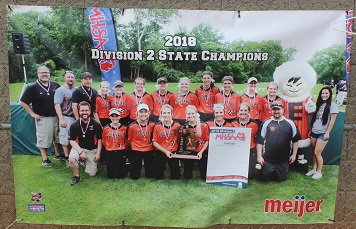
 Last year the Eskymos confirmed their elite prep status by winning the MHSAA Division 2 title, and they again are in the thick of this year's championship picture. Escanaba belted South Haven 5-0 in last season’s Final, after clipping Eaton Rapids 2-0 in the Semifinal two days before.
The Eskymos won their final 13 games last year to finish 31-3. Gabi Salo, then a sophomore, fanned 11 of the title game's opening 13 batters and allowed three hits while punching out 13 batters total. Salo and Escanaba yielded just two runs over seven postseason games. The six EHS seniors on that team compiled a 131-18 record during their four seasons.
Escanaba previously was Division 1 runner-up in 2003 and lost in Division 2 Semifinals in 2016 and 2017.
Salo has helped the Eskymos to a 15-1 record in this weather-marred spring, and Escanaba was ranked No. 1 in the state before losing to Kent State recruit Gabbie Sherman and Division 3 top-rated Millington 3-0 on Friday in Escanaba. Sherman, another of the state's prime pitchers, also throttled Escanaba 2-1 last year.
The Eskymos rebounded from Friday's loss in grand style on a frigid Saturday, whipping Marshfield, Wis., 9-5 and then clipping arch-rival Gladstone 7-0 behind a perfect game by Salo, who whiffed 14 batters.
Gladstone manager John Nevala said "if her control is good and she can get the corner called, she can be called unhittable. We had been hitting the ball pretty good until we faced Gabi."
Salo demonstrated better location and control against Gladstone than the previous night's rare loss. "She is in a class of her own," said Nevala. "She has to be one of the top pitchers in the state. She had very good movement.
"She has excellent speed (around 64-65 mph) and an excellent changeup. She changes speeds so well. She probably has three different speeds. You can't really dig in on one location at the plate."
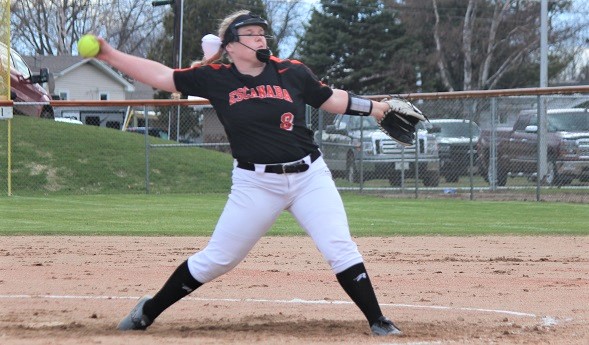
This season Salo is 10-1 with two saves and sports a dominating 0.02 ERA. She has struck out 136 batters in 69 2/3 innings, but has also issued eight walks and hit four batters during wicked spring conditions the opening month. (NOTE: After a pair of no-hitters Monday and Tuesday against Marquette and Gladstone, respectively, Salo is 12-1 with 161 strikeouts in just under 84 innings pitched.)
A University of Wisconsin recruit since last spring, Salo felt she threw well against Millington and Gladstone, but indicated she was "pretty tight" in the freezing opener. She said her curveball and changeup worked better against Gladstone.
She didn't pay attention to keeping Gladstone off the bases. "I try not to think about those things. I feel like it is a jinx," she said.
 Salo worked hard last year to develop her back-breaking change-up and now terms it her favorite pitch. "It is spot-on," she said. "It throws the hitters off their game. I go out, focus and attack the hitter. I like getting swinging strikes." She is not afraid to use her change on a 3-2 count.
She fires her fastball down-and-in or inside-and-high and loves to get her pitches inside on the batter's fists.
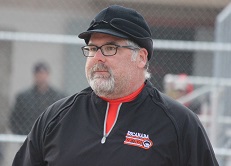
The Escanaba first-year manager is her father, Gary, who was the pitching coach for the Eskymos last year under Jamie Segorski, who resigned as coach just as practice began this spring. Gary and Gabi have been together for several years on different summer travel teams.
He signals the pitches from his dugout perch, using input from his daughter and junior catcher and Ferris State commit Dakota Cloutier, who also handled that spot last season.
Senior right fielder Lexi Chaillier, a three-sport, four-year standout, leads the Eskymos with a .481 batting average and five home runs. Gabi Salo leads with 18 RBI and hits .378, while sophomore first baseman-pitcher Nicole Kamin is hitting .477 with 14 runs driven in. Cloutier is hitting .356 with 12 RBI.
Expect that quartet to lead the way this weekend when the Eskymos play in a highly-competitive 20-team invitational tournament in Ann Arbor. The strong field is what the Eskymos search for in compiling a schedule, with trips into Wisconsin and lower Michigan to find high-quality opponents.
Referring to other top hurlers, along with Millington's circle ace, Gary Salo said "we want to go up against elite pitching if we want to go to the next level." And now, with a state title, he said the Eskymos know "we are going to get everybody's best game."
After Friday's loss and the twin wins Saturday, the Escanaba skipper said "our kids are very resilient. We licked our wounds."
Much of the high school program's success is credit to a tremendous Little League program. Gabi Salo began pitching at age 10 when her youth coach asked if anyone wanted to throw. For many years she has received extensive coaching from Pat Brower in Ann Arbor. "He has developed Gabi into the pitcher she is," said her dad. "It is well worth driving six-and-a-half hours each way."
 Gabi Salo began her travel ball experience with the Escanaba Heartbreakers at age 10, then joined downstate teams, playing with Wixom Finesse the past three summers. The opportunity to play against quality travel teams in addition to high school has been crucial to her development.
Travel ball has taken the Salos to Atlanta, Huntington Beach, Calif. and Boulder, Colo. in addition to such destinations as the Grand Canyon. Gary Salo drives the family RV everywhere, with just father-daughter on most jaunts.
"Softball has given us a summer-long vacation," said Gary Salo.
"Definitely travel ball has helped me see parts of the country I would never get to see," said Gabi, who plans to enter the nursing field at UW and works at Christian Park Nursing in Escanaba. She also bowled for EHS and participates in dance, saying she would skip a softball game but would not skip a dance recital.
"The travel ball and high school competition is pretty equal," she said. "We play the best competition there is in the country."
Escanaba, which also excels in the classroom (a state-best 3.83 GPA), knows a title repeat will be difficult to achieve because teams like Richmond, Muskegon Oakridge, Eaton Rapids, Spring Lake, Detroit Country Day, Freeland and Stevensville Lakeshore are very dangerous.
"It is not a seven-game series. They are seven-inning games," Gary Salo said of the postseason dynamics.
"A lot of teams are playing really, really well," he said. "Any team has the opportunity to get lucky like we did."
 Denny Grall retired in 2012 after 39 years at the Escanaba Daily Press and four at the Green Bay Press-Gazette, plus 15 months for WLST radio in Escanaba; he served as the Daily Press sports editor from 1970-80 and again from 1984-2012 and currently is in a second stint as the interim in that position. Grall was inducted into the Upper Peninsula Sports Hall of Fame in 2002 and serves as its executive secretary. E-mail him at [email protected] with story ideas for the Upper Peninsula.
PHOTOS: (Top) Gabi Salo makes her move toward the plate during last weekend’s Escanaba Invitational. (Middle) A championship banner at the Eskymos’ home field celebrates last season’s Division 2 championship. (Below) Gary Salo has taken over the varsity this spring. (Photos by Dennis Grall.)