


Classes Still Create Hoosier Hysteria
July 27, 2017
By Rob Kaminski
MHSAA benchmarks editor
This is the fourth part in a series on MHSAA tournament classification, past and present, that will be published over the next two weeks. This series originally ran in this spring's edition of MHSAA benchmarks.
Twenty years ago, Bloomington North High School won the Indiana High School Athletic Association boys basketball championship, defeating Delta 75-54 at the RCA Dome in Indianapolis.
The date, March 22, 1997, is at the same time revered and disdained by traditionalists in the state who saw it as the last schoolboy championship game the state would ever host.
That’s how devout the game of basketball, particularly interscholastic basketball, had become in the Hoosier state during the 87 years a state champion – one state champion, to be precise – was crowned.
Following that 1997 season, the IHSAA moved to a four-class system for its roundball tournaments, like so many of its state association counterparts had done years earlier.
It would be shocking to find more than a small percentage of current high school basketball players around the country unfamiliar with the iconic movie Hoosiers, even though the film is now more than 30 years old.
And, the storyline for that blockbuster unfolded more than 30 years prior to its release, when small-town, undermanned Milan High School defeated Muncie Central High School 32-30 in the 1954 IHSAA title game.
Perhaps it’s because of the David vs Goliath notion, or the fame of the movie that replaced Milan with the fictional Hickory and real-life star Bobby Plump with Hollywood hero Jimmy Chitwood, or the simple fact that Indiana had something other states didn’t.
Whatever the reason, plenty of opposition remains to this day to basketball classification in the state.
The fact is, the small rural schools were regularly being beaten handily by the much larger suburban and city schools as the tournament progressed each season.
Small schools also were closing at a rapid rate following the state’s School Reorganization Act in 1959, as students converged on larger, centralized county schools. From 1960 to 2000, the number of schools entering the tournament dropped from 694 to 381, and in 1997 a total of 382 schools and 4,584 athletes began competition at the Sectional level (the first level of the IHSAA Basketball Tournament).
It was at the entry level of the tournament where school administrators felt the pain of the new class system, but not necessarily for the same nostalgic reasons as the fans who either attended or boycotted the tournament.
At the Sectional round of the tournament, the IHSAA was culling just 2 percent of the revenue, with the participating schools splitting the balance. So, when Sectional attendance dropped by 14 percent in that first year of class basketball, many schools realized a financial loss. It was money they had grown to count on in prior years to help fund various aspects of the department.
Schools cumulatively received more than $900,000 from Sectional competition in 1998, but that total was down from more than $1 million in the last year of the single-class tournament.
Yet, the current format provides a great deal more opportunity and realistic chances at championship runs for schools of all enrollments.
To date, 60 additional teams have championship or runner-up trophies on display in school trophy cases around Indiana.
That was the mission in front of then-IHSAA commissioner Bob Gardner (now National Federation executive director) once the board made its decision: to give thousands more student-athletes the opportunity for once-in-a-lifetime experiences.
As any statistician knows, figures can be manipulated to tell any side of a story. Declining attendance in year one of class basketball is such a number.
The truth is tournament attendance had been on a steady downward spiral since its peak of just over 1.5 million in 1962. By the last single-class event in 1997, the total attendance was half that.
The challenge then and today, as it is for all state associations, is to find that delicate balance for those holding onto tradition, those holding onto trophies, and the number of trophies to hand out.
Editor’s Note: Stories from the Fort Wayne Journal Gazette in 1998 and from a 2007 issue of Indianapolis Monthly provided facts in this article.
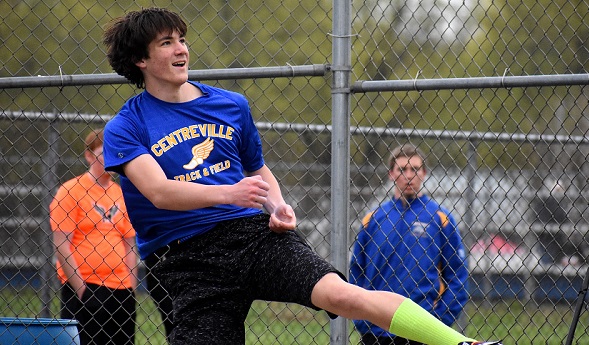
Self-Taught Overholt Firing Record Tosses
By
Wes Morgan
Special for MHSAA.com
May 10, 2019
We’re all students at YouTube University now, with information — some useful — accessible from experts around the globe. Trending this week are videos ranging from Gordon Ramsay’s breakfast tacos tutorial to step-by-step guides for picking locks with hairpins.
 Centreville senior Tyler Overholt made better use of his online browsing time, eventually stumbling upon Poland’s two-time Olympic silver medalist in the discus, Piotr Malachowski. Though he doesn’t know it, Malachowski became Overholt’s coach.
An immeasurable amount of determination, and countless hours of watching film of Malachowski, led Overholt to break a 42-year-old school record earlier this year — a mark he since has bettered twice. At the White Pigeon Invitational in April, Overholt registered a distance of 155 feet, 7 inches to surpass Trent Grossman on the Bulldogs’ record board. A week later, Overholt made a toss of 160-6 in a meet that wasn’t officially finished due to inclement weather. In the following meet, he recorded a throw of 158-1.
“Let me tell you, I don’t smile much, but I had a big smile on my face,” said the soft-spoken Overholt, who earned Division 4 all-state status with a seventh-place finish after posting a mark of 138-3 at last year’s MHSAA Finals. “I was jumping up and down.”
Centreville jumped up to Division 3 this year, but Overholt’s marks still make him one of the favorites a few weeks from now at this year’s Finals at Jenison High School. Yet, you probably wouldn’t assume that with just a passing glance.
As a lanky freshman, Overholt was encouraged to try something other than discus. Still lanky now at 6-foot-6, 192 pounds, Overholt doesn’t look like a prototypical thrower.
But his fascination with the event only grew. As a sophomore, he approached new head coach Mike Hunter about giving it a try. Hunter, like most coaches at smaller schools, does the most he can to instruct his athletes in a wide variety of events. But he’s honest about a lack of expertise in the discus.
“He worked hard at the discus basically by himself,” Hunter said of Overholt. “He did some research and found some people. The hard thing with track is it is hard to coach every event if you don’t understand it, so to speak. I never did field events. I’ve tried to do the best I could to help him, but he’s done a lot on his own.
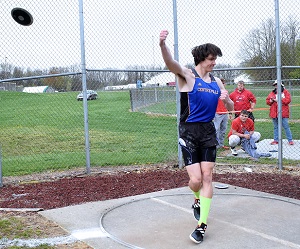 “He has just worked hard and has great technique. It’s not just arming the thing out there. He’s been great to coach, and he’ll do what you ask him to do. He’s right (in the state championship mix) if he can relax and throw with confidence.”
Overholt, who also took on the shot put and hurdles for the first time this spring, knew mastering the technique could trump strength. So he studied Malachowski and other high-level throwers, had his mother, Debra, record his meets, and he broke down that film as well.
“For the first year, I just searched a lot of Olympic discus throwers and tried to copy them,” he said. “Then I started applying details into the spin. There was a lot of improvement, especially my junior year.”
Gaining 20 pounds over the last year has factored in as well after Overholt begrudgingly followed Hunter’s advice to spend more time in the weight room.
“I wasn’t really into it at first,” Overholt said. “It took me until my senior year to really start lifting. Now I’m a lot stronger.”
And more confident and experienced. He admitted that his performance at the
Finals last year was far from his best as he wrestled with the nerves that often come into play for first-timers. Overholt entered this season with the school record in his crosshairs, and now that he’s crossed that off his list, he’s chasing 170 feet. As a result of his success in the circle, his future plans have been altered in the last week.
Instead of going into the Navy after graduation, Overholt is headed to Olivet College, where he’ll throw for the Comets. He still intends to enlist in the Navy when he’s done.
“Some people are amazed by what I do and want to know the secret,” he said. “I’ve surprised myself.”
 Wes Morgan has reported for the Kalamazoo Gazette, ESPN and ESPNChicago.com, 247Sports and Blue & Gold Illustrated over the last 12 years and is the publisher of JoeInsider.com. He can be reached at [email protected] with story ideas for Berrien, Cass, St. Joseph and Branch counties.
PHOTOS: (Top) Centreville’s Tyler Overholt watches one of his discus tosses soar. (Middle) Overholt unloads a toss during a meet this spring. (Photos courtesy of JoeInsider.com.)