


Classes Still Create Hoosier Hysteria
July 27, 2017
By Rob Kaminski
MHSAA benchmarks editor
This is the fourth part in a series on MHSAA tournament classification, past and present, that will be published over the next two weeks. This series originally ran in this spring's edition of MHSAA benchmarks.
Twenty years ago, Bloomington North High School won the Indiana High School Athletic Association boys basketball championship, defeating Delta 75-54 at the RCA Dome in Indianapolis.
The date, March 22, 1997, is at the same time revered and disdained by traditionalists in the state who saw it as the last schoolboy championship game the state would ever host.
That’s how devout the game of basketball, particularly interscholastic basketball, had become in the Hoosier state during the 87 years a state champion – one state champion, to be precise – was crowned.
Following that 1997 season, the IHSAA moved to a four-class system for its roundball tournaments, like so many of its state association counterparts had done years earlier.
It would be shocking to find more than a small percentage of current high school basketball players around the country unfamiliar with the iconic movie Hoosiers, even though the film is now more than 30 years old.
And, the storyline for that blockbuster unfolded more than 30 years prior to its release, when small-town, undermanned Milan High School defeated Muncie Central High School 32-30 in the 1954 IHSAA title game.
Perhaps it’s because of the David vs Goliath notion, or the fame of the movie that replaced Milan with the fictional Hickory and real-life star Bobby Plump with Hollywood hero Jimmy Chitwood, or the simple fact that Indiana had something other states didn’t.
Whatever the reason, plenty of opposition remains to this day to basketball classification in the state.
The fact is, the small rural schools were regularly being beaten handily by the much larger suburban and city schools as the tournament progressed each season.
Small schools also were closing at a rapid rate following the state’s School Reorganization Act in 1959, as students converged on larger, centralized county schools. From 1960 to 2000, the number of schools entering the tournament dropped from 694 to 381, and in 1997 a total of 382 schools and 4,584 athletes began competition at the Sectional level (the first level of the IHSAA Basketball Tournament).
It was at the entry level of the tournament where school administrators felt the pain of the new class system, but not necessarily for the same nostalgic reasons as the fans who either attended or boycotted the tournament.
At the Sectional round of the tournament, the IHSAA was culling just 2 percent of the revenue, with the participating schools splitting the balance. So, when Sectional attendance dropped by 14 percent in that first year of class basketball, many schools realized a financial loss. It was money they had grown to count on in prior years to help fund various aspects of the department.
Schools cumulatively received more than $900,000 from Sectional competition in 1998, but that total was down from more than $1 million in the last year of the single-class tournament.
Yet, the current format provides a great deal more opportunity and realistic chances at championship runs for schools of all enrollments.
To date, 60 additional teams have championship or runner-up trophies on display in school trophy cases around Indiana.
That was the mission in front of then-IHSAA commissioner Bob Gardner (now National Federation executive director) once the board made its decision: to give thousands more student-athletes the opportunity for once-in-a-lifetime experiences.
As any statistician knows, figures can be manipulated to tell any side of a story. Declining attendance in year one of class basketball is such a number.
The truth is tournament attendance had been on a steady downward spiral since its peak of just over 1.5 million in 1962. By the last single-class event in 1997, the total attendance was half that.
The challenge then and today, as it is for all state associations, is to find that delicate balance for those holding onto tradition, those holding onto trophies, and the number of trophies to hand out.
Editor’s Note: Stories from the Fort Wayne Journal Gazette in 1998 and from a 2007 issue of Indianapolis Monthly provided facts in this article.
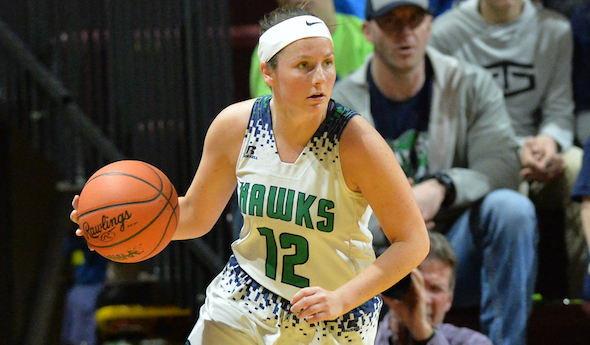
Still #1: Heritage Lands 2nd Straight Title
By
Paul Costanzo
Special for MHSAA.com
March 23, 2019
GRAND RAPIDS – Not often is the reigning champion the hunter and not the hunted. But that’s how the Saginaw Heritage girls basketball approached this season.
With the graduation of some key members from the 2018 Class A title team, the Hawks felt they were being overlooked.
On Saturday, they re-established themselves as the top team among the state’s largest schools, now classified as Division 1.
Behind a stifling defense, Heritage earned a second straight MHSAA title by defeating top-ranked Southfield Arts & Technology 55-40 at Van Noord Arena on the campus of Calvin College.
“If anything, we kind of felt underestimated, like a lot of people didn’t think we were going to get right back,” Heritage senior Shine Strickland-Gills said. “We lost two players, and they scored a lot … and it didn’t look like we had much coming in through the tunnel after them, so they didn’t really think we were going to go back again. But we wanted to prove them all wrong, and our whole thing was to stick together. Our end goal, everybody’s end goal, was to play in the last game and win. We just knew what we had to do, and we made sure that got done.”
It was the third MHSAA championship for the Hawks (25-2), and it seemed fitting it was this senior class that spearheaded these last two. Strickland-Gills and classmates Moira Joiner and Mallory McCartney have been playing together for more than a decade, and had predicted they could accomplish this before they got into high school.
“They were eighth graders the last time we were in a Final Four, and they all cut school and came down to the Breslin Center and watched Heritage,” Hawks coach Vonnie DeLong said. “We lost that day, and they told me that day, ‘We’re getting back here and we’re winning it, Coach.’ They made good on their promise to me.”
Heritage looked like a team that knew it was supposed to be playing in Saturday’s moment, taking control early and remaining calm and composed while clinically finishing it off.
The Hawks were hitting 50 percent of their 3-pointers at one point in the third quarter, and finished the game with 19 assists on 20 made baskets. Joiner led the way with 17 points, eight rebounds and eight assists, nearly matching the triple double she had in Friday’s Semifinal against Wayne Memorial. Strickland-Gills added 16 points, eight rebounds, six assists and six blocks, while junior Keyonie Champion had 12 points. McCartney added seven points, five rebounds and five assists.
 “Having them be seniors, not just seniors, but having been in this game before – having been in these big games is huge,” DeLong said. “Today they just knew. I talked to them this morning and told them, ‘This is it, last time you’re ever going to play together – you're going to keep playing, but not together – and this is the last chance you got. I’m going to tell you right now, last game senior year, if you can go out a winner, that’s absolutely the way you want to go.’”
While Heritage didn’t have much trouble settling in, the Hawks made it hard for the Warriors (24-2) to do so, especially on the offensive end. They played zone and closed down on everything in the paint, forcing Southfield A&T into its worst offensive performance of the season.
It was only the second time all year the Warriors – who shot 16 of 47 (34 percent) from the field – were held below 50 points. The other time was a 45-43 loss to Heritage in the second game of the season.
“They were in a zone, and the zone packed it in a little bit, and we were struggling to find some gaps to attack,” Southfield A&T coach Michele Marshall said. “We play inside-out, and it just appeared the gaps were not there. If they were, when we tried to attack, we were just a little bit hesitant.”
Zone isn’t the typical defensive setup for Heritage, but DeLong said possible fatigue from the previous night’s Semifinal and the importance of keeping Strickland-Gills out of foul trouble pushed her to make the change.
“I don’t think we’ve played a full game of zone all year this year,” DeLong said. “We played it a couple times last year, and it worked in the Final. We talked about it last night, watched some film today and did some walkthrough at a gym this morning. Most of them have played our zone enough, so they know what to do, but a couple of our kids are a little shaky. But we got them through, and it worked.”
The Warriors shot 6 of 21 (28.6 percent) in the first half, and just 2 of 8 (25 percent) in the second quarter. They played more than six minutes of the second quarter without star forward Alexis Johnson, who was sidelined with three fouls.
Heritage was able to take advantage during that span, stretching its lead to 11 points by halftime and never looking back.
Soleil Barnes led Southfield A&T with 14 points, while Cheyenne McEvans had 13.
PHOTOS: (Top) Heritage’s Mallory McCartney looks for open teammates Saturday during the Division 1 Final. (Middle) A&T’s Cheyenne McEvans directs her team’s offense.