


Classes Still Create Hoosier Hysteria
July 27, 2017
By Rob Kaminski
MHSAA benchmarks editor
This is the fourth part in a series on MHSAA tournament classification, past and present, that will be published over the next two weeks. This series originally ran in this spring's edition of MHSAA benchmarks.
Twenty years ago, Bloomington North High School won the Indiana High School Athletic Association boys basketball championship, defeating Delta 75-54 at the RCA Dome in Indianapolis.
The date, March 22, 1997, is at the same time revered and disdained by traditionalists in the state who saw it as the last schoolboy championship game the state would ever host.
That’s how devout the game of basketball, particularly interscholastic basketball, had become in the Hoosier state during the 87 years a state champion – one state champion, to be precise – was crowned.
Following that 1997 season, the IHSAA moved to a four-class system for its roundball tournaments, like so many of its state association counterparts had done years earlier.
It would be shocking to find more than a small percentage of current high school basketball players around the country unfamiliar with the iconic movie Hoosiers, even though the film is now more than 30 years old.
And, the storyline for that blockbuster unfolded more than 30 years prior to its release, when small-town, undermanned Milan High School defeated Muncie Central High School 32-30 in the 1954 IHSAA title game.
Perhaps it’s because of the David vs Goliath notion, or the fame of the movie that replaced Milan with the fictional Hickory and real-life star Bobby Plump with Hollywood hero Jimmy Chitwood, or the simple fact that Indiana had something other states didn’t.
Whatever the reason, plenty of opposition remains to this day to basketball classification in the state.
The fact is, the small rural schools were regularly being beaten handily by the much larger suburban and city schools as the tournament progressed each season.
Small schools also were closing at a rapid rate following the state’s School Reorganization Act in 1959, as students converged on larger, centralized county schools. From 1960 to 2000, the number of schools entering the tournament dropped from 694 to 381, and in 1997 a total of 382 schools and 4,584 athletes began competition at the Sectional level (the first level of the IHSAA Basketball Tournament).
It was at the entry level of the tournament where school administrators felt the pain of the new class system, but not necessarily for the same nostalgic reasons as the fans who either attended or boycotted the tournament.
At the Sectional round of the tournament, the IHSAA was culling just 2 percent of the revenue, with the participating schools splitting the balance. So, when Sectional attendance dropped by 14 percent in that first year of class basketball, many schools realized a financial loss. It was money they had grown to count on in prior years to help fund various aspects of the department.
Schools cumulatively received more than $900,000 from Sectional competition in 1998, but that total was down from more than $1 million in the last year of the single-class tournament.
Yet, the current format provides a great deal more opportunity and realistic chances at championship runs for schools of all enrollments.
To date, 60 additional teams have championship or runner-up trophies on display in school trophy cases around Indiana.
That was the mission in front of then-IHSAA commissioner Bob Gardner (now National Federation executive director) once the board made its decision: to give thousands more student-athletes the opportunity for once-in-a-lifetime experiences.
As any statistician knows, figures can be manipulated to tell any side of a story. Declining attendance in year one of class basketball is such a number.
The truth is tournament attendance had been on a steady downward spiral since its peak of just over 1.5 million in 1962. By the last single-class event in 1997, the total attendance was half that.
The challenge then and today, as it is for all state associations, is to find that delicate balance for those holding onto tradition, those holding onto trophies, and the number of trophies to hand out.
Editor’s Note: Stories from the Fort Wayne Journal Gazette in 1998 and from a 2007 issue of Indianapolis Monthly provided facts in this article.
Rivals Find Success in Cooperation
March 8, 2019
By Chris Dobrowolski
Special for Second Half
In the place where rivalries turn into partnerships and adversaries become teammates stands the Great North Alpine ski team and the Bay Reps hockey squad.
 The two programs — cooperatives that both include neighboring foes Traverse City St. Francis and Elk Rapids — have used that unique alliance to have great success in their respective sports this winter.
At last week’s Division 2 Skiing Finals, Great North Alpine’s boys team captured its first title, unseating Petoskey and ending the Northmen’s state record-tying streak of eight straight championships.
The Bay Reps, which also includes athletes from Kalkaska, Kingsley, Bear Lake and Mancelona, have also reached uncharted territory this season. The Reps advanced to the Division 1 Semifinals for the first time after beating Byron Center 4-3 in overtime in Wednesday’s Quarterfinal matchup.
It might be an unlikely union, given that Elk Rapids, St. Francis and Kalkaska compete against one another in the Lake Michigan Conference for most sports, while Kingsley is a rival in the Northern Michigan Football League. However, it would be difficult for either team to exist if not for the joining of forces between multiple schools.
“That’s the main reason we look for partnerships with other schools,” said St. Francis athletic director Aaron Biggar. “A smaller school like ourselves, or even our other partners, can offer a larger array of extracurricular activities. All the athletic directors that you talk to, they understand and know that athletics and extracurricular activities are good for students and you want to provide as many opportunities for those students.”
What they’ve done with those opportunities has been special. Even before the Great North Alpine boys team captured the Finals championship this season, it had been one of the elite teams in the state in Division 2. Beating Petoskey proved to be the big challenge and resulted in three consecutive runner-up finishes to the Northmen.
 This year was different, though, and the Great North Alpine boys were able to interrupt the Northmen’s stranglehold on the crown and match the Finals championship the Great North Alpine girls won in 2016.
“It was a great feeling,” said Doug White, who co-coaches the Great North Alpine teams with Ben Ferris. “You felt like that monkey was finally off our back. We were able to overcome Petoskey, which was a great feat. They are a powerhouse.”
The Bay Reps have won four consecutive Northern Michigan Hockey League titles, but a postseason run this deep has eluded them in the nearly two decades since the program was formed. The Reps won Regional titles in 2002, 2003 and 2010, but were turned away in the Quarterfinals each time. This year they were able to string together four wins and break through that barrier, even though they opted to stay in Division 1 when they could have dropped to Division 2 due to fewer schools being part of the co-op (which resulted in a smaller combined enrollment).
“This year the kids are playing great, and we’re able to compete with those teams,” said first-year Bay Reps head coach Mike Matteucci. “We’ve come a long way this year. It’s been a lot of fun. A lot of growing and a lot of learning.”
Chemistry is the biggest obstacle for a co-op team, both coaches say, but they’ve found ways for team building and then meshing into a cohesive group.
“That’s something we focus on, getting the kids to work with each other,” said Matteucci. “Obviously when they get on the ice, that’s the best thing about hockey in my experience. You might go into a locker room not knowing who anyone is and you’re not going to talk much, but once you get on the ice it’s different. Everybody kind of comes together. Communicating on the ice and getting to know each other. That’s the bond that all these kids have.”
 White also has seen similar results, but in his case it’s on the ski slopes.
“Traverse City St. Francis and Elk Rapids are rivals. It is something to overcome,” said White. “As a coach you don’t look at it that way. You just look at it as another athlete on the team. The big thing is you work on it. As the team gets together when you first start out with dry land training, that’s the most challenging then. But after you get out on the hill and start training on the hill, they come together. Everybody starts to jell together and become one.”
Along the way new friendships are established between teammates who are not always classmates or live in the same town.
“You’re usually competing against these other schools, but when you’re on the same team as them you really have the opportunity to expand your friendships across schools, and you kind of start thinking about those schools differently,” said Elk Rapids senior Finn Husband, who won the Division 2 individual slalom and giant slalom this season. “I know coming into high school I was more like, ‘Oh, these schools are my enemies. We play them in basketball. We play them (in other sports). You really root against them.’ But when you compete on the same team and you have the opportunity to understand how kids in those schools are basically doing the same thing you’re doing, you come together, you make friends and it’s an awesome time for everyone.
“I feel like I have a connection (with St. Francis), knowing the guys on the team and knowing how awesome and competitive they are.”
 Chris Dobrowolski has covered northern Lower Peninsula sports since 1999 at the Ogemaw County Herald, Alpena News, Traverse City Record-Eagle and currently as sports editor at the Antrim Kalkaska Review since 2016. He can be reached at [email protected] with story ideas for Manistee, Wexford, Missaukee, Roscommon, Ogemaw, Iosco, Alcona, Oscoda, Crawford, Kalkaska, Grand Traverse, Benzie, Leelanau, Antrim, Otsego, Montmorency, Alpena, Presque Isle, Cheboygan, Charlevoix and Emmet counties.
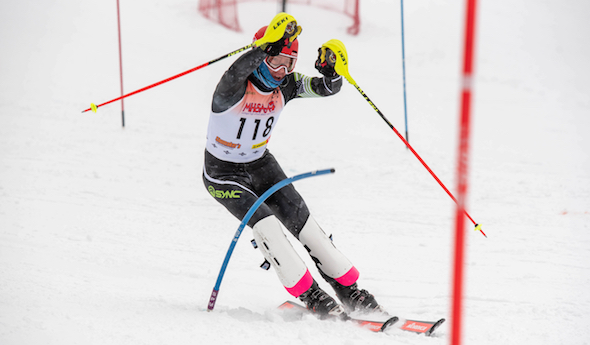
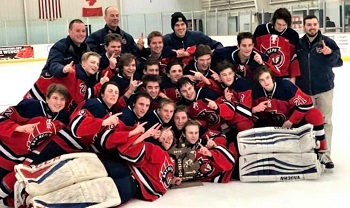
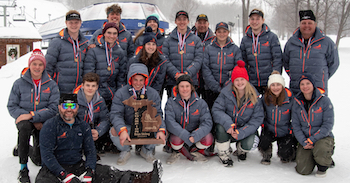
PHOTOS: (Top) Great North Alpine’s Cooper Kerkhof – a student from Elk Rapids – helps the co-op program’s boys team to its first MHSAA Finals title last month. (Middle) The Traverse City Bay Reps hockey team celebrates its Regional title last week. (Below) Members of Great Alpine’s boys and girls teams pose with the championship trophy. (Ski photos by Sports in Motion; hockey photo courtesy of the Bay Reps program.)