


Classes Still Create Hoosier Hysteria
July 27, 2017
By Rob Kaminski
MHSAA benchmarks editor
This is the fourth part in a series on MHSAA tournament classification, past and present, that will be published over the next two weeks. This series originally ran in this spring's edition of MHSAA benchmarks.
Twenty years ago, Bloomington North High School won the Indiana High School Athletic Association boys basketball championship, defeating Delta 75-54 at the RCA Dome in Indianapolis.
The date, March 22, 1997, is at the same time revered and disdained by traditionalists in the state who saw it as the last schoolboy championship game the state would ever host.
That’s how devout the game of basketball, particularly interscholastic basketball, had become in the Hoosier state during the 87 years a state champion – one state champion, to be precise – was crowned.
Following that 1997 season, the IHSAA moved to a four-class system for its roundball tournaments, like so many of its state association counterparts had done years earlier.
It would be shocking to find more than a small percentage of current high school basketball players around the country unfamiliar with the iconic movie Hoosiers, even though the film is now more than 30 years old.
And, the storyline for that blockbuster unfolded more than 30 years prior to its release, when small-town, undermanned Milan High School defeated Muncie Central High School 32-30 in the 1954 IHSAA title game.
Perhaps it’s because of the David vs Goliath notion, or the fame of the movie that replaced Milan with the fictional Hickory and real-life star Bobby Plump with Hollywood hero Jimmy Chitwood, or the simple fact that Indiana had something other states didn’t.
Whatever the reason, plenty of opposition remains to this day to basketball classification in the state.
The fact is, the small rural schools were regularly being beaten handily by the much larger suburban and city schools as the tournament progressed each season.
Small schools also were closing at a rapid rate following the state’s School Reorganization Act in 1959, as students converged on larger, centralized county schools. From 1960 to 2000, the number of schools entering the tournament dropped from 694 to 381, and in 1997 a total of 382 schools and 4,584 athletes began competition at the Sectional level (the first level of the IHSAA Basketball Tournament).
It was at the entry level of the tournament where school administrators felt the pain of the new class system, but not necessarily for the same nostalgic reasons as the fans who either attended or boycotted the tournament.
At the Sectional round of the tournament, the IHSAA was culling just 2 percent of the revenue, with the participating schools splitting the balance. So, when Sectional attendance dropped by 14 percent in that first year of class basketball, many schools realized a financial loss. It was money they had grown to count on in prior years to help fund various aspects of the department.
Schools cumulatively received more than $900,000 from Sectional competition in 1998, but that total was down from more than $1 million in the last year of the single-class tournament.
Yet, the current format provides a great deal more opportunity and realistic chances at championship runs for schools of all enrollments.
To date, 60 additional teams have championship or runner-up trophies on display in school trophy cases around Indiana.
That was the mission in front of then-IHSAA commissioner Bob Gardner (now National Federation executive director) once the board made its decision: to give thousands more student-athletes the opportunity for once-in-a-lifetime experiences.
As any statistician knows, figures can be manipulated to tell any side of a story. Declining attendance in year one of class basketball is such a number.
The truth is tournament attendance had been on a steady downward spiral since its peak of just over 1.5 million in 1962. By the last single-class event in 1997, the total attendance was half that.
The challenge then and today, as it is for all state associations, is to find that delicate balance for those holding onto tradition, those holding onto trophies, and the number of trophies to hand out.
Editor’s Note: Stories from the Fort Wayne Journal Gazette in 1998 and from a 2007 issue of Indianapolis Monthly provided facts in this article.
Forsythe Honorees Led with Statewide View
By
Geoff Kimmerly
MHSAA.com senior editor
March 6, 2019
Jim Derocher always tried to listen to everyone before making a decision while serving on the MHSAA's Representative Council. He wanted to best serve not just the stars but all student-athletes, and not just those down the road but all over Michigan.
Longtime Council member Fred Smith always thought back to something Lake Michigan Catholic coach Terry Rose once told him: when making decisions, do what's best for kids first. Smith did so while trying to consider the needs not just of the student-athletes in his community, but in the many communities all over the state.
Both Derocher and Smith served thousands of students locally over decades of service and provided statewide contributions that continue to guide educational athletics in Michigan today. In recognition of their dedication, Derocher and Smith have been named the 2019 recipients of the Michigan High School Athletic Association’s Charles E. Forsythe Award.
The annual award is in its 42nd year and named after former MHSAA Executive Director Charles E. Forsythe, the Association's first full-time and longest-serving chief executive. Forsythe Award recipients are selected each year by the MHSAA Representative Council, based on an individual's outstanding contributions to the interscholastic athletics community. Derocher and Smith will receive their honors during the break after the first quarter of the MHSAA Division 1 Boys Basketball Final on March 16 at the Breslin Student Events Center in East Lansing.
After beginning his career as a teacher and coach at L’Anse, Derocher went on to serve as athletic director and assistant principal at Ishpeming Westwood from 1989-94, then as superintendent at Brimley from 1994-98 and finally Negaunee from 1998-2014. He also represented the Upper Peninsula’s Class C & D schools on the MHSAA Representative Council from 2003-14 and served as its president from 2008-14.
Smith taught, coached and served as athletic director at St. Joseph Lake Michigan Catholic from 1981-91, then served as athletic director at Comstock from 1991-2007, Buchanan from 2007-2015 and Benton Harbor from 2015-17. He represented the Lower Peninsula’s Southwestern Class A & B schools on the MHSAA Representative Council from 2008-17, including serving as vice president his final four years.
“Jim Derocher was an outstanding Council president, always approaching things first as a superintendent and looking at the big picture,” MHSAA Executive Director Mark Uyl said. “He provided a statewide perspective through an Upper Peninsula prism, always considering how decisions would impact schools from Monroe to Menominee.
“Fred Smith is simply one of the best athletic directors I’ve gotten to work with during my career in athletics,” Uyl added. “I met him while he was at Comstock; from Comstock to Buchanan to Benton Harbor he was presented with and led his programs through different challenges. And he always served as a champion for those schools in that part of the state while keeping a statewide perspective when helping shape the Council’s work.”
 Derocher finished his time at L’Anse earning the Copper Country Conference Coach of the Year award for boys basketball in 1989, and he also served as an MHSAA-registered official in football, boys and girls basketball from 1970-90. While on the Representative Council, Derocher served concurrently on the Upper Peninsula Athletic Committee.
He was a member of the Michigan Association of School Administrators from 1994-2014 and selected as its Region 1 Superintendent of the Year in 2013. He also received MASA’s 20-year Distinguished Administrator Award.
“I believe the experiences our student-athletes get in school athletics molds their future, whether they are the stars of the team or the supporting cast that make a team. This experience is no different for students in Brimley, Negaunee or Detroit," Derocher said. "I was always trying to work with other members of the Representative Council to recognize that these student-athletes are the same all over the state. I wanted to provide the best possible experience while also giving equality to all.”
Smith’s impact continues to be far-reaching. He remains active as part of the Michigan Interscholastic Athletic Administrators Association (MIAAA) and National Interscholastic Athletic Administrators Association (NIAAA), having served on the Board of Directors for both and recently named to the Strategic Planning Committee for the latter. He also continues to teach courses for the MHSAA’s Coaches Advancement Program (CAP) and taught the NIAAA’s Leadership Training Course at the national conference and via the internet in 13 states. He has presented at a number of MHSAA New Athletic Administrator In-Service programs and served as the co-chairperson of the MIAAA’s Professional Development Committee.
 Smith has been a registered cross country and track & field official for more than 30 years, and while an athletic director at his various schools hosted a multitude of MHSAA Tournament events in cross country, volleyball, boys and girls tennis, boys and girls basketball, track & field, wrestling, baseball, boys and girls soccer and softball. He received the MHSAA’s Allen W. Bush Award in 2014 for his many contributions behind the scenes, was named the MIAAA’s Athletic Director of the Year in 2000 and George Lovich State Award of Merit winner in 2007, and received the Art Jevert/Bruce Jacobs Distinguished Service Award from the Association of Track Officials of Michigan (ATOM) in 2013. He was named Midwest Athletic Director of the Year in 2000 as well by the National Council of Secondary School Athletic Directors (NCSSAD), and recognized by the NIAAA with a special commendation in 1999, its Distinguished Service Award in 2000, its Thomas Frederick Award of Excellence in 2004 and its Frank Kovaleski Professional Development Award in 2012. Smith also is a member of the Battle Creek St. Philip and Comstock halls of fame.
“Looking back on the service, it goes back to something my mom taught me when I was young and tried to impress on my brothers and sisters – it’s better to serve than to be served,” Smith said. “I’ve always tried to serve. I was very blessed with good high school coaches, and I enjoyed my high school experience at St. Philip. I was wanting to give back and fell into that niche, and I really enjoyed it.”
Derocher graduated from L’Anse High School in 1970 and earned his bachelor’s in secondary education, mathematics and physics in 1975 and master’s in education in 1988, both from Northern Michigan University. He also earned education specialist certification in 2003. He was a member of the Lake Superior Community Partnership from 2003-14 and remains a member of the Negaunee Lions Club. He resides in Ishpeming and works as an account executive for SET SEG, which coordinates benefits for Michigan public schools and their employees.
Smith graduated from Battle Creek St. Philip in 1973 and Western Michigan University with his bachelor’s degree in 1979. He received the Certified Master Athletic Administrator designation from the NIAAA in 2004. He remains active through his church, Our Lady Queen of Peace Catholic Church in Bridgman, and resides in Stevensville.
Past recipients of the Charles E. Forsythe Award
1978 - Brick Fowler, Port Huron; Paul Smarks, Warren
1979 - Earl Messner, Reed City; Howard Beatty, Saginaw
1980 - Max Carey, Freesoil
1981 - Steven Sluka, Grand Haven; Samuel Madden, Detroit
1982 - Ernest Buckholz, Mt. Clemens; T. Arthur Treloar, Petoskey
1983 - Leroy Dues, Detroit; Richard Maher, Sturgis
1984 - William Hart, Marquette; Donald Stamats, Caro
1985 - John Cotton, Farmington; Robert James, Warren
1986 - William Robinson, Detroit; Irving Soderland, Norway
1987 - Jack Streidl, Plainwell; Wayne Hellenga, Decatur
1988 - Jack Johnson, Dearborn; Alan Williams, North Adams
1989 - Walter Bazylewicz, Berkley; Dennis Kiley, Jackson
1990 - Webster Morrison, Pickford; Herbert Quade, Benton Harbor
1991 - Clifford Buckmaster, Petoskey; Donald Domke, Northville
1992 - William Maskill, Kalamazoo; Thomas G. McShannock, Muskegon
1993 - Roy A. Allen Jr., Detroit; John Duncan, Cedarville
1994 - Kermit Ambrose, Royal Oak
1995 - Bob Perry, Lowell
1996 - Charles H. Jones, Royal Oak
1997 - Michael A. Foster, Richland; Robert G. Grimes, Battle Creek
1998 - Lofton C. Greene, River Rouge; Joseph J. Todey, Essexville
1999 - Bernie Larson, Battle Creek
2000 - Blake Hagman, Kalamazoo; Jerry Cvengros, Escanaba
2001 - Norm Johnson, Bangor; George Lovich, Canton
2002 - John Fundukian, Novi
2003 - Ken Semelsberger, Port Huron
2004 - Marco Marcet, Frankenmuth
2005 - Jim Feldkamp, Troy
2006 - Dan McShannock, Midland; Dail Prucka, Monroe
2007 - Keith Eldred, Williamston; Tom Hickman, Spring Lake
2008 - Jamie Gent, Haslett; William Newkirk, Sanford-Meridian
2009 - Paul Ellinger, Cheboygan
2010 - Rudy Godefroidt, Hemlock; Mike Boyd, Waterford
2011 - Eric C. Federico, Trenton
2012 - Bill Mick, Midland
2013 - Jim Gilmore, Tecumseh; Dave Hutton, Grandville
2014 - Dan Flynn, Escanaba
2015 - Hugh Matson, Saginaw
2016 - Gary Hice, Petoskey; Gina Mazzolini, Lansing
2017 - Chuck Nurek, Rochester Hills
2018 - Gary Ellis, Allegan
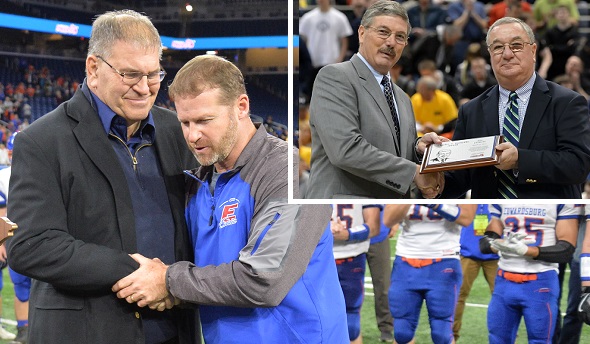
PHOTOS: (Top left) Fred Smith, left, congratulates Edwardsburg football coach Kevin Bartz after the 2017 Division 4 Final at Ford Field. (Top right) Jim Derocher, left, presents Tecumseh's Jim Gilmore with the Forsythe Award in 2013 at the Breslin Center.