


Classes Still Create Hoosier Hysteria
July 27, 2017
By Rob Kaminski
MHSAA benchmarks editor
This is the fourth part in a series on MHSAA tournament classification, past and present, that will be published over the next two weeks. This series originally ran in this spring's edition of MHSAA benchmarks.
Twenty years ago, Bloomington North High School won the Indiana High School Athletic Association boys basketball championship, defeating Delta 75-54 at the RCA Dome in Indianapolis.
The date, March 22, 1997, is at the same time revered and disdained by traditionalists in the state who saw it as the last schoolboy championship game the state would ever host.
That’s how devout the game of basketball, particularly interscholastic basketball, had become in the Hoosier state during the 87 years a state champion – one state champion, to be precise – was crowned.
Following that 1997 season, the IHSAA moved to a four-class system for its roundball tournaments, like so many of its state association counterparts had done years earlier.
It would be shocking to find more than a small percentage of current high school basketball players around the country unfamiliar with the iconic movie Hoosiers, even though the film is now more than 30 years old.
And, the storyline for that blockbuster unfolded more than 30 years prior to its release, when small-town, undermanned Milan High School defeated Muncie Central High School 32-30 in the 1954 IHSAA title game.
Perhaps it’s because of the David vs Goliath notion, or the fame of the movie that replaced Milan with the fictional Hickory and real-life star Bobby Plump with Hollywood hero Jimmy Chitwood, or the simple fact that Indiana had something other states didn’t.
Whatever the reason, plenty of opposition remains to this day to basketball classification in the state.
The fact is, the small rural schools were regularly being beaten handily by the much larger suburban and city schools as the tournament progressed each season.
Small schools also were closing at a rapid rate following the state’s School Reorganization Act in 1959, as students converged on larger, centralized county schools. From 1960 to 2000, the number of schools entering the tournament dropped from 694 to 381, and in 1997 a total of 382 schools and 4,584 athletes began competition at the Sectional level (the first level of the IHSAA Basketball Tournament).
It was at the entry level of the tournament where school administrators felt the pain of the new class system, but not necessarily for the same nostalgic reasons as the fans who either attended or boycotted the tournament.
At the Sectional round of the tournament, the IHSAA was culling just 2 percent of the revenue, with the participating schools splitting the balance. So, when Sectional attendance dropped by 14 percent in that first year of class basketball, many schools realized a financial loss. It was money they had grown to count on in prior years to help fund various aspects of the department.
Schools cumulatively received more than $900,000 from Sectional competition in 1998, but that total was down from more than $1 million in the last year of the single-class tournament.
Yet, the current format provides a great deal more opportunity and realistic chances at championship runs for schools of all enrollments.
To date, 60 additional teams have championship or runner-up trophies on display in school trophy cases around Indiana.
That was the mission in front of then-IHSAA commissioner Bob Gardner (now National Federation executive director) once the board made its decision: to give thousands more student-athletes the opportunity for once-in-a-lifetime experiences.
As any statistician knows, figures can be manipulated to tell any side of a story. Declining attendance in year one of class basketball is such a number.
The truth is tournament attendance had been on a steady downward spiral since its peak of just over 1.5 million in 1962. By the last single-class event in 1997, the total attendance was half that.
The challenge then and today, as it is for all state associations, is to find that delicate balance for those holding onto tradition, those holding onto trophies, and the number of trophies to hand out.
Editor’s Note: Stories from the Fort Wayne Journal Gazette in 1998 and from a 2007 issue of Indianapolis Monthly provided facts in this article.
Success Cascades for Jackson-Area Pair
By
Jeff Bleiler
Special for MHSAA.com
March 2, 2019
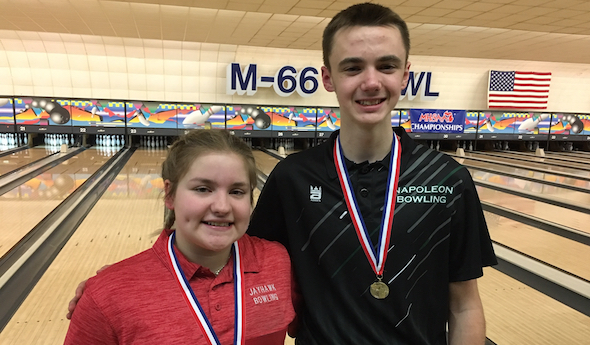
BATTLE CREEK – Not long after they claimed their Division 4 high school bowling singles championships, both Collin Baldwin and Mackenzie Johnson thought back to people who impacted them during their freshman years.
Baldwin proved “some kid” was wrong three years ago, while Johnson paid further homage to her father, who died shortly after her freshman season.
Baldwin, a Napoleon senior, and Johnson, a Vandercook Lake senior, won their MHSAA Finals titles Saturday at M-66 Bowl in Battle Creek, becoming the first Cascades Conference duo to win titles in the same season since Adam LaRoe of Napoleon and Malloree Ambs of Vandercook Lake claimed 2013 crowns.
In front of what sounded like the entire town of Napoleon – the crescendo of cheers getting louder with each successive strike – Baldwin stormed out to a 98-pin lead after the first game in the title match and needed nearly all of it as New Lothrop senior Tate Steinborn rallied but fell short in a 396-366 match.
About 15 minutes later, and eight lanes over, Johnson polished off her second straight Division 4 championship by rolling strikes on five of the first six frames of the second game to defeat Bronson junior Dakota Smith 364-333. Johnson became only the second girl in MHSAA bowling history to repeat as an individual champion, joining Jordan Richard of Tecumseh who won Division 2 titles in 2012 and 2013.
Moments after winning the school’s second Finals singles championship, an emotional Baldwin hugged dozens of teammates, family and fans who made the trek from Napoleon.
“I have a huge support section from my team, family, other teams,” Baldwin said. “I’ve made a lot of friends through this, and they’re all very nice and very supportive of me. I’m just thankful for bowling.”
He had perhaps the most thankless road to the championship, having to face 2017 Finals champion Brandon Hyska of Bronson in the quarterfinals and Vandercook Lake senior Korey Reichard in the semifinals. Baldwin edged Hyska 343-339 with a clutch mark in the 10th frame of the second game, then overcame a 26-pin deficit to Reichard after the first game to win 364-354.
“They’re both really great bowlers,” Baldwin said of Hyska and Reichard. “I’m happy to have bowled with them through high school. They got bad breaks, and I got some good ones. I was relaxed for the most part (going into the championship match), because I had just knocked out Brandon and Korey who had both bowled really good today. Going into the finals, I felt pretty confident in myself and just stuck to my game.”
Baldwin threw eight strikes during a clean 247 to Steinborn’s 149 in a battle of bowlers who employ the ever popular two-handed delivery style. Baldwin went cold in the second game with four opens through nine frames while Steinborn carried a four-bagger and made things interesting. But needing strings of strikes to make up the deficit, Steinborn came up short and Baldwin secured the championship.
“It feels great,” said Napoleon coach Randy Chesney, who also coached the two-handed LaRoe to his Finals championship six years ago. “Collin’s really worked hard, probably harder than any kid I’ve ever had, so he really deserved it. And it was probably the toughest bracket to get through today.”
And that “kid” from three years ago?
“Freshman year, some kid told me I couldn’t bowl two-handed,” said Baldwin, who plans to attend and bowl at Jackson College in the fall. “And I made my goal to be better than him, and I did that today.”
For Johnson, the repeat championship helped cement her among the greats in the storied history of Vandercook Lake bowling and provided proper punctuation to close out Todd Reichard’s 18 seasons as coach.
Johnson trailed after the first game of the championship 170-163. Despite two late open frames the second game, she finished off a 201 to Smith’s 163 to win. Never far from her thoughts was her father, Brad Johnson, who died of an inoperable brain tumor in 2016. He was 49.
“I always feel him in a bowling alley,” she said. “That was the person sixth-grade year, nine hours in a bowling alley a day it felt like. He’d be back there getting his steps in with his Fitbit. I’m always feeling him. If I get lucky on a shot, it’s thanks to Brad. I look up and, ‘Thanks, Brad. You were right.’”
There through every step of her high school years was her mother, Kris, a woman Mackenzie Johnson called “my rock.”
“Throughout this whole thing, my mom is my everything. She’s my rock. She’s my person,” she said. “That is the person I look up to. She’s motivated me to do this. She is my drive. She’s why I do my high school sports; that’s why I’m so competitive. She’s my everything.”
Also there through every step was Reichard, who closed out his high school coaching career guiding his sixth Finals singles champion. Reichard will focus on coaching the Concordia University women’s bowling program, and it seemed fitting that Johnson was the final high school bowler he coached.
“She’s like a daughter to me. Totally amazing,” Reichard said. “There’s nothing she can’t do with a bowling ball. She told me to just (put a bowling ball in her hands) and she can do anything with it. She’s a leader, kids look up to her. She can be tough on them, but she’s a great player. I don’t know where she ranks at Vandercook, but she’s got to be one of the best.”
He might not have seen the last of Johnson, though. She is considering Concordia if she decides to bowl at the next level.
“Todd’s everything I could ask for in a coach and more,” Johnson said. “I honestly don’t plan to bowl anywhere but Concordia. I just thank him for the four seasons he helped me through.”
Click for full girls results and full boys results.