


Classes Still Create Hoosier Hysteria
July 27, 2017
By Rob Kaminski
MHSAA benchmarks editor
This is the fourth part in a series on MHSAA tournament classification, past and present, that will be published over the next two weeks. This series originally ran in this spring's edition of MHSAA benchmarks.
Twenty years ago, Bloomington North High School won the Indiana High School Athletic Association boys basketball championship, defeating Delta 75-54 at the RCA Dome in Indianapolis.
The date, March 22, 1997, is at the same time revered and disdained by traditionalists in the state who saw it as the last schoolboy championship game the state would ever host.
That’s how devout the game of basketball, particularly interscholastic basketball, had become in the Hoosier state during the 87 years a state champion – one state champion, to be precise – was crowned.
Following that 1997 season, the IHSAA moved to a four-class system for its roundball tournaments, like so many of its state association counterparts had done years earlier.
It would be shocking to find more than a small percentage of current high school basketball players around the country unfamiliar with the iconic movie Hoosiers, even though the film is now more than 30 years old.
And, the storyline for that blockbuster unfolded more than 30 years prior to its release, when small-town, undermanned Milan High School defeated Muncie Central High School 32-30 in the 1954 IHSAA title game.
Perhaps it’s because of the David vs Goliath notion, or the fame of the movie that replaced Milan with the fictional Hickory and real-life star Bobby Plump with Hollywood hero Jimmy Chitwood, or the simple fact that Indiana had something other states didn’t.
Whatever the reason, plenty of opposition remains to this day to basketball classification in the state.
The fact is, the small rural schools were regularly being beaten handily by the much larger suburban and city schools as the tournament progressed each season.
Small schools also were closing at a rapid rate following the state’s School Reorganization Act in 1959, as students converged on larger, centralized county schools. From 1960 to 2000, the number of schools entering the tournament dropped from 694 to 381, and in 1997 a total of 382 schools and 4,584 athletes began competition at the Sectional level (the first level of the IHSAA Basketball Tournament).
It was at the entry level of the tournament where school administrators felt the pain of the new class system, but not necessarily for the same nostalgic reasons as the fans who either attended or boycotted the tournament.
At the Sectional round of the tournament, the IHSAA was culling just 2 percent of the revenue, with the participating schools splitting the balance. So, when Sectional attendance dropped by 14 percent in that first year of class basketball, many schools realized a financial loss. It was money they had grown to count on in prior years to help fund various aspects of the department.
Schools cumulatively received more than $900,000 from Sectional competition in 1998, but that total was down from more than $1 million in the last year of the single-class tournament.
Yet, the current format provides a great deal more opportunity and realistic chances at championship runs for schools of all enrollments.
To date, 60 additional teams have championship or runner-up trophies on display in school trophy cases around Indiana.
That was the mission in front of then-IHSAA commissioner Bob Gardner (now National Federation executive director) once the board made its decision: to give thousands more student-athletes the opportunity for once-in-a-lifetime experiences.
As any statistician knows, figures can be manipulated to tell any side of a story. Declining attendance in year one of class basketball is such a number.
The truth is tournament attendance had been on a steady downward spiral since its peak of just over 1.5 million in 1962. By the last single-class event in 1997, the total attendance was half that.
The challenge then and today, as it is for all state associations, is to find that delicate balance for those holding onto tradition, those holding onto trophies, and the number of trophies to hand out.
Editor’s Note: Stories from the Fort Wayne Journal Gazette in 1998 and from a 2007 issue of Indianapolis Monthly provided facts in this article.
D3 Preview: Spoilers Look to Advance
February 21, 2019
By Geoff Kimmerly
Second Half editor
Dundee and Richmond have met in seven of the last nine Division 3 Wrestling Finals, and it’s hardly a shock they are the top-seeded teams heading into this weekend at Kalamazoo’s Wings Event Center.
 But there are potential spoilers waiting. Remus Chippewa Hills is only three seasons removed from a title match appearance, and Whitehall brings 10 Individual Finals qualifiers and a pair of coaches with championship experience as it looks to make a move toward the top.
Below is a look at all eight teams competing in Division 3, listed by seed. Quarterfinal matches begin at 4:30 p.m. Friday, with Semifinals at noon Saturday and the championship match that afternoon at 3:45 p.m. All matches this weekend will be viewable live on a subscription basis on MHSAA.tv. For Friday’s schedule and results throughout, check the MHSAA Wrestling page.
#1 Richmond
Record/rank: 24-2, No. 2
League finish: First in Blue Water Area Conference
Co-coaches: Brandon Day, 15th season (452-95); Preston Treend, third season (70-9)
Championship history: Eight MHSAA championships (most recent 2017), six runner-up finishes.
Individual Finals qualifiers: 103 Hunter Keller (22-4) soph., 112 Daniel McNichol (27-8) sr., 112 JD Gross (24-10) jr., 125 Austin Kilburn (22-6) jr., 130 Hunter Seguin (23-14) sr., 140 Hayden Bastian (26-5) sr., 145 Ethan Wyatt (16-11) sr., 171 Wesley Peters (30-11) fr., 215 Luke Davis (37-5) jr., 285 Dan McKiernan (29-14) soph.
Outlook: After winning the Division 3 Final in 2017 by tie-breaker criteria over Dundee, Richmond fell in the 2018 Final to Dundee 40-15. Among those back for possibly more are returning Finals placers McNichol, Bastian and junior Josh Barton. McNichol and Bastian are two of just four senior starters, but 13 starters and 14 Blue Devils total have at least 20 wins this winter. They once again eliminated No. 5 Algonac on the way to Kalamazoo.
#2 Dundee
Record/rank: 15-5, No. 1
League finish: First in Lenawee County Athletic Association
Coach: Tim Roberts, 20th season (512-74-1)
Championship history: Ten MHSAA championships (most recent 2018), seven runner-up finishes.
Individual Finals qualifiers: 103 Casey Swiderski (39-2) fr., 112. Austin Fietz (32-9) soph., 135 Jonathon White (32-9) sr., 135 Tyler Swiderski (22-10) soph., 140 Christian Killion (38-5) jr., 145. Grant Ott (32-11) sr., 154. Stoney Buell (38-8) soph., 171 Jaxon Guinn (16-6) jr.
Outlook: Dundee is wrestling for its fifth Division 3 championship over the last seven seasons, with a roster that impressively has just three seniors and five juniors – and five upperclassmen expected to start. But Buell is a reigning individual champion and Killion and Tyler Swiderski were Finals runners-up a year ago, while Fietz, White, Guinn and senior Cal McAvoy also were placers.
#3 Whitehall
Record/rank: 28-2, No. 3
League finish: First in West Michigan Conference
Co-coaches: Justin and Collin Zeerip, first seasons (28-2)
Championship history: Class C runner-up 1984.
Individual Finals qualifiers: 103 Aidan Weiler (33-9) fr., 125 Max Brown (38-4) fr., 135 Jacob Haynes (14-12) soph., 140 Marco Moore (21-18) soph., 145 Kyler Honore (30-12) jr., 152 Ira Jenkins (34-6) fr., 160 Trenton Blanchard (34-6) sr., 189 Kayleb Venema (40-2) jr., 215 Allen Powers (37-4) sr., 215 Jarrean Sargeant (34-10) jr.
Outlook: Under the Hesperia champion Zeerip brothers, Whitehall is making its fourth straight Quarterfinal appearance and move up a seed this season after reaching the Semifinals a year ago. With just two seniors on the roster, and five freshman starters, this is another team with an exciting future to go with the present. Blanchard, Venema and Powers were Finals placers a year ago.
#4 Remus Chippewa Hills
Record/rank: 27-1, No. 4
League finish: First in Central State Activities Association Gold
Coach: Kevin Edwards, first season (27-1)
Championship history: Division 3 runner-up 2016.
Individual Finals qualifiers: 112 Taylor Gibson (35-11) jr., 112 Daylin Wittig (30-6) soph., 119 Gavin Miller (22-15) soph., 125 Carson Hayes (35-9) soph., 135 Bray Haynes (36-9) sr., 140 Mason Hayes (40-0) sr., 160 Trenten Wiggins (31-7) soph., 171 Gabriel Petoskey (36-11) jr., 189 Chayton Wiggins (45-1) jr., 215 Carl Whipple (27-7) soph., 285 Colby Roosa (35-1) soph.
Outlook: Chippewa Hills will wrestle in its eighth straight Quarterfinal hoping to advance to a fifth straight Semifinal. Edwards took over this season for longtime coach Nate Ethridge after serving as an assistant during Ethridge’s 18 running the program. Haynes was a Finals placer last season and is one of four repeat qualifiers. There are only three senior starters, but 12 of 14 in the expected lineup have won at least 25 matches this winter.
#5 Montrose
Record/rank: 27-5, No. 6
League finish: Second in Mid-Michigan Activities Conference
Coach: Steve Barnette, seventh season (140-76)
Championship history: Nine MHSAA championships (most recent 2005), five runner-up finishes.
Individual Finals qualifiers: 119 Jake Elasivich (42-7) soph., 145 Robert Skinner (26-11) soph., 171 Jack Kalakay (34-7) jr., 285 Griffin Barnette (45-4) jr.
Outlook: Montrose is returning to the Quarterfinals for the first time since the last championship season of 2005, and defeated No. 7 Birch Run to help get here. The Rams finished second in their league to another contender, Division 4 power New Lothrop. Watch for them moving forward – they have one senior starter but 10 underclassmen in this weekend’s lineup. Elasivich and Griffin Barnette were Finals placers last season.
#6 Alma
Record/rank: 33-6, No. 8
League finish: First in Tri-Valley Conference Central
Coach: Randy Miniard, eighth season (188-92)
Championship history: Has not appeared in an MHSAA Final.
Individual Finals qualifiers: 119 Dametrius Castillo (32-4) soph., 125 Solomon Rosales (25-11) soph., 130 Josiah Baltierra (27-18) fr., 135 Jarrett Ferman (32-3) jr., 152 Justin VanBlaricum (28-9) jr.
Outlook: The Panthers are making their second straight Quarterfinal trip coming off a third consecutive league title, and also moved up a seed from a year ago. Alma got past No. 10 Lake Odessa Lakewood to clinch what was also its second Regional title ever. Castillo also achieved some individual history for the program with its first Finals championship last season since 1993. There is only one senior on the roster and 10 underclassmen in the lineup for this weekend.
#7 Dowagiac
Record/rank: 24-9, unranked
League finish: Third in Wolverine Conference
Coach: Colin Burandt, fourth season (76-35)
Championship history: Two runner-up finishes (most recent 1998).
Individual Finals qualifiers: 119 Dylan Elmore (45-5) sr.; 285 Wyatt Bailey (33-11) soph.
Outlook: Dowagiac returned to the Quarterfinals last season for the first time since 2004 and now has made two straight. The experience should continue to pay off as the team will graduate only three seniors with only two expected to start this weekend. Six wrestlers have at least 30 wins this winter.
#8 Shepherd
Record/rank: 12-1, No. 9
League finish: Second in Tri-Valley Conference Central
Coach: BJ Cline, fourth season (57-19)
Championship history: Four runner-up finishes (most recent 2001).
Individual Finals qualifiers: 112 Kye Andrews (37-8) jr., 119 Lance Clark (26-6) soph., 145 Trevor Robinson (40-2) sr., 285 Kevin Smith (36-8) sr.
Outlook: Shepherd is returning to the Quarterfinals for the first time since 2002, with three senior starters who all have at least 30 wins and also nine underclassmen among expected starters. Robinson was the Finals runner-up at 135 last season, and he also was a runner-up in 2016.
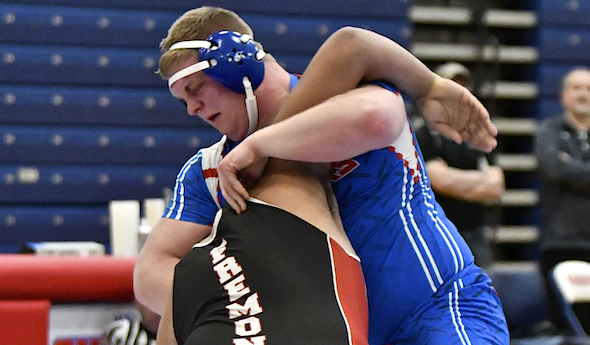
PHOTO: Remus Chippewa Hills, here at its league tournament, is one of the few to break into a Division 3 Final over the last decade. (Click for more from HighSchoolSportsScene.com.)