


Classes Still Create Hoosier Hysteria
July 27, 2017
By Rob Kaminski
MHSAA benchmarks editor
This is the fourth part in a series on MHSAA tournament classification, past and present, that will be published over the next two weeks. This series originally ran in this spring's edition of MHSAA benchmarks.
Twenty years ago, Bloomington North High School won the Indiana High School Athletic Association boys basketball championship, defeating Delta 75-54 at the RCA Dome in Indianapolis.
The date, March 22, 1997, is at the same time revered and disdained by traditionalists in the state who saw it as the last schoolboy championship game the state would ever host.
That’s how devout the game of basketball, particularly interscholastic basketball, had become in the Hoosier state during the 87 years a state champion – one state champion, to be precise – was crowned.
Following that 1997 season, the IHSAA moved to a four-class system for its roundball tournaments, like so many of its state association counterparts had done years earlier.
It would be shocking to find more than a small percentage of current high school basketball players around the country unfamiliar with the iconic movie Hoosiers, even though the film is now more than 30 years old.
And, the storyline for that blockbuster unfolded more than 30 years prior to its release, when small-town, undermanned Milan High School defeated Muncie Central High School 32-30 in the 1954 IHSAA title game.
Perhaps it’s because of the David vs Goliath notion, or the fame of the movie that replaced Milan with the fictional Hickory and real-life star Bobby Plump with Hollywood hero Jimmy Chitwood, or the simple fact that Indiana had something other states didn’t.
Whatever the reason, plenty of opposition remains to this day to basketball classification in the state.
The fact is, the small rural schools were regularly being beaten handily by the much larger suburban and city schools as the tournament progressed each season.
Small schools also were closing at a rapid rate following the state’s School Reorganization Act in 1959, as students converged on larger, centralized county schools. From 1960 to 2000, the number of schools entering the tournament dropped from 694 to 381, and in 1997 a total of 382 schools and 4,584 athletes began competition at the Sectional level (the first level of the IHSAA Basketball Tournament).
It was at the entry level of the tournament where school administrators felt the pain of the new class system, but not necessarily for the same nostalgic reasons as the fans who either attended or boycotted the tournament.
At the Sectional round of the tournament, the IHSAA was culling just 2 percent of the revenue, with the participating schools splitting the balance. So, when Sectional attendance dropped by 14 percent in that first year of class basketball, many schools realized a financial loss. It was money they had grown to count on in prior years to help fund various aspects of the department.
Schools cumulatively received more than $900,000 from Sectional competition in 1998, but that total was down from more than $1 million in the last year of the single-class tournament.
Yet, the current format provides a great deal more opportunity and realistic chances at championship runs for schools of all enrollments.
To date, 60 additional teams have championship or runner-up trophies on display in school trophy cases around Indiana.
That was the mission in front of then-IHSAA commissioner Bob Gardner (now National Federation executive director) once the board made its decision: to give thousands more student-athletes the opportunity for once-in-a-lifetime experiences.
As any statistician knows, figures can be manipulated to tell any side of a story. Declining attendance in year one of class basketball is such a number.
The truth is tournament attendance had been on a steady downward spiral since its peak of just over 1.5 million in 1962. By the last single-class event in 1997, the total attendance was half that.
The challenge then and today, as it is for all state associations, is to find that delicate balance for those holding onto tradition, those holding onto trophies, and the number of trophies to hand out.
Editor’s Note: Stories from the Fort Wayne Journal Gazette in 1998 and from a 2007 issue of Indianapolis Monthly provided facts in this article.
Adrian Madison's Isom Leads at All Levels
By
Geoff Kimmerly
MHSAA.com senior editor
February 21, 2019
Over more than three decades, Adrian Madison athletic director Kris Isom has taken on responsibilities not only in her league and regionally, but statewide as a member of the MHSAA Representative Council – in addition to her athletic department responsibilities at the high school and junior high.
And yet, she still teaches multiple classes and coaches at least one of the district’s teams every year, serving and building relationships at the most local level of her wide influence on educational athletics.
She’s made those relationships a priority, also serving as class advisor to Madison students through last year when her daughter Rachel graduated. One year during the 1990s, in fact, the graduating class even dedicated its yearbook to her.
 “I like being in the classroom and coaching because I still have a connection with kids, know who they are,” Isom said. “Being at a smaller school, you’re able to know who kids are, but at the middle school especially I don’t know a lot. Getting involved in coaching has helped me put a name with a face so I will know them coming up.”
She continues to impact students at Madison and beyond, and will be recognized for her many contributions with the 32nd Women In Sports Leadership Award during halftime of the Division 3 Girls Basketball Final on March 23 at Calvin College’s Van Noord Arena.
Each year, the Representative Council considers the achievements of women coaches, officials and athletic administrators affiliated with the MHSAA who show exemplary leadership capabilities and positive contributions to athletics.
Isom is in her 33rd year as athletic director at Adrian Madison, taking over athletics for the high school and junior high after serving as a teacher and coach for a year at Clinton. She has served as part of the MHSAA Representative Council since 2008, representing Class C and D schools from the state’s southeastern section.
“I’m very honored by this award, not only because it’s for women in leadership. I’ve been doing this 33 years and I’ve seen more and more women in this profession … that for all things considered is a man’s profession,” Isom said. “Having a daughter, who while she’s not following my footsteps, but getting her in the business world eventually, it’s a good feeling.”
Isom’s contributions to high school sports and its participants are many and at all levels. Within her district, she has coached basketball, volleyball, sideline cheer, track & field and softball – at least one sport every year, including as the eighth grade girls basketball coach this season.
At the league level, Isom has served as president of the Tri-County Conference since 2002 after previously serving as vice president and secretary/treasurer. Serving more of her neighboring districts, Isom has hosted numerous District, Regional and Quarterfinal competitions and MHSAA Coaches Advancement Program (CAP) sessions.
At the statewide level, Isom has provided her expertise as a member of the Representative Council and as a 33-year member of the Michigan Interscholastic Athletic Administrators Association and National Interscholastic Athletic Administrators Association. She also assists MHSAA staff annually in selecting members of the 16-student Student Advisory Council.
She was named the MIAAA’s Region 6 “Athletic Director of the Year” in 2000 and received the MHSAA’s Allen W. Bush Award in 2016 to recognize her many behind-the-scenes contributions.
“Kris Isom continues to provide a steadying presence on our Representative Council. She researches issues and really brings a voice of reason to the discussion – not only to the full Council, but to the Executive Committee as well,” MHSAA Executive Director Mark Uyl said. “She does a great job representing the southeastern corner of the state, bringing a small-school perspective to the table time after time. We’re thankful for her leadership and glad to present her with the Women In Sports Leadership Award.”
Part of leadership is being an example, and Isom has served as one for many. Of course that growing group included her daughter who this year left home to study in the dental hygiene program at Jackson College but has frequently been by Mom’s side for the many activities.
“Hopefully, (she learned) to be assertive, that she needs to be a good listener, and obviously you have to be a mediator,” Kris Isom said. “Hopefully seeing all those aspects, and dealing with situations and different issues, she’ll be a better problem solver, be more open (to the idea) that there is more than one side of a story.”
A graduate of Clinton High School, Isom received her bachelor’s degree in science and teaching certification in physical education and health in 1984 from Michigan State University. She earned her master’s in elementary education in 1986 from Eastern Michigan University and also has completed graduate courses from Fresno Pacific University.
In addition to the MIAAA and NIAAA, Isom is a member of the Michigan Association for Health, Physical Education, Recreation and Dance (MAHPERD) and the Michigan State University Alumni Association. She’s active with The Clinton United Church of Christ in various service projects, including an annual fundraiser for cancer research, and also participates in local Meals on Wheels, American Red Cross and Habitat for Humanity projects.
The first Women In Sports Leadership Award was presented in 1990.
Past recipients
1990 – Carol Seavoy, L’Anse
1991 – Diane Laffey, Harper Woods
1992 – Patricia Ashby, Scotts
1993 – Jo Lake, Grosse Pointe
1994 – Brenda Gatlin, Detroit
1995 – Jane Bennett, Ann Arbor
1996 – Cheryl Amos-Helmicki, Huntington Woods
1997 – Delores L. Elswick, Detroit
1998 – Karen S. Leinaar, Delton
1999 – Kathy McGee, Flint
2000 – Pat Richardson, Grass Lake
2001 – Suzanne Martin, East Lansing
2002 – Susan Barthold, Kentwood
2003 – Nancy Clark, Flint
2004 – Kathy Vruggink Westdorp, Grand Rapids
2005 – Barbara Redding, Capac
2006 – Melanie Miller, Lansing
2007 – Jan Sander, Warren Woods
2008 – Jane Bos, Grand Rapids
2009 – Gail Ganakas, Flint; Deb VanKuiken, Holly
2010 – Gina Mazzolini, Lansing
2011 – Ellen Pugh, West Branch; Patti Tibaldi, Traverse City
2012 – Janet Gillette, Comstock Park
2013 – Barbara Beckett, Traverse City
2014 – Teri Reyburn, DeWitt
2015 – Jean LaClair, Bronson
2016 – Betty Wroubel, Pontiac Notre Dame Prep
2017 – Dottie Davis, Ann Arbor Huron
2018 – Meg Seng, Ann Arbor Greenhills
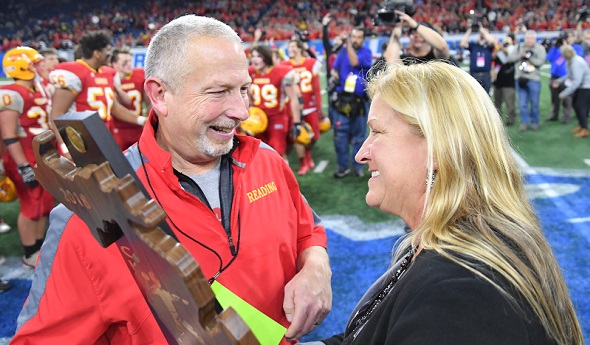
PHOTO: Adrian Madison athletic director Kris Isom, right, presents the Division 8 football championship trophy to Reading coach Rick Bailey in November at Ford Field.