


Classes Still Create Hoosier Hysteria
July 27, 2017
By Rob Kaminski
MHSAA benchmarks editor
This is the fourth part in a series on MHSAA tournament classification, past and present, that will be published over the next two weeks. This series originally ran in this spring's edition of MHSAA benchmarks.
Twenty years ago, Bloomington North High School won the Indiana High School Athletic Association boys basketball championship, defeating Delta 75-54 at the RCA Dome in Indianapolis.
The date, March 22, 1997, is at the same time revered and disdained by traditionalists in the state who saw it as the last schoolboy championship game the state would ever host.
That’s how devout the game of basketball, particularly interscholastic basketball, had become in the Hoosier state during the 87 years a state champion – one state champion, to be precise – was crowned.
Following that 1997 season, the IHSAA moved to a four-class system for its roundball tournaments, like so many of its state association counterparts had done years earlier.
It would be shocking to find more than a small percentage of current high school basketball players around the country unfamiliar with the iconic movie Hoosiers, even though the film is now more than 30 years old.
And, the storyline for that blockbuster unfolded more than 30 years prior to its release, when small-town, undermanned Milan High School defeated Muncie Central High School 32-30 in the 1954 IHSAA title game.
Perhaps it’s because of the David vs Goliath notion, or the fame of the movie that replaced Milan with the fictional Hickory and real-life star Bobby Plump with Hollywood hero Jimmy Chitwood, or the simple fact that Indiana had something other states didn’t.
Whatever the reason, plenty of opposition remains to this day to basketball classification in the state.
The fact is, the small rural schools were regularly being beaten handily by the much larger suburban and city schools as the tournament progressed each season.
Small schools also were closing at a rapid rate following the state’s School Reorganization Act in 1959, as students converged on larger, centralized county schools. From 1960 to 2000, the number of schools entering the tournament dropped from 694 to 381, and in 1997 a total of 382 schools and 4,584 athletes began competition at the Sectional level (the first level of the IHSAA Basketball Tournament).
It was at the entry level of the tournament where school administrators felt the pain of the new class system, but not necessarily for the same nostalgic reasons as the fans who either attended or boycotted the tournament.
At the Sectional round of the tournament, the IHSAA was culling just 2 percent of the revenue, with the participating schools splitting the balance. So, when Sectional attendance dropped by 14 percent in that first year of class basketball, many schools realized a financial loss. It was money they had grown to count on in prior years to help fund various aspects of the department.
Schools cumulatively received more than $900,000 from Sectional competition in 1998, but that total was down from more than $1 million in the last year of the single-class tournament.
Yet, the current format provides a great deal more opportunity and realistic chances at championship runs for schools of all enrollments.
To date, 60 additional teams have championship or runner-up trophies on display in school trophy cases around Indiana.
That was the mission in front of then-IHSAA commissioner Bob Gardner (now National Federation executive director) once the board made its decision: to give thousands more student-athletes the opportunity for once-in-a-lifetime experiences.
As any statistician knows, figures can be manipulated to tell any side of a story. Declining attendance in year one of class basketball is such a number.
The truth is tournament attendance had been on a steady downward spiral since its peak of just over 1.5 million in 1962. By the last single-class event in 1997, the total attendance was half that.
The challenge then and today, as it is for all state associations, is to find that delicate balance for those holding onto tradition, those holding onto trophies, and the number of trophies to hand out.
Editor’s Note: Stories from the Fort Wayne Journal Gazette in 1998 and from a 2007 issue of Indianapolis Monthly provided facts in this article.
Hesperia Stars Guiding Whitehall's Title Drive
By
Tom Kendra
Special for MHSAA.com
February 6, 2019
Whitehall wrestling already had a solid infrastructure in place.
 The Vikings have been the dominant wrestling program in the Muskegon area since George W. Bush was President, recently winning their 13th consecutive Greater Muskegon Athletic Association city wrestling championship.
On the state level, Whitehall also has been a fixture at the Division 3 Team Finals in recent years – losing to powerhouse Dundee in the Semifinals both last year and 2016, and bowing to Lake Fenton in the 2017 Quarterfinals.
Could this be the year Whitehall breaks through with an MHSAA championship?
The Vikings hope that the hiring of young, first-year co-coaches and brothers Justin Zeerip and Collin Zeerip – legends from nearby Hesperia who went on to wrestle at the University of Michigan – is exactly what the program needs to take that final step.
“Honestly, it’s been an amazing experience being coached by them,” said Whitehall senior Allen Powers (189 pounds), who has a 32-3 record on the season. “It gives us a bunch of extra confidence knowing that they were just Division I college wrestlers – and they’re not afraid to get on the mat and show it to us.”
Whitehall, which has a 24-2 dual record and is ranked No. 3 in Division 3, starts its drive to the Team Finals on Thursday at the District tournament at Shelby. If the Vikings prevail Thursday, they would host Team Regionals on Feb. 13. A win there would put them back in the Finals at Wings Event Center on Feb. 22-23, with a chance to prove they have closed the gap on Dundee and Richmond – which between them have won the past nine Division 3 titles.
 Last year’s loss to Dundee was particularly one-sided, 67-3, a pummeling which has motivated Whitehall to improve throughout the offseason and so far this winter. The Vikings’ only losses have come to Rockford and Hartland, both Division 1 schools.
“It’s been awesome watching these kids grow – both in technique and in their confidence,” said Justin Zeerip, the oldest of the three Zeerip brothers (Justin, Brandon and Collin), all of whom wrestled at Michigan. “My brother and I just want to bring that college wrestling atmosphere into the room. We’ve set high goals; we want to be wrestling on that final day. “
Suffice to say: when the Zeerips talk, the Vikings listen.
After all, Justin Zeerip, 30, brings instant credibility as a four-time Division 4 individual champion at Hesperia who graduated with a 260-0 record and 203 pins. He went on to win 100 matches during a five-year career at Michigan and now teaches middle school math at Hesperia.
Collin Zeerip, meanwhile, is 26 and was a three-time individual champion at Hesperia, graduating with 238 victories. He won 38 matches at Michigan before returning home to help run the family business, Heritage Farm Markets in Fremont.
While all three of his boys wrestled at Michigan, Justin and Collin’s father, Craig Zeerip, was a four-year wrestler at Ohio State. Craig Zeerip is now the head wrestling coach at Fremont.
“Our family has always loved the month of February,” said Justin Zeerip, who as a senior at Hesperia in 2007 became at that time the fourth wrestler in state history to finish a four-year career unbeaten and the 13th to win four Finals titles. “There’s a whole different feel. I’m really enjoying it as a coach as well.”
Whitehall’s strong wrestling foundation began in the 1980s under Rick Champion and Craig Christensen, who are still coaching in the program. Cliff Sandee coached the Vikings for the past 11 years – a tenure which was highlighted by 11 city titles, nine Districts, five Regionals and four Final Four appearances – before leaving to take an assistant principal position at Muskegon Reeths-Puffer last August.
 That departure opened the door for the Zeerips, who inherited a young, but well-rounded team with just three seniors – Sam Baustert (112), Trenton Blanchard (160) and Powers – in the normal 14-wrestler lineup.
The strength is in the upper weights, starting with freshman Ira Jenkins (152) with a sparkling first-year record of 27-6. Trenton Blanchard is 29-4, junior Kayleb Vennema (171) is 34-2 and junior Jarrean Sargeant (285) is 28-8.
The impressive records continue when the match swings to the lowest weights, with freshman Aiden Weiler (103) at 29-6 and Baustert at 29-4.
“I know they are going to be really good the next few years with all of our young guys, but I really don’t see any reason we can’t win state this year,” said Baustert, an all-state track and cross country performer who will run at Grand Valley State. “The new coaches have given us all a whole new sense of hope. We all have learned a few moves that we haven’t done before.”
 Tom Kendra worked 23 years at The Muskegon Chronicle, including five as assistant sports editor and the final six as sports editor through 2011. E-mail him at [email protected] with story ideas for Muskegon, Oceana, Mason, Lake, Oceola, Mecosta and Newaygo counties.
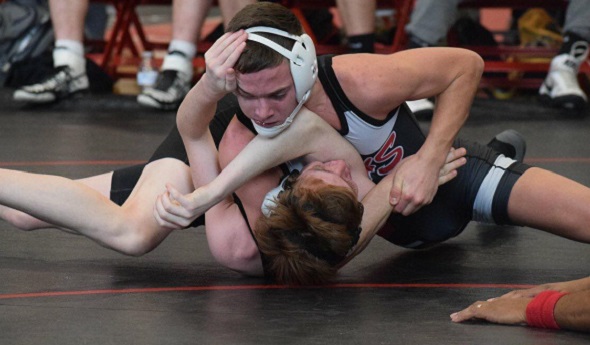
PHOTOS: (Top) Whitehall senior Sam Baustert works toward a pin. (Middle) Trenton Blanchard is another Vikings senior standout this winter. (Below) Whitehall co-head coaches Collin Zeerip, left, and Justin Zeerip, right, flank Baustert after an invitational victory earlier this season. (Photos courtesy of the Whitehall wrestling program.)