


Classes Still Create Hoosier Hysteria
July 27, 2017
By Rob Kaminski
MHSAA benchmarks editor
This is the fourth part in a series on MHSAA tournament classification, past and present, that will be published over the next two weeks. This series originally ran in this spring's edition of MHSAA benchmarks.
Twenty years ago, Bloomington North High School won the Indiana High School Athletic Association boys basketball championship, defeating Delta 75-54 at the RCA Dome in Indianapolis.
The date, March 22, 1997, is at the same time revered and disdained by traditionalists in the state who saw it as the last schoolboy championship game the state would ever host.
That’s how devout the game of basketball, particularly interscholastic basketball, had become in the Hoosier state during the 87 years a state champion – one state champion, to be precise – was crowned.
Following that 1997 season, the IHSAA moved to a four-class system for its roundball tournaments, like so many of its state association counterparts had done years earlier.
It would be shocking to find more than a small percentage of current high school basketball players around the country unfamiliar with the iconic movie Hoosiers, even though the film is now more than 30 years old.
And, the storyline for that blockbuster unfolded more than 30 years prior to its release, when small-town, undermanned Milan High School defeated Muncie Central High School 32-30 in the 1954 IHSAA title game.
Perhaps it’s because of the David vs Goliath notion, or the fame of the movie that replaced Milan with the fictional Hickory and real-life star Bobby Plump with Hollywood hero Jimmy Chitwood, or the simple fact that Indiana had something other states didn’t.
Whatever the reason, plenty of opposition remains to this day to basketball classification in the state.
The fact is, the small rural schools were regularly being beaten handily by the much larger suburban and city schools as the tournament progressed each season.
Small schools also were closing at a rapid rate following the state’s School Reorganization Act in 1959, as students converged on larger, centralized county schools. From 1960 to 2000, the number of schools entering the tournament dropped from 694 to 381, and in 1997 a total of 382 schools and 4,584 athletes began competition at the Sectional level (the first level of the IHSAA Basketball Tournament).
It was at the entry level of the tournament where school administrators felt the pain of the new class system, but not necessarily for the same nostalgic reasons as the fans who either attended or boycotted the tournament.
At the Sectional round of the tournament, the IHSAA was culling just 2 percent of the revenue, with the participating schools splitting the balance. So, when Sectional attendance dropped by 14 percent in that first year of class basketball, many schools realized a financial loss. It was money they had grown to count on in prior years to help fund various aspects of the department.
Schools cumulatively received more than $900,000 from Sectional competition in 1998, but that total was down from more than $1 million in the last year of the single-class tournament.
Yet, the current format provides a great deal more opportunity and realistic chances at championship runs for schools of all enrollments.
To date, 60 additional teams have championship or runner-up trophies on display in school trophy cases around Indiana.
That was the mission in front of then-IHSAA commissioner Bob Gardner (now National Federation executive director) once the board made its decision: to give thousands more student-athletes the opportunity for once-in-a-lifetime experiences.
As any statistician knows, figures can be manipulated to tell any side of a story. Declining attendance in year one of class basketball is such a number.
The truth is tournament attendance had been on a steady downward spiral since its peak of just over 1.5 million in 1962. By the last single-class event in 1997, the total attendance was half that.
The challenge then and today, as it is for all state associations, is to find that delicate balance for those holding onto tradition, those holding onto trophies, and the number of trophies to hand out.
Editor’s Note: Stories from the Fort Wayne Journal Gazette in 1998 and from a 2007 issue of Indianapolis Monthly provided facts in this article.

Performance: Quincy's William Dunn
January 18, 2019
 William Dunn
Quincy junior – Basketball
The 6-foot-8 forward had 30 points to lead Quincy past Reading 55-46 on Jan. 8, pushing the Orioles to 9-0 this season while becoming just the third player in program history to go over 1,000 career points. He entered the game needing four to reach the milestone, and he also grabbed 12 rebounds on the way to earning the Michigan Army National Guard “Performance of the Week.”
Over 2½ varsity seasons, Dunn has lead Quincy to a combined 47-10 record, two league titles and a District championship, earning all-state honorable mention from The Associated Press after both of his first two seasons. This winter he’s averaging 25.2 points, 12.1 rebounds, 2.3 assists, 3.4 blocks and 1.2 steals per game, making 55 percent of his shots from the floor and 42 percent of his 3-point tries. Heading into tonight’s game against Concord, Dunn has 1,026 career points, trailing only 1995 graduate Jeff Bell (1,071 points) and 2003 grad Dominic Lopez (1,707) on the school’s all-time scoring list. Both of those players went on to compete at the college level – Bell at Olivet and Lopez at Navy – and Dunn already has scholarship offers from three Division I or II programs, including Division I American University in Washington, D.C.
 Dunn has worked over the last year to get stronger and has upped his endurance as well, necessities especially as he deals with two and three defenders at a time aimed at stopping him. He also played football as a freshman and sophomore, making the varsity as a receiver his second season, and carries a 3.2 GPA with history his favorite academic interest. He could help his 380-student high school make some before his career is done; the Orioles are seeking their first Regional title in boys basketball and made the Regional Final his freshman season.
Coach Scott Rodesiler said: “William Dunn is a unique talent who has been on the varsity team since his freshman season. During his first season, you could see that there was something special about him as a player. … (He) brings a unique blend of size, skill, athleticism, work ethic, competitiveness, and unselfishness to our team. Dunn's game is extremely versatile because his skill set allows him to score in so many different ways: fastbreaks, posting up, shooting a 3-pointer, driving to the hoop, shooting a mid-range jumper, (putting back) an offensive rebound, or hitting free throws. You may see him filling a lane on the fastbreak or getting the rebound and leading the fastbreak himself. William is basically a guard in a big man's body. I would not hesitate to play him at point guard if I needed him to do so. His ball handling and vision of the court are outstanding. The great thing about having William on the team is that you always know going into a game that you have a great chance of winning because he is capable of scoring 30+ points, pulling down 15+ rebounds and forcing other teams to change their defensive game plans. ... William's biggest improvement since last season has been his outside shot, in my opinion. Dunn made thousands of shots in the past year to take his game to a new level. He always had a nice shooting stroke, but the work he put in has allowed him to shoot with greater consistency. William has achieved at a high level all while facing double and triple teams, as well as numerous 'junk' defenses. One of his greatest abilities is making the right decisions with the basketball when faced with these types of defenses.”
Performance Point: “I just thought it was pretty cool that I was the third player to get (1,000), and so that means that not many people get that opportunity,” Dunn said. “(Reaching it as a junior) just shows all of the work that I've put in. It's just reflecting that. It's another step to everything that's been going on.”
On the radar, and the map: “It's nice for people to start recognizing some of the stuff that I've been able to do, or some of the stuff that I've accomplished. After my freshman year I had gone to some camps, and some people asked who I was and said they had heard of me. It's funny, because a lot of times they'll ask me where I'm from, and I tell them and they have no clue. They don't know where (Quincy) is. I ask them (if they know) where Coldwater is, because we're right next to that and it's a little bigger town, and if they don't know where that is, I just say it's right next to the Indiana border. ... Sometimes I hold up my hand like the mitten and point to it.”
 Small town, big support: “It's kinda unique. … It feels like when we do something special, it's means more because it doesn't happen as often. I like the community aspect (of being small-town). Everybody knows you, everywhere you go. You go in town, go out to eat, there's people that you have no clue who they are but they've heard about you, seen you in the newspaper. It's real cool.”
Hard work pays: “It's really exciting to do this for the school and for the town. We work hard. We come into practice every day, practice extremely hard. We bond really well. There's nobody butting heads or anything; we mesh really well.”
School in session: “I’m been thinking about going into education and trying to be a teacher. Both of my parents are teachers; my dad is a weight training teacher and (teaches) health class and personal finance, and my mom is a fifth-grade science teacher. … They’ve always stressed (education), that school always comes first. Sometimes it gets a little hectic, but I've always adjusted to it. I always have known I have to get my work done.”
- Geoff Kimmerly, Second Half editor
Every week during the 2018-19 school year, Second Half and the Michigan Army National Guard recognizes a “Performance of the Week" from among the MHSAA's 750 member high schools.
The Michigan Army National Guard provides trained and ready forces in support of the National Military Strategy, and responds as needed to state, local, and regional emergencies to ensure peace, order, and public safety. The Guard adds value to our communities through continuous interaction. National Guard soldiers are part of the local community. Guardsmen typically train one weekend per month and two weeks in the summer. This training maintains readiness when needed, be it either to defend our nation's freedom or protect lives and property of Michigan citizens during a local natural disaster.
Past 2018-19 honorees
November 29: Dequan Finn, Detroit Martin Luther King football - Read
November 22: Paige Briggs, Lake Orion volleyball - Read
November 15: Hunter Nowak, Morrice football - Read
November 8: Jon Dougherty, Detroit Country Day soccer - Read
November 1: Jordan Stump, Camden-Frontier volleyball - Read
October 25: Danielle Staskowski, Pontiac Notre Dame Prep golf - Read
October 18: Adam Bruce, Gladstone cross country - Read
October 11: Ericka VanderLende, Rockford cross country - Read
October 4: Kobe Clark, Schoolcraft football - Read
September 27: Jonathan Kliewer, Grand Rapids Forest Hills Northern soccer - Read
September 20: Kiera Lasky, Bronson volleyball - Read
September 13: Judy Rector, Hanover-Horton cross country - Read
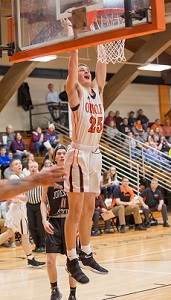
PHOTOS: (Top) Quincy's William Dunn goes to the basket against Jonesville on Dec. 9. (Middle) Dunn rises to the rim during the 35-29 win. (Photos by Expressions Photography Design.)