


Classes Still Create Hoosier Hysteria
July 27, 2017
By Rob Kaminski
MHSAA benchmarks editor
This is the fourth part in a series on MHSAA tournament classification, past and present, that will be published over the next two weeks. This series originally ran in this spring's edition of MHSAA benchmarks.
Twenty years ago, Bloomington North High School won the Indiana High School Athletic Association boys basketball championship, defeating Delta 75-54 at the RCA Dome in Indianapolis.
The date, March 22, 1997, is at the same time revered and disdained by traditionalists in the state who saw it as the last schoolboy championship game the state would ever host.
That’s how devout the game of basketball, particularly interscholastic basketball, had become in the Hoosier state during the 87 years a state champion – one state champion, to be precise – was crowned.
Following that 1997 season, the IHSAA moved to a four-class system for its roundball tournaments, like so many of its state association counterparts had done years earlier.
It would be shocking to find more than a small percentage of current high school basketball players around the country unfamiliar with the iconic movie Hoosiers, even though the film is now more than 30 years old.
And, the storyline for that blockbuster unfolded more than 30 years prior to its release, when small-town, undermanned Milan High School defeated Muncie Central High School 32-30 in the 1954 IHSAA title game.
Perhaps it’s because of the David vs Goliath notion, or the fame of the movie that replaced Milan with the fictional Hickory and real-life star Bobby Plump with Hollywood hero Jimmy Chitwood, or the simple fact that Indiana had something other states didn’t.
Whatever the reason, plenty of opposition remains to this day to basketball classification in the state.
The fact is, the small rural schools were regularly being beaten handily by the much larger suburban and city schools as the tournament progressed each season.
Small schools also were closing at a rapid rate following the state’s School Reorganization Act in 1959, as students converged on larger, centralized county schools. From 1960 to 2000, the number of schools entering the tournament dropped from 694 to 381, and in 1997 a total of 382 schools and 4,584 athletes began competition at the Sectional level (the first level of the IHSAA Basketball Tournament).
It was at the entry level of the tournament where school administrators felt the pain of the new class system, but not necessarily for the same nostalgic reasons as the fans who either attended or boycotted the tournament.
At the Sectional round of the tournament, the IHSAA was culling just 2 percent of the revenue, with the participating schools splitting the balance. So, when Sectional attendance dropped by 14 percent in that first year of class basketball, many schools realized a financial loss. It was money they had grown to count on in prior years to help fund various aspects of the department.
Schools cumulatively received more than $900,000 from Sectional competition in 1998, but that total was down from more than $1 million in the last year of the single-class tournament.
Yet, the current format provides a great deal more opportunity and realistic chances at championship runs for schools of all enrollments.
To date, 60 additional teams have championship or runner-up trophies on display in school trophy cases around Indiana.
That was the mission in front of then-IHSAA commissioner Bob Gardner (now National Federation executive director) once the board made its decision: to give thousands more student-athletes the opportunity for once-in-a-lifetime experiences.
As any statistician knows, figures can be manipulated to tell any side of a story. Declining attendance in year one of class basketball is such a number.
The truth is tournament attendance had been on a steady downward spiral since its peak of just over 1.5 million in 1962. By the last single-class event in 1997, the total attendance was half that.
The challenge then and today, as it is for all state associations, is to find that delicate balance for those holding onto tradition, those holding onto trophies, and the number of trophies to hand out.
Editor’s Note: Stories from the Fort Wayne Journal Gazette in 1998 and from a 2007 issue of Indianapolis Monthly provided facts in this article.
The Official View: Don't Make it Personal
By
Brent Rice
MHSAA Assistant Director
January 15, 2019
By Brent Rice
MHSAA Assistant Director
Statistics tell us poor sportsmanship is a leading factor in officials leaving officiating and a major impediment to recruiting new officials. The official catching flak is not new.
This week’s “It’s Official” discusses work being done to bring civility to high-intensity situations where criticism of officials has frequently turned personal.
It’s Official!
Poor Sportsmanship and the Official
 As long as there have been officials, there has been dissatisfaction with officials by players and coaches. It’s not that instances of poor sportsmanship are becoming more frequent – it’s that these instances are becoming more personal. And in part because of the accessibility of social media, they are more sensationalized.
The great Major League Baseball veteran umpire Harry Wendelstedt regularly used to say, “You may yell at the uniform, but you can’t yell at me.” His point recognizes not everyone will agree with the calls officials make, but that criticism and disapproval should be directed about the call and not about the person.
Some sports have ejectable offenses specific to that sport. Others – think soccer, volleyball, basketball or football – have a progressive system of fouls that lead to an automatic ejection. This doesn’t mean, though, that coaches and players receive a one-time free pass to say whatever they want. Personal attacks are not permitted and are grounds for immediate disqualification. Personal attacks include:
• Offensive or derogatory remarks about an official’s (real or perceived) gender, ethnicity, sexual orientation, age, religion or disability.
• Threats or intimidation of physical violence, withdrawing games or a downgrade of ratings.
• Personal insults that disparage an individual or openly question an official’s integrity, impartiality, honesty or character.
For example, instead of using the personal insult “You’re terrible!” that would result in an immediate ejection, players and coaches could substitute the impersonal “That’s terrible!” The use of “you” or “you’re” personalizes the attack, and anything that follows those words in a disparaging manner almost always will result in a disqualification.
While the onus of ensuring good sportsmanship is primarily the responsibility of administrators, coaches and players, the officials also play a significant role by enforcing behavior and conduct rules through penalization. Officials are being instructed to strictly enforce this policy moving forward. To emphasize the importance of avoiding personal attacks on officials, the MHSAA will be starting the new campaign “Get Personal … Get Ejected!” We are looking for help from coaches, players and spectators in showing respect and appreciation for the hardworking men and women who officiate MHSAA contests by keeping criticisms brief and absent of personal attacks.
 Sports Officials Appreciation
The MHSAA is seeking ways we can show appreciation for the contribution Registered officials provide to the MHSAA and its member schools. This will soon include the introduction of an “Official Thanks” campaign and providing schools a framework to institute “Officials Appreciation” events.
To further express our gratitude, the MHSAA has partnered with the Detroit Red Wings to host a Sports Officials Night on Sunday, March 31 beginning at 7:30pm. The package includes a specially-priced Red Wings ticket, souvenir cooling towel and access to a pre-game speaking engagement with former professional officials. Additional benefits also are being worked on. Details are posted on the Officials page of the MHSAA website and will be delivered to all officials via email.
Rule of the Week
GIRLS COMPETITIVE CHEER As Team A attempts a swinging stunt during Round 3, the flyer is propelled into an almost-vertical position with her feet in the air and head near the floor.
Ruling: This is an illegal stunt and an 8-point deduction per infraction.
It’s Your Call
BASKETBALL This week’s clip shows Team A in white attempting to move the ball up court against Team B’s press. A pass is made to #11 near the division line. What’s the call?
Last IYC Ruling: In the last “It’s Your Call” clip, the attacking wrestler picks up his opponent and slams him to the mat. This is a dangerous act, and a flagrant misconduct should have been assessed. (Click to see video.)
Official View: Giving Back
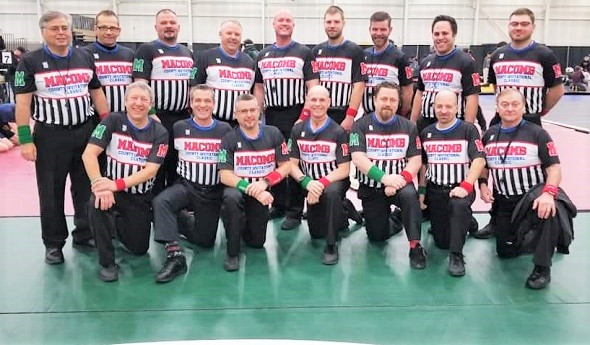
Every year, the Macomb County Coaches Association and area officials come together to host a Christmas Tournament where funds are raised for educational scholarship opportunities. This year’s event was another huge success.
For officials, it’s a great time to give back and enjoy the sport they love. Tradition has been that custom uniform shirts are purchased for the officials, who also wear their best (or worst) pair of Christmas socks.
Pictured above are: (Back row) Phil Lieblang, Lenny Gino, Chad Davinich, Dave Hall, Bryan Legree, Josh Orzechowski, Mike Billiu, Matt Stabley, Brandon Orzechowski. (Front row) Eugene English, Gary Kowalewski, Jerry Angelo, Ron Minoletti, Rob Peltier, Eric Siefert, Jim Niemiec.