


Classes Still Create Hoosier Hysteria
July 27, 2017
By Rob Kaminski
MHSAA benchmarks editor
This is the fourth part in a series on MHSAA tournament classification, past and present, that will be published over the next two weeks. This series originally ran in this spring's edition of MHSAA benchmarks.
Twenty years ago, Bloomington North High School won the Indiana High School Athletic Association boys basketball championship, defeating Delta 75-54 at the RCA Dome in Indianapolis.
The date, March 22, 1997, is at the same time revered and disdained by traditionalists in the state who saw it as the last schoolboy championship game the state would ever host.
That’s how devout the game of basketball, particularly interscholastic basketball, had become in the Hoosier state during the 87 years a state champion – one state champion, to be precise – was crowned.
Following that 1997 season, the IHSAA moved to a four-class system for its roundball tournaments, like so many of its state association counterparts had done years earlier.
It would be shocking to find more than a small percentage of current high school basketball players around the country unfamiliar with the iconic movie Hoosiers, even though the film is now more than 30 years old.
And, the storyline for that blockbuster unfolded more than 30 years prior to its release, when small-town, undermanned Milan High School defeated Muncie Central High School 32-30 in the 1954 IHSAA title game.
Perhaps it’s because of the David vs Goliath notion, or the fame of the movie that replaced Milan with the fictional Hickory and real-life star Bobby Plump with Hollywood hero Jimmy Chitwood, or the simple fact that Indiana had something other states didn’t.
Whatever the reason, plenty of opposition remains to this day to basketball classification in the state.
The fact is, the small rural schools were regularly being beaten handily by the much larger suburban and city schools as the tournament progressed each season.
Small schools also were closing at a rapid rate following the state’s School Reorganization Act in 1959, as students converged on larger, centralized county schools. From 1960 to 2000, the number of schools entering the tournament dropped from 694 to 381, and in 1997 a total of 382 schools and 4,584 athletes began competition at the Sectional level (the first level of the IHSAA Basketball Tournament).
It was at the entry level of the tournament where school administrators felt the pain of the new class system, but not necessarily for the same nostalgic reasons as the fans who either attended or boycotted the tournament.
At the Sectional round of the tournament, the IHSAA was culling just 2 percent of the revenue, with the participating schools splitting the balance. So, when Sectional attendance dropped by 14 percent in that first year of class basketball, many schools realized a financial loss. It was money they had grown to count on in prior years to help fund various aspects of the department.
Schools cumulatively received more than $900,000 from Sectional competition in 1998, but that total was down from more than $1 million in the last year of the single-class tournament.
Yet, the current format provides a great deal more opportunity and realistic chances at championship runs for schools of all enrollments.
To date, 60 additional teams have championship or runner-up trophies on display in school trophy cases around Indiana.
That was the mission in front of then-IHSAA commissioner Bob Gardner (now National Federation executive director) once the board made its decision: to give thousands more student-athletes the opportunity for once-in-a-lifetime experiences.
As any statistician knows, figures can be manipulated to tell any side of a story. Declining attendance in year one of class basketball is such a number.
The truth is tournament attendance had been on a steady downward spiral since its peak of just over 1.5 million in 1962. By the last single-class event in 1997, the total attendance was half that.
The challenge then and today, as it is for all state associations, is to find that delicate balance for those holding onto tradition, those holding onto trophies, and the number of trophies to hand out.
Editor’s Note: Stories from the Fort Wayne Journal Gazette in 1998 and from a 2007 issue of Indianapolis Monthly provided facts in this article.
Lakes 'Family' Ready to Run Again
By
Tom Markowski
Special for Second Half
December 13, 2018
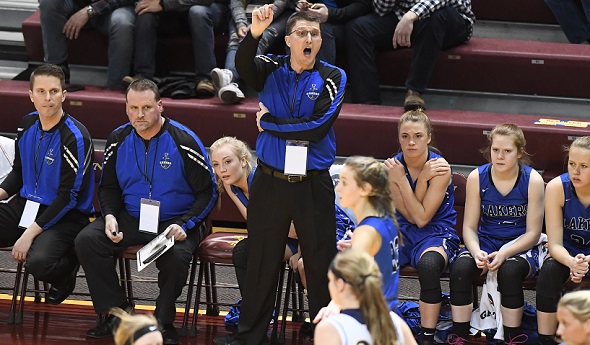
WATERFORD – Waterford Our Lady of the Lakes has taken a big step forward and become a perennial state power in girls basketball since Steve Robak became the coach before the 2007-08 season.
 Robak guided the Lakers to a Regional Final that first winter and a Quarterfinal appearance in 2009 before Our Lady went on to play in its first MHSAA Final in the sport – and tie the Class D girls basketball record with three straight titles. The Lakers followed that run by losing in the 2013 championship game.
Although Our Lady hasn’t reached a Final since, the Lakers have been to the Semifinals three times (including last winter) and as far as the Quarterfinals on another occasion. The only season the Lakers haven’t won at least a District title under Robak was 2013-14.
Any coach who has experienced similar success will tell you it takes a certain amount of talent to reach this level. Robak is no different. But at this Detroit Catholic League school, you’ll find achieving such success goes far beyond talent.
Our Lady of the Lakes offers a community aspect to the high school experience that only a few small public and non-public schools provide. The students and faculty are like family, no more so than for Robak and his extended family.
Robak, 51, is a graduate of Our Lady and attended school there for 12 years, from 1st-12th grade. The school offers students a K-12 education and is one of four within the Catholic League to do so, along with Allen Park Cabrini, Dearborn Divine Child, Royal Oak Shrine and Clarkston Everest Collegiate. Thirty or 40 years ago this was quite common within the Detroit Catholic League. It isn’t so now and makes places like Our Lady rare, a fact not lost on those who attend or work within a parish school.
Vic Michaels is the director of athletics for the Detroit Catholic League, and in the 1980s was the boys basketball coach at Center Line St. Clement when it was a parish school.
“Years ago there were a lot of schools like that,” he said. “It’s a comfortable environment. You have the support of the parish. The kids continue through high school and, yes, you will get some new students. But (your) classmates, for the most part, remain the same.”
Robak is the oldest of seven children, all of whom went to Our Lady of the Lakes.
“There’s a real comfort there,” Robak said. “You’ve been friends for seven or eight years before you get to high school. We’ve had some come in the ninth grade, but it’s a small number. We’ve had two transfers in our program in my tenure.
“When you’re at a parochial school, (and people say), ‘Oh, you recruit.’ That doesn’t happen here. Our players come up through the system. That’s not to say we haven’t had some go on to play in college. I’m not a travel-AAU guy at all. A good athlete will be found no matter where you play.”
 Another word that’s often associated with a winning program is stability. When Robak took over the program, his brother Paul came on as an assistant before switching to take over the boys program six years later. Replacing him was Tim Ross, the Robaks’ brother-in-law. Last season Paul returned to the girls program as an assistant.
We’re just starting with this family thing.
Steve had two daughters play for him: Lauren, a 2011 graduate, and Lexie, who graduated two years later. Both were all-staters. Ross had two daughters come through the system, Lindsay and Megan. And not to be left out, Paul’s oldest daughter, Brooklyn, is a sophomore on the team this season and one of the top players. Paul has another daughter, Elli, but she’s still in grade school. Another niece, Maria Oliver, is a freshman on the team.
Want more? Steve has two more daughters, currently in grade school, who are expected to be a part of the program in the future.
And therein lies a big reason for the program’s success. The students are in the same building from the elementary level through high school. The younger ones look up to those on varsity, and the coaches at all levels are on the same page teaching the same system.
“We get to the younger coaches, showing them how to teach our younger kids through clinics and stuff,” Steve said. “A lot of times volunteers are needed. When you have coaches who have the same philosophy, it helps. Also, winning helps. Winning has helped get kids out who might not have played.”
This season the Lakers are in a bit of a transition. Three starters graduated and there are just two seniors, two juniors and no junior varsity. Our Lady is 0-3 having lost to Flint Hamady, Romeo and Harper Woods Chandler Park, all from higher enrollment divisions, with a combined record of 9-1.
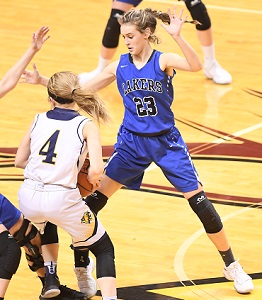
Isabelle Kline started playing basketball at Our Lady when she was in 6th grade. Kline rarely missed a varsity home game while in grade school and noticed the high level of determination those players displayed – which she said played a major role in her work ethic and development.
Now a junior, Kline, a three-year varsity player, is one of two starters returning. She said even though there isn’t a lot of experience, the team is progressing despite a slow start.
“We have a young team but the transition has been very good,” she said. “We’ve been bonding as a team.
“We came into (the game against Romeo) with our heads low, and that wasn’t the right thing to do. But we played incredible. We were talking on defense. It was a team effort. We played great team defense.
“We knew those (first three) teams we’re really good. When we saw who we were playing it was like, ‘Steve, what are you doing?’ But we played a tough (nonconference) schedule last year with Detroit Country Day and (Ypsilanti) Arbor Prep and we made it to the semis. We know we have to play good teams to get better.”
 Tom Markowski is a correspondent for the State Champs! Sports Network and previously directed its web coverage. He also covered primarily high school sports for the The Detroit News from 1984-2014, focusing on the Detroit area and contributing to statewide coverage of football and basketball. Contact him at [email protected] with story ideas for Oakland, Macomb and Wayne counties.
PHOTOS: (Top) Our Lady coach Steve Robak (standing) directs his team during last season’s Class D Semifinal against Chassell at Van Noord Arena. (Middle) Isabelle Kline (23) blocks a path as the Panthers look to push the ball up the floor.