


Classes Still Create Hoosier Hysteria
July 27, 2017
By Rob Kaminski
MHSAA benchmarks editor
This is the fourth part in a series on MHSAA tournament classification, past and present, that will be published over the next two weeks. This series originally ran in this spring's edition of MHSAA benchmarks.
Twenty years ago, Bloomington North High School won the Indiana High School Athletic Association boys basketball championship, defeating Delta 75-54 at the RCA Dome in Indianapolis.
The date, March 22, 1997, is at the same time revered and disdained by traditionalists in the state who saw it as the last schoolboy championship game the state would ever host.
That’s how devout the game of basketball, particularly interscholastic basketball, had become in the Hoosier state during the 87 years a state champion – one state champion, to be precise – was crowned.
Following that 1997 season, the IHSAA moved to a four-class system for its roundball tournaments, like so many of its state association counterparts had done years earlier.
It would be shocking to find more than a small percentage of current high school basketball players around the country unfamiliar with the iconic movie Hoosiers, even though the film is now more than 30 years old.
And, the storyline for that blockbuster unfolded more than 30 years prior to its release, when small-town, undermanned Milan High School defeated Muncie Central High School 32-30 in the 1954 IHSAA title game.
Perhaps it’s because of the David vs Goliath notion, or the fame of the movie that replaced Milan with the fictional Hickory and real-life star Bobby Plump with Hollywood hero Jimmy Chitwood, or the simple fact that Indiana had something other states didn’t.
Whatever the reason, plenty of opposition remains to this day to basketball classification in the state.
The fact is, the small rural schools were regularly being beaten handily by the much larger suburban and city schools as the tournament progressed each season.
Small schools also were closing at a rapid rate following the state’s School Reorganization Act in 1959, as students converged on larger, centralized county schools. From 1960 to 2000, the number of schools entering the tournament dropped from 694 to 381, and in 1997 a total of 382 schools and 4,584 athletes began competition at the Sectional level (the first level of the IHSAA Basketball Tournament).
It was at the entry level of the tournament where school administrators felt the pain of the new class system, but not necessarily for the same nostalgic reasons as the fans who either attended or boycotted the tournament.
At the Sectional round of the tournament, the IHSAA was culling just 2 percent of the revenue, with the participating schools splitting the balance. So, when Sectional attendance dropped by 14 percent in that first year of class basketball, many schools realized a financial loss. It was money they had grown to count on in prior years to help fund various aspects of the department.
Schools cumulatively received more than $900,000 from Sectional competition in 1998, but that total was down from more than $1 million in the last year of the single-class tournament.
Yet, the current format provides a great deal more opportunity and realistic chances at championship runs for schools of all enrollments.
To date, 60 additional teams have championship or runner-up trophies on display in school trophy cases around Indiana.
That was the mission in front of then-IHSAA commissioner Bob Gardner (now National Federation executive director) once the board made its decision: to give thousands more student-athletes the opportunity for once-in-a-lifetime experiences.
As any statistician knows, figures can be manipulated to tell any side of a story. Declining attendance in year one of class basketball is such a number.
The truth is tournament attendance had been on a steady downward spiral since its peak of just over 1.5 million in 1962. By the last single-class event in 1997, the total attendance was half that.
The challenge then and today, as it is for all state associations, is to find that delicate balance for those holding onto tradition, those holding onto trophies, and the number of trophies to hand out.
Editor’s Note: Stories from the Fort Wayne Journal Gazette in 1998 and from a 2007 issue of Indianapolis Monthly provided facts in this article.
Sizable Fremont Has Big-Time Aspirations
December 5, 2018
By Tom Kendra
Special for Second Half
Fremont is synonymous with babies, as the founding home of Gerber Products and host of the National Baby Food Festival each July.
 Some of those babies grow up to be giants – as evidenced by this year’s Fremont Packers boys basketball team.
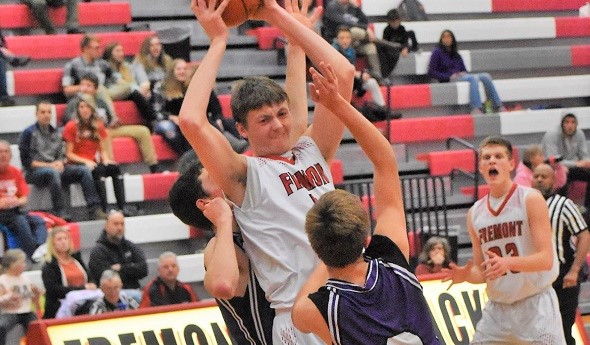
Senior Logan Karnemaat (6-foot-10) and junior Tristan Campbell (6-8) are the twin towers whose presence sets the tone on both ends of the court for the Packers, who are off to a 2-0 start and have high hopes for the rest of the season.
“I guess you could say we ate all of our baby food, and someone must have put some Miracle-Gro in there, too,” Karnemaat said with a laugh.
Karnemaat knows all about fertilizer as a third-generation farmer. He spends much of his time when he’s not in school or playing basketball working on his family’s 3,000-acre farm operation, which includes crops and livestock.
His life goal has always been to get a business degree and return to run the family farm, with playing basketball almost an afterthought.
When pressed on the subject, he said that both Grace Christian and Calvin College in Grand Rapids have shown interest in him, then quickly added: “There are two more I can’t think of off the top of my head.”
Karnemaat is clearly more focused on making the most out of his senior basketball season, which shows signs of great promise after an impressive 45-35 win Tuesday night at Ludington, which made it all the way to the MHSAA Class B Final in 2017.
“I’d say that was our biggest road win in 10-12 years,” said Fremont coach Peter Zerfas, who is now in his 19th year. “It was how we did it. Ludington is a very good team, but we came out with confidence and we were the more aggressive team.”
The scorebook does not tell the true story of the game, as Campbell scored only seven points and Karnemaat just five. The real story was the rebounding and shot-blocking of the twin towers – Karnemaat finished with 10 rebounds and Campbell had five blocked shots, with both of them altering and contesting countless others.
 As a result of their presence, Ludington suffered through one of its worst offensive nights in recent memory, scoring just 18 total points over the first three quarters. Senior standout Josh Laman, who nailed the memorable 3-pointer in the Class B Semifinals two seasons ago to send the Orioles to the championship game, had no field goals in the first half and just 10 total points.
Fremont senior forwards Calvin Miller (11 points) and Julian Echavarria, who also have good size at 6-5 and 6-3, respectively, also contributed on both ends of the court.
Zerfas said the key to the big win was the play of his young guards, particularly junior starters Carter Moon (13 points) and Jaxx Miller, who held up under Ludington’s relentless full-court pressure during the second half.
“We have four young guards, and how well they develop will be the key for us this season,” said Zerfas, whose youngest son, sophomore Joshua Zerfas, is one of those young backcourt players. “We have the size and we have some depth, so if those guards keep coming like they are, we have a chance to be really good.”
Zerfas has the Packers competing at a championship level after back-to-back down years in 2015-16 (6-16) and 2016-17 (13-8). Basketball is a big deal in this small town, which has had some great runs in cross country but for the most part is known for baby food, farming and hoops.
Fremont has won a pack of conference and District championships, but Regionals has generally been the end of the road. In fact, the last time Fremont won a Regional championship was 1956, before losing to Stephenson that winter in the Class B Quarterfinals.
Shortly after Zerfas took over as coach in 2000, Fremont had a string of five consecutive District titles, with longtime nemesis Muskegon Heights ending the Packers’ run at the regional level in four of those five years.
Fremont fought its way back to Regionals last winter, before being humbled by Grand Rapids South Christian and finishing with a 17-7 record.
The Packers feel like they have even more pieces in place this winter and are eager to start work towards their first goal, a Central States Activities Association Gold championship, when they open league play Friday night at Reed City.
Karnemaat, who led Fremont with 14 points, eight rebounds and five blocked shots per game last season, can’t wait for back-to-back home games next week against Montague and Sparta.
While he spends much of his time working in relative solitude on the family farm, there’s nothing he enjoys more than the contrast of playing basketball in front of a rowdy home crowd.
“Our students and our community come out and supports us, and it really helps,” Karnemaat said. “We have a good team, but then to have 2,000 fans behind you and get you going, I love it.”
 Tom Kendra worked 23 years at The Muskegon Chronicle, including five as assistant sports editor and the final six as sports editor through 2011. E-mail him at [email protected] with story ideas for Muskegon, Oceana, Mason, Lake, Oceola, Mecosta and Newaygo counties.
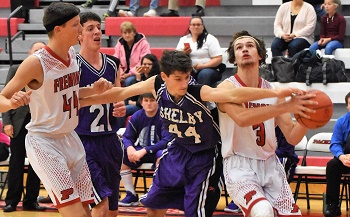
PHOTOS: (Top) Fremont 6-10 senior center Logan Karnemaat holds the ball up high, well out of the reach of two Shelby defenders, during a 75-50 season-opening win Nov. 27. (Middle) Fremont sophomore Braiden McDonald, one of the contributors off the Packers' deep bench, drives to the basket. (Photos by Russell Tindall.)