


Classes Still Create Hoosier Hysteria
July 27, 2017
By Rob Kaminski
MHSAA benchmarks editor
This is the fourth part in a series on MHSAA tournament classification, past and present, that will be published over the next two weeks. This series originally ran in this spring's edition of MHSAA benchmarks.
Twenty years ago, Bloomington North High School won the Indiana High School Athletic Association boys basketball championship, defeating Delta 75-54 at the RCA Dome in Indianapolis.
The date, March 22, 1997, is at the same time revered and disdained by traditionalists in the state who saw it as the last schoolboy championship game the state would ever host.
That’s how devout the game of basketball, particularly interscholastic basketball, had become in the Hoosier state during the 87 years a state champion – one state champion, to be precise – was crowned.
Following that 1997 season, the IHSAA moved to a four-class system for its roundball tournaments, like so many of its state association counterparts had done years earlier.
It would be shocking to find more than a small percentage of current high school basketball players around the country unfamiliar with the iconic movie Hoosiers, even though the film is now more than 30 years old.
And, the storyline for that blockbuster unfolded more than 30 years prior to its release, when small-town, undermanned Milan High School defeated Muncie Central High School 32-30 in the 1954 IHSAA title game.
Perhaps it’s because of the David vs Goliath notion, or the fame of the movie that replaced Milan with the fictional Hickory and real-life star Bobby Plump with Hollywood hero Jimmy Chitwood, or the simple fact that Indiana had something other states didn’t.
Whatever the reason, plenty of opposition remains to this day to basketball classification in the state.
The fact is, the small rural schools were regularly being beaten handily by the much larger suburban and city schools as the tournament progressed each season.
Small schools also were closing at a rapid rate following the state’s School Reorganization Act in 1959, as students converged on larger, centralized county schools. From 1960 to 2000, the number of schools entering the tournament dropped from 694 to 381, and in 1997 a total of 382 schools and 4,584 athletes began competition at the Sectional level (the first level of the IHSAA Basketball Tournament).
It was at the entry level of the tournament where school administrators felt the pain of the new class system, but not necessarily for the same nostalgic reasons as the fans who either attended or boycotted the tournament.
At the Sectional round of the tournament, the IHSAA was culling just 2 percent of the revenue, with the participating schools splitting the balance. So, when Sectional attendance dropped by 14 percent in that first year of class basketball, many schools realized a financial loss. It was money they had grown to count on in prior years to help fund various aspects of the department.
Schools cumulatively received more than $900,000 from Sectional competition in 1998, but that total was down from more than $1 million in the last year of the single-class tournament.
Yet, the current format provides a great deal more opportunity and realistic chances at championship runs for schools of all enrollments.
To date, 60 additional teams have championship or runner-up trophies on display in school trophy cases around Indiana.
That was the mission in front of then-IHSAA commissioner Bob Gardner (now National Federation executive director) once the board made its decision: to give thousands more student-athletes the opportunity for once-in-a-lifetime experiences.
As any statistician knows, figures can be manipulated to tell any side of a story. Declining attendance in year one of class basketball is such a number.
The truth is tournament attendance had been on a steady downward spiral since its peak of just over 1.5 million in 1962. By the last single-class event in 1997, the total attendance was half that.
The challenge then and today, as it is for all state associations, is to find that delicate balance for those holding onto tradition, those holding onto trophies, and the number of trophies to hand out.
Editor’s Note: Stories from the Fort Wayne Journal Gazette in 1998 and from a 2007 issue of Indianapolis Monthly provided facts in this article.
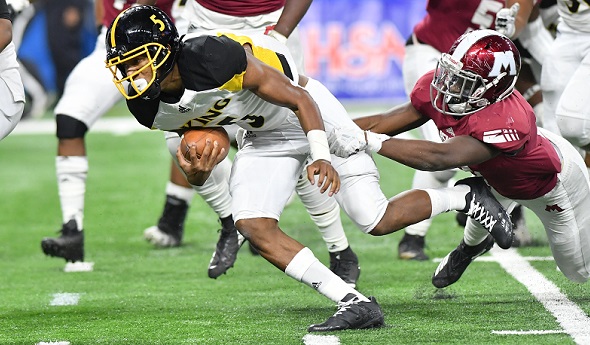
Performance: Detroit King's Dequan Finn
November 29, 2018
 Dequan Finn
Detroit Martin Luther King senior – Football
The Crusaders’ standout quarterback capped his high school career by leading his team to a 41-25 win over Muskegon to clinch the Division 3 championship Saturday at Ford Field. Finn completed 9-of-13 passes for 173 yards and four touchdowns and ran for another 73 yards and a score on 11 carries to earn the Michigan Army National Guard “Performance of the Week.”
This wasn’t Finn’s first time succeeding on the state’s biggest stage – the 6-foot-1, 195-pound signal-caller also quarterbacked King to the Division 2 championship in 2016, and the Crusaders fell just shy of making the Finals in 2017 as well, losing by a point in their Semifinal against Warren DeLaSalle. King was 35-6 over his three seasons as the varsity starter, and this fall he threw for 2,109 yards and 26 touchdowns and ran for 1,262 yards and 21 scores. He was further recognized Tuesday by being awarded this season’s statewide Mr. Football Award from State Champs Sports Network.
 King finished 12-2 this fall, winning the Detroit Public School League Black division championship and defeating league champs River Rouge, Warren Woods Tower and DeWitt plus Allen Park on the way to Ford Field. The Crusaders’ losses came Week 2 – at Muskegon, 24-21 – and then in the PSL playoffs final to Detroit Cass Tech, 42-8. But Finn led the team’s rebound after each defeat and will get the chance to continue leading an offense at the college level. (He has been committed to sign with Central Michigan University, although the Chippewas recently fired coach John Bonamego and Finn didn’t have a comment on his future plans in the immediate aftermath of the championship win.) Finn also owns an MHSAA Finals championship in track & field – he helped King win the 800-meter relay in Lower Peninsula Division 2 this past spring – and excels academically, carrying a 3.1 grade-point average.
Coach Tyrone Spencer said: “He did a phenomenal job. That’s our 35th win together. I’m just proud of him, the way he did for us. He’s a great leader, a great competitor and a great football player. … Just his play-making ability, his decision-making. He was calm. He’s been here before, and he looked like it. He didn’t look rattled, or he wasn’t doing too much. He just played in the moment, and that’s why he plays so well.”
Performance Point: “It’s just a real moment right now,” Finn said during postgame interviews. “I’m just thankful for having it, for my team, and for just going hard these three years. It was a good experience. … I just tried to be the best me I could be – the best version of me.”
 Second time’s the charm: “(Playing Muskegon twice) helped a lot, just (with) pre-snap reads – I knew where to go every single play. It was a big advantage for us to go against them Week 2. We still had that 24-21 loss in our minds. … It was an emotional game. We took it personally.”
Playoff rebound: “Coach Spencer said there’s a state championship out there (after the Cass Tech loss). If you want to get it, you’ve got to go get it. We just had to lock in mentally and prepare. That’s all we had to do, prepare and execute.”
From last season to this one: “(My) maturity, me knowing what to do and what not to do at certain points. Knowing down and distance; for instance, knowing what plays to run and what plays not to run. It’s just the little stuff.”
From Week 2 to today: “I learned I just had to calm down, not get too high, not get too low. Just remain calm at all times.”
- Geoff Kimmerly, Second Half editor
Every week during the 2018-19 school year, Second Half and the Michigan Army National Guard recognizes a “Performance of the Week" from among the MHSAA's 750 member high schools.
The Michigan Army National Guard provides trained and ready forces in support of the National Military Strategy, and responds as needed to state, local, and regional emergencies to ensure peace, order, and public safety. The Guard adds value to our communities through continuous interaction. National Guard soldiers are part of the local community. Guardsmen typically train one weekend per month and two weeks in the summer. This training maintains readiness when needed, be it either to defend our nation's freedom or protect lives and property of Michigan citizens during a local natural disaster.
Past 2018-19 honorees
November 22: Paige Briggs, Lake Orion volleyball - Read
November 15: Hunter Nowak, Morrice football - Read
November 8: Jon Dougherty, Detroit Country Day soccer - Read
November 1: Jordan Stump, Camden-Frontier volleyball - Read
October 25: Danielle Staskowski, Pontiac Notre Dame Prep golf - Read
October 18: Adam Bruce, Gladstone cross country - Read
October 11: Ericka VanderLende, Rockford cross country - Read
October 4: Kobe Clark, Schoolcraft football - Read
September 27: Jonathan Kliewer, Grand Rapids Forest Hills Northern soccer - Read
September 20: Kiera Lasky, Bronson volleyball - Read
September 13: Judy Rector, Hanover-Horton cross country - Read
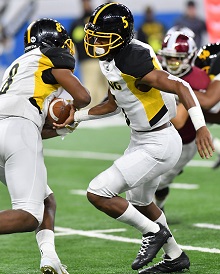
PHOTOS: (Top) Detroit Martin Luther King's Dequan Finn pulls away from a Muskegon defender during Saturday's Division 3 championship win at Ford Field. (Middle) Finn hands off to teammate Peny Boone.